
CXMT's $8.6bn IPO Crowns China's Memory Chip Funding Push
China’s fourth-largest DRAM maker will begin trading in Shanghai on Monday after a blockbuster listing aimed at funding capacity, research and manufacturing upgrades.
What you need to know
- CXMT has raised 57.92 billion yuan, or about $8.6 billion, in its Shanghai IPO.
- The listing is Asia’s largest so far in 2026 and the biggest Chinese A-share semiconductor offering on record.
- The DRAM maker plans to spend the proceeds on capacity, manufacturing upgrades and research and development.
ChangXin Memory Technologies, better known as CXMT, has raised 57.92 billion yuan, or about $8.6 billion, in a Shanghai initial public offering that is Asia’s largest so far this year.
The Chinese memory-chip maker confirmed that its shares will begin trading on the Shanghai STAR Market on Monday 27 July under the code 688825. The company priced 6.69 billion shares at 8.66 yuan each, making it the largest mainland listing by a Chinese semiconductor company.
The base offering is worth roughly $8.5 billion before any overallotment option. If that option is fully used, CXMT could raise 66.6 billion yuan, or about $9.8 billion. At the base size, the shares represent 10% of CXMT’s enlarged capital, implying a valuation of 579 billion yuan, or $85.2 billion, on listing.
The deal overtakes SMIC’s 2020 share sale as the largest Chinese A-share semiconductor offering, and marks a major funding event for a company at the centre of China’s push to build a more self-reliant chip supply chain.
Heavy demand for a major memory-chip listing
CXMT launched the subscription process on 16 July after more than doubling its original fundraising target of 29.5 billion yuan. Online demand reached around 244 times the initial allocation, according to the company’s offering details, leaving successful applicants with less than 0.5% of the shares they requested.
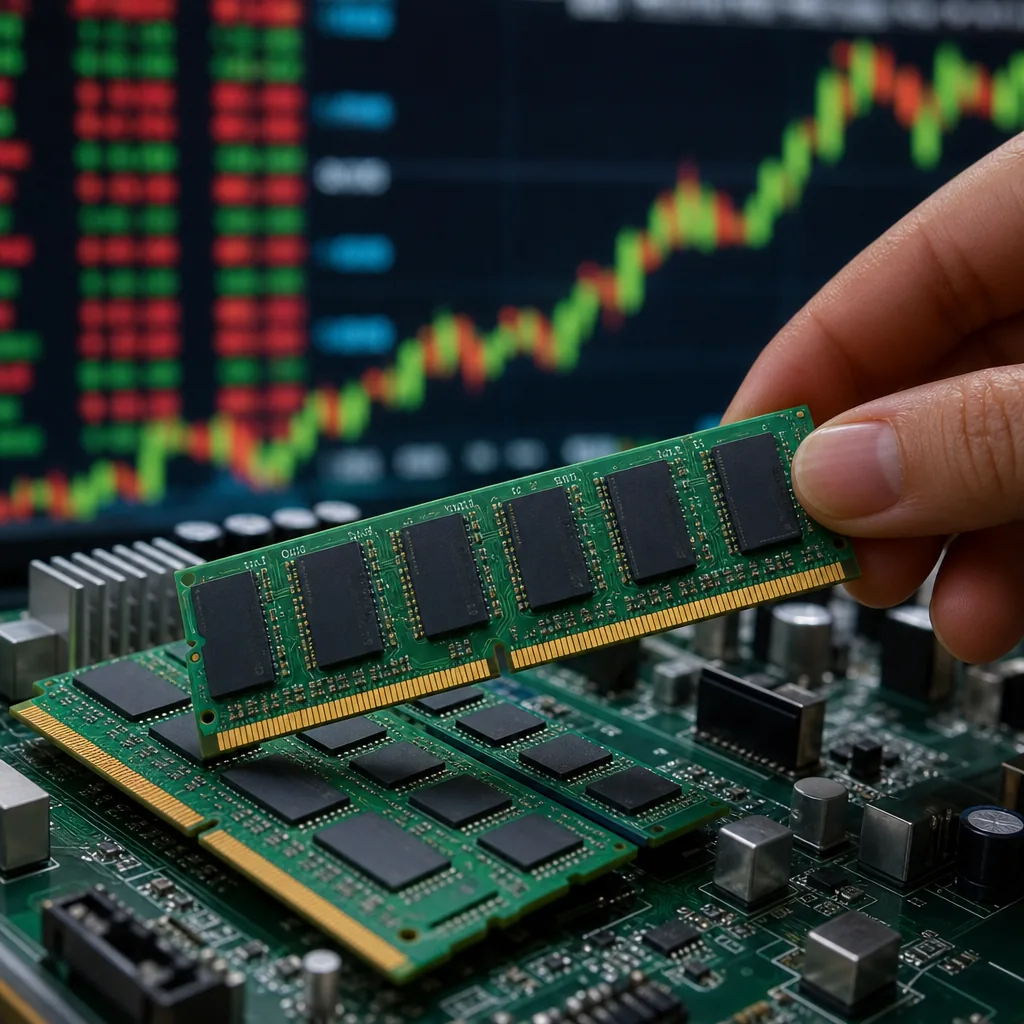
The company makes dynamic random-access memory, or DRAM: the short-term memory used in smartphones, PCs, servers and artificial-intelligence systems. CXMT had an estimated 7.7% share of the global DRAM market in 2025, placing it fourth behind Samsung Electronics, SK Hynix and Micron Technology.
Based in Hefei, in China’s Anhui province, CXMT has benefited from recovering memory-chip prices and growing AI-related demand. Its first-quarter revenue rose 719% year on year to 50.8 billion yuan. The company forecasts first-half sales of between 110 billion yuan and 120 billion yuan, nearly double the 61.8 billion yuan it generated during the whole of 2025.
CXMT has also guided for first-half net profit attributable to controlling shareholders of 57 billion yuan. Its average selling price for DDR memory products rose 61% in 2025, while shipment volume measured by memory capacity climbed 282.22%. Sales of newer DDR5 and LPDDR5X products helped raise the value of its product mix.
Cash for expansion and chip development
CXMT says it will use the IPO proceeds to increase capacity, upgrade its manufacturing technology and fund research and development. Chairman Zhu Yiming described the listing as a “new starting point” and a “new responsibility” at a 15 July investor roadshow.
“Memory supply is still not enough,” said Donnie Teng, a Greater China semiconductor analyst at Nomura, citing unprecedented demand from the AI industry.
Zhu, who is also the founder of Chinese memory-chip design company GigaDevice Semiconductor, is described in CXMT’s filings as central to the creation and development of the business. He has committed not to sell his holdings for 10 years after the listing. Zhu holds roughly 2.65% of CXMT, while Alibaba holds nearly 5% through two entities, according to the prospectus.
Other major shareholders include Hefei state capital entities, the China Integrated Circuit Industry Investment Fund, an employee stock ownership platform and Anhui Provincial Investment Group. CXMT’s key customers are predominantly Chinese companies, including Alibaba Cloud, ByteDance, Xiaomi and Honor.
AI ambitions meet export-control pressure
The company can currently manufacture DRAM using D1y and D1z nodes, in the 17nm to 13nm range. It also launched China’s first LPDDR5 DRAM chips, validated by Chinese smartphone makers including Xiaomi and Transsion.
CXMT is pursuing high-bandwidth memory, or HBM, which is stacked directly onto AI accelerators. Competitive HBM production at scale could reduce China’s dependence on SK Hynix and Samsung, which currently dominate the market. However, CXMT still trails its larger rivals in high-bandwidth memory technology.
Its expansion comes amid tighter US restrictions. Since October 2022, US export controls have required licences for equipment and technology used to produce DRAM at 18nm half-pitch or below. The US Commerce Department has been preparing to blacklist CXMT alongside subsidiaries of SMIC and YMTC, while the US Defense Department designated CXMT a “Chinese Military Company” in June.
There are also concerns that the large flotation could pull money away from other Chinese equities. Peter Alexander, founder of Z-Ben Advisors, said capital was being drawn from the market ahead of the public listing, though he expects strong initial demand for the shares.
What happens next
Trading begins on Monday, when investors will determine whether demand seen during the subscription process carries into the public market. CXMT’s ability to turn the proceeds into greater production capacity and more advanced memory products will be closely watched.
For buyers in the UK, the immediate effect is indirect. HP, Dell, Acer and Asus are actively qualifying CXMT DRAM for devices sold outside the US, meaning memory made by the company could become more common in UK-market hardware. Greater DRAM competition could put downward pressure on component prices over time, but access to advanced manufacturing equipment and the boom-and-bust nature of memory pricing could still affect global supply.
Why it matters
UK shoppers will not buy CXMT chips directly, but its memory could increasingly appear in laptops and other devices sold outside the US. More competition in DRAM could eventually help ease component costs for PC and phone makers, although export controls and the memory market’s cyclical nature remain significant risks to supply and pricing.