
AMD to Buy Taalas to Put AI Models Directly Into Chips
AMD’s proposed acquisition of Toronto start-up Taalas targets faster, lower-latency AI inference by building individual models into silicon.
What you need to know
- AMD announced an agreement to acquire Toronto-based AI inference chip start-up Taalas on 6 August 2026.
- Taalas hardwires an individual AI model’s parameters into chip logic rather than loading them from memory for every query.
- The deal has no disclosed value and is expected to close in Q4 2026, subject to regulatory approvals.
AMD has agreed to acquire Toronto-based AI chip start-up Taalas, aiming to add a radically specialised form of AI inference hardware to its growing data-centre line-up. The deal was announced on 6 August, after US markets closed, and is expected to complete in the fourth quarter of 2026 subject to regulatory approvals.
Financial terms have not been disclosed. An AMD representative declined to provide a purchase price, despite Taalas having raised $219 million in venture funding since it was founded in 2023. AMD said the Taalas team will join its Artificial Intelligence Group, led by senior vice-president Vamsi Boppana.
The proposed purchase is not about another general-purpose GPU. Taalas builds accelerators around the idea that “the model is the computer”: instead of repeatedly fetching an AI model’s weights from high-bandwidth memory, it physically embeds a model’s maths, routing and parameters into CMOS logic.
A chip made for one model
Conventional GPUs, including AMD’s own Instinct accelerators and Nvidia’s products, are designed to be flexible. They can run thousands of different AI models, but that flexibility comes with a cost: model weights must be supplied to programmable compute engines every time a query runs, creating considerable power and memory-bandwidth demands.
Taalas takes the opposite approach. Its accelerators are customised for a single base model, with the model’s weights effectively fixed in the chip. That can make the hardware far quicker at generating AI responses, particularly during the token-by-token “decode” phase of inference, but it also means the underlying model is permanent.
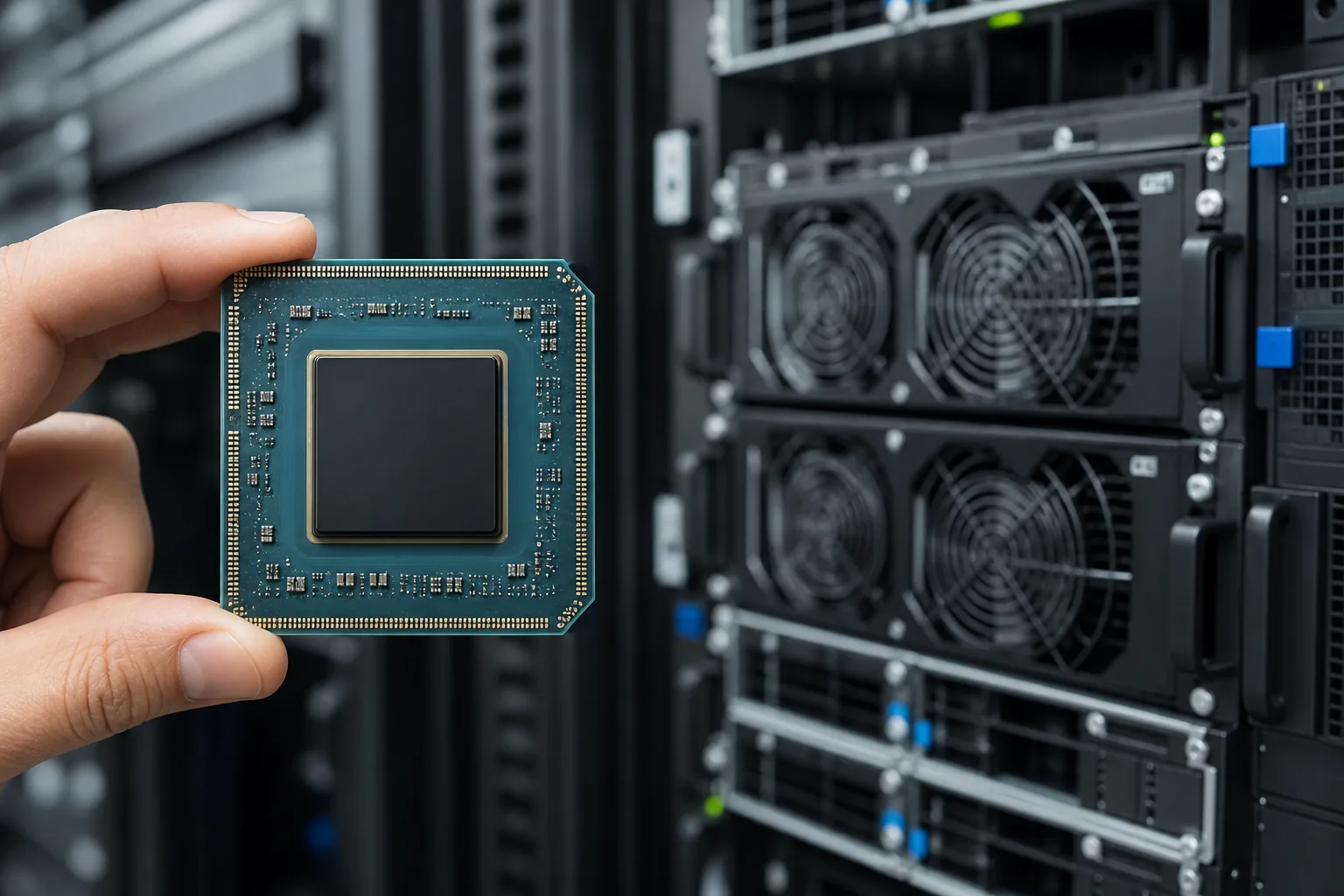
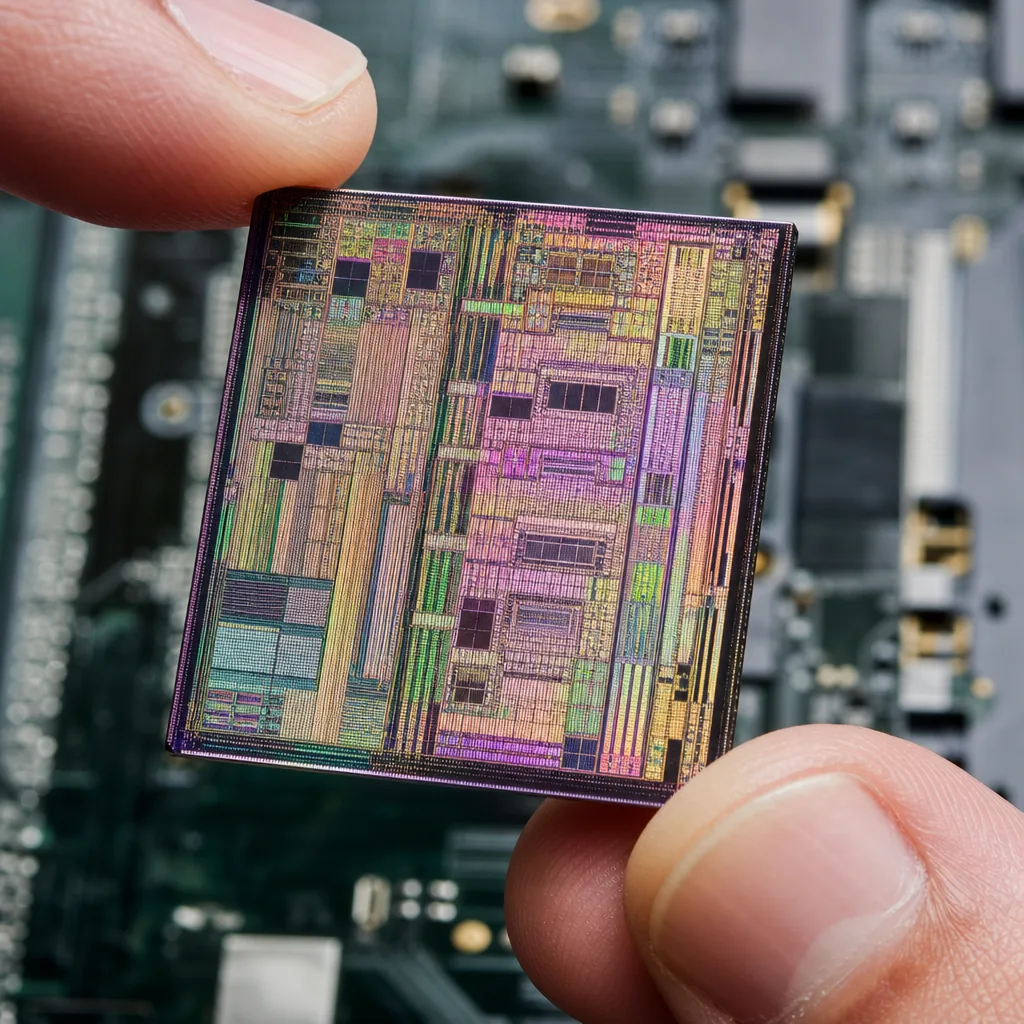
The company’s HC1 Technology Demonstrator uses an 815mm² die with 53 billion transistors. Taalas says only the top two metal layers of its roughly 100-layer design need changing for a particular model. That is intended to cut the time needed to put a new model into silicon to about two months, compared with roughly six months for a fully custom chip.
The HC1 was fabricated on TSMC’s 6nm process and uses on-chip SRAM. LoRA adapters can be loaded into its memory and its context window is adjustable, but those features do not change the fixed base model embedded in the design.
Huge speed claims, with important caveats
Taalas says HC1 can deliver around 17,000 tokens per second per user on Meta’s Llama 3.1 8B model. Its original figure was 16,960 tokens per second, which it said was 48 times faster than Nvidia GPUs and 8.5 times faster than Cerebras accelerators in its comparison.
Those numbers need careful handling. Analyst Karl Freund measured 14,357 tokens per second in an independent test, below Taalas’s own result. The company’s benchmark figures have also not been independently verified at production scale, so they should be treated as technology-demonstrator results rather than a promise of data-centre performance.
Taalas says the chip uses around 250W. A server containing 10 HC1 cards would therefore draw roughly 2.5kW, a level it says can fit in standard air-cooled racks. The company has also claimed a cost of 0.75 cents for one million Llama 3.1 8B tokens, based on its own calculations.
How AMD plans to use it
AMD said it plans to incorporate Taalas chips and technology into its roadmap alongside Epyc processors and Instinct GPUs, with systems tied into its Helios rack architecture and ROCm software platform.
The most obvious arrangement would divide AI inference between two types of processor. An Instinct GPU could perform prefill, the compute-heavy task of processing a user’s prompt. A Taalas accelerator could then handle decoding, generating the response one token at a time, where the model’s fixed on-chip weights could provide the biggest advantage.
“AMD is building a full-stack AI platform that gives customers the flexibility to deploy the right compute solutions for every AI workload,” Boppana said in AMD’s announcement.
Taalas co-founder and chief executive Ljubisa Bajic, an AMD alumnus and former Tenstorrent chief executive, will join AMD with the Canada-based team. AMD said the acquisition reflects its commitment to retaining and growing Canadian semiconductor and AI talent.
Another piece in AMD’s AI push
The deal lands amid an industry race to own more of the AI inference stack. AMD has been building out the components behind its Helios racks, having bought Silo AI for $665 million in 2024 and ZT Systems for $4.9 billion. It also announced a Cerebras partnership in July and previously bought smaller AI companies including inference software specialist MK1.
Nvidia has made a similarly forceful move, spending $20 billion on assets from Groq a little over seven months ago. AMD chief executive Lisa Su has argued there is no single chip architecture for every AI task, while still expecting GPUs to remain the majority of the AI chip market because of their adaptability.
For ordinary UK buyers, this acquisition will not put a new AMD chip in a shop. Its relevance is further upstream: faster and more efficient inference hardware could ultimately influence the responsiveness and operating costs of AI services. Whether that happens depends on AMD turning Taalas’s promising demonstration technology into systems customers can deploy at scale.
Why it matters
This is not a consumer hardware launch, so there is no UK retail product or pricing to consider. But if AMD can turn Taalas’s approach into deployable data-centre systems, AI services used by UK businesses and consumers could eventually return responses faster and potentially more efficiently. The trade-off is flexibility: a hardwired chip is designed around one base model, while GPUs can run many different models.