
AMD Launches Zen 6 EPYC Venice and MI455X AI Hardware
AMD’s new Helios rack brings together Zen 6 EPYC processors, MI455X accelerators and networking hardware for large-scale AI deployments.
What you need to know
- AMD launched its Helios AI rack, MI455X accelerator and 6th Gen EPYC Venice server CPUs on 23 July.
- Helios contains 72 MI455X GPUs and is due to begin shipping to customers, including Microsoft, in the second half of 2026.
- AMD is pitching the platform against Nvidia’s Vera Rubin NVL72, though like-for-like performance comparisons remain difficult.
AMD puts Zen 6 and a new AI rack into production
AMD has launched its next-generation AI infrastructure portfolio, led by the Helios rack-scale platform, the Instinct MI455X accelerator and 6th Gen EPYC “Venice” server processors. The announcements were made on 23 July at AMD’s Advancing AI 2026 event at San Francisco’s Moscone Center, which ran in person and online from 22 to 23 July.
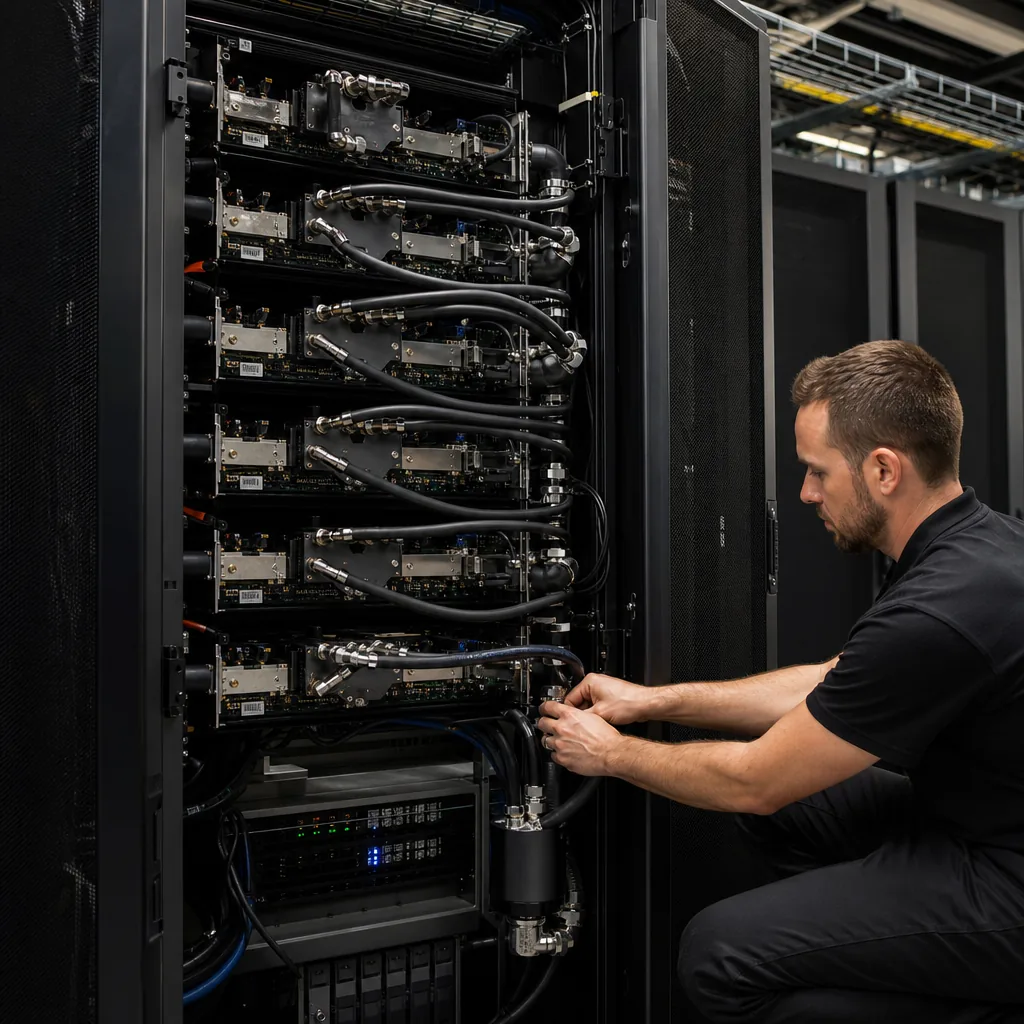
Helios is AMD’s answer to the increasingly important market for rack-scale AI systems: huge, liquid-cooled units built to train and run the largest generative AI models. The company says the system is now in production and will be deployed by leading AI companies at gigawatt scale. OpenAI chief executive Sam Altman joined AMD chief executive Lisa Su on stage during the keynote, underlining the importance of AI labs as customers for this hardware.
AMD says it will begin shipping Helios to customers, including Microsoft, in the second half of 2026. Systems will also be offered through OEMs and infrastructure partners including Bull, HPE, Lenovo and Supermicro. Individual UK pricing has not been confirmed.
Helios combines 72 MI455X GPUs with Zen 6 EPYC CPUs
A full Helios rack contains 18 compute trays and six switch trays within a 44U Open Rack Wide frame. Each compute tray carries four MI455X GPUs and a single-socket EPYC 9006 processor, meaning the complete system has 72 accelerators. It also combines AMD’s ROCm software and Pensando networking hardware in an integrated, liquid-cooled chassis.
At the centre of the platform is the Instinct MI455X, a CDNA 5-based accelerator made using TSMC’s 2nm and 3nm process technologies. AMD says the full chip contains 320 billion transistors, carries 432GB of HBM4 memory across 16 stacks, and supplies 19.6TB/s of memory bandwidth per GPU.
The company rates each MI455X at 40 PFLOPs of FP4 compute and 20 PFLOPs of FP8 compute. It can also be divided into as many as eight SR-IOV virtual machines, allowing cloud operators to allocate a single accelerator among multiple workloads.
At rack scale, AMD quotes up to 2.9 exaflops of FP4 compute, 1.4 exaflops of FP8 compute and 31TB of HBM4 memory. The rack also has 1.4PB/s of aggregate bandwidth, according to AMD. Its MI455X GPUs are connected using Ultra Accelerator Link over Ethernet, or UALoE, which AMD says offers 3.6TB/s of bi-directional bandwidth per GPU.
Venice brings Zen 6 to servers first
The other major launch is EPYC Venice, formally the EPYC 9006 Series. In an unusual change for AMD’s Zen architecture, Zen 6 is reaching servers before other product categories. Venice is also described by AMD as the industry’s first x86 server processor built on TSMC’s 2nm node.
EPYC 9006 chips will range from eight to 256 physical CPU cores. Versions with and without 3D V-Cache are planned, with up to 1,152MB of L3 cache in one socket, while at least one version will use LPDDR5X memory.
The top 256-core model represents a 33% rise over the current 192-core EPYC Turin range. AMD claims a 70% CPU-performance improvement over Zen 5-based chips, though that figure is the company’s own claim rather than an independent benchmark result.
Venice moves to AMD’s new SP7 socket, adding PCIe 6.0 and 16-channel memory support. The preceding EPYC Turin SP5 platform supports up to 12 memory channels and PCIe 5.0. Venice packages two central 4nm server I/O dies, with eight 2nm chiplets on each side; each chiplet includes 32 Zen 6 cores.
AMD is aiming directly at Nvidia’s Rubin systems
Helios arrives as AMD tries to narrow Nvidia’s lead in large-scale AI infrastructure. Analysts covering the launch put the price of a Helios rack at between $5 million and $5.5 million, although AMD has not published an official list price. That estimate compares with roughly $3.5 million to $4 million for Nvidia’s Vera Rubin system, according to Futurum Group analyst Daniel Newman.
AMD claims Helios has 15% more peak FP4 performance, 50% more HBM capacity and 6% more HBM bandwidth than Nvidia’s published Vera Rubin NVL72 specifications. Those comparisons require caution. Nvidia’s Rubin GPU is rated at 50 PFLOPs of FP4, compared with 40 PFLOPs for MI455X, and the vendors use differing numeric formats that do not translate cleanly.
In aggregate inference compute, AMD rates Nvidia’s Vera Rubin NVL72 at 3.6 exaflops of FP4, ahead of Helios at 2.9 exaflops. AMD’s argument instead leans heavily on memory capacity, bandwidth and cost efficiency. It says Helios can deliver up to 30% more tokens per dollar than a leading competing system, but that is an AMD figure and has not been independently verified.
“AMD and Microsoft have spent years building high-performance infrastructure together, and today we’re extending that partnership across the full stack of AMD AI solutions on Azure,” said Dr Lisa Su, AMD chair and chief executive.
What happens next
Microsoft has confirmed it is expanding its Azure infrastructure portfolio with AMD Helios, while AMD has named OpenAI, Anthropic, Meta, Oracle, HUMAIN, Tensorwave, Vultr and Cirrascale among organisations choosing the platform. The immediate test will be whether those commitments become substantial deployments and whether the hardware can match AMD’s claims in independently measured workloads.
There is also a timing question around the accelerator itself. AMD says Helios will start shipping in the second half of 2026, while independent analysis from MLQ AI places MI455X mass production in the second quarter of 2027. AMD’s longer roadmap already points to MI500 accelerators in 2027 and MI600 hardware by 2028, making Helios the opening move in a rapidly accelerating data-centre contest.
Why it matters
This is data-centre hardware rather than something consumers can buy, but it could affect the AI services ordinary UK users encounter through cloud platforms and software. A stronger AMD alternative may give cloud providers more choice and potentially ease pressure on the scarce, expensive AI computing capacity that currently shapes the cost and availability of generative AI products. The headline performance claims still need independent testing.