
Garmin Watches UK: The Complete Range Compared
From the satellite-connected Fenix 8 Pro to the brand-new entry-level Forerunner 70 — every Garmin worth buying in Britain right now, ranked, compared and matched to the right wrist.
We link to the exact model on Amazon UK. Prices change often, so check the live price before you buy. As an Amazon Associate we earn from qualifying purchases.
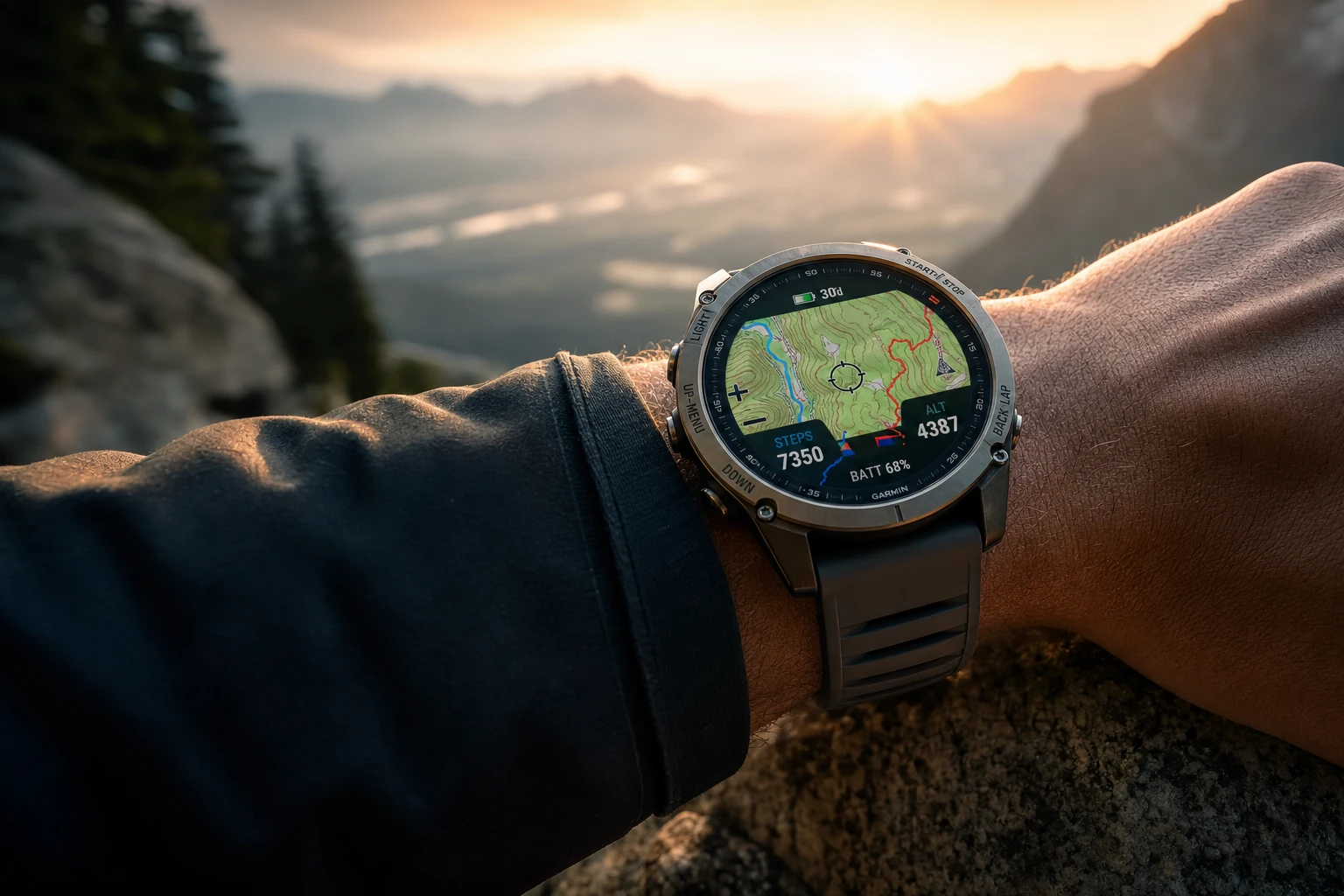
The 2026 Garmin lineup spans rugged adventure tools, dedicated running watches and slim AMOLED smartwatches.
Garmin's catalogue has never been more sprawling — or more confusing. After a frantic 2025 that delivered the Fenix 8 Pro with LTE and satellite messaging, the brand-new Forerunner 970 with running economy metrics, the rectangular Venu X1, and a refreshed Forerunner 570, Venu 4, Vivoactive 6 and Instinct 3, the company has kept its foot down in 2026: May saw an all-new entry-level trio — the Forerunner 70, 170 and 170 Music — that finally moves the budget tier to AMOLED and retires the long-serving Forerunner 165. Working out which model is actually right for you takes some unpicking. I've spent the last few months living with most of them on a daily basis, swapping between marathon training, hill walks in the Lakes and the school run, and what follows is the head-to-head you actually need as of June 2026.
Garmin's UK lineup spans budget AMOLED running watches up to four-figure multi-sport flagships - the right pick is mostly about how seriously you train.
What we'll cover
- The full 2026 UK range
- Fenix 8 vs Fenix 8 Pro
- Forerunner 970 vs 570
- Venu 4 and Venu X1
- Instinct 3 for adventurers
- Entry-level: FR70, FR170, Vivoactive 6
- Head-to-head comparison
- Who should buy which?
- Verdict and FAQs
The 2026 UK Range at a Glance
One of Garmin's quiet superpowers is that, no matter who you are, there's a watch in the line-up that fits. That's both a blessing and a curse — the breadth means you genuinely can find something dialled in for your needs, but it also means you'll trip over half a dozen models that look almost identical at first glance. Here's the lay of the land for 2026.
Roughly speaking, the family splits into five buckets: the Fenix line for premium outdoor and multisport, the Forerunner line for runners (970 at the top, 570 in the middle, the new 70 and 170 at the bottom), the Venu line for lifestyle users who still want serious health tracking, the Instinct line for ruggedness-first buyers, and the Approach line for golfers. The new Vivoactive 6 sits below Venu 4 as a true entry-level smartwatch. One notable platform shift this year: MIP displays are now gone entirely from the Forerunner line — every current Forerunner is AMOLED, with memory-in-pixel surviving only on the Enduro, Instinct and Fenix Solar models where battery life and bright-sun visibility matter most.
Fenix 8 and Fenix 8 Pro: The Top of the Tree
Shop Fenix 8 and Fenix 8 Pro on Amazon UK
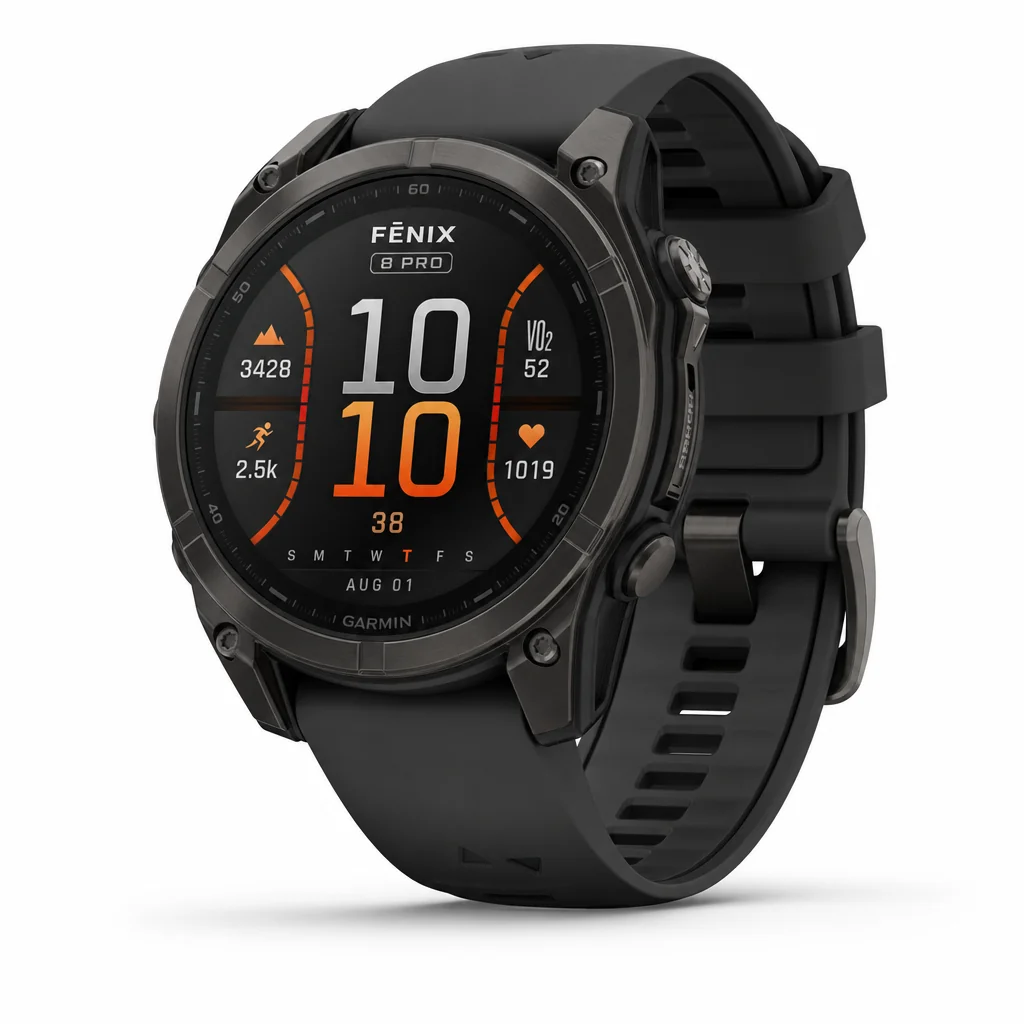
If money is no object and you want the most capable wrist computer Garmin makes, you're looking at a Fenix. The standard Fenix 8 arrived in three case sizes — 43mm, 47mm and 51mm — and lets you choose between a punchy AMOLED display (with sapphire glass available) or a memory-in-pixel solar variant if you want to stretch every last hour out of the battery. AMOLED models pack ECG functionality through the metal bezel, an LED flashlight, multi-band GNSS, full topographic mapping, a speaker and microphone for taking calls from the wrist, music storage and Garmin Pay.
The Fenix 8 Pro, which landed on 3 September 2025, is where things get genuinely interesting. It takes the Fenix 8 platform and bolts on LTE-M connectivity plus Skylo's geostationary satellite network (with an active inReach plan)-based satellite messaging — essentially folding inReach functionality into the watch itself. That means you can send messages, trigger SOS or simply text a friend to say you're running late, all without your phone, and even when you're well off-grid. It comes in 47mm (£1,029.99) and 51mm (£1,119.99) AMOLED versions; there's no 43mm option, because there's simply no room for the LTE antenna. For mountain runners, ultra-distance walkers and anyone who heads into the hills alone, that's a properly meaningful upgrade.
Garmin also produced a halo Fenix 8 Pro MicroLED variant — the first MicroLED smartwatch and, with a blistering 4,500-nit, 1.4-inch panel built from some 400,000 individual LEDs, the brightest display ever fitted to a wearable. It is 51mm only, and it remains eye-wateringly expensive, although Garmin has since trimmed the UK price to around £1,500 (down from its original £1,730). If you've ever squinted at your wrist in summer Cornwall sunshine, you'll understand the appeal — just note that all that brightness costs battery, at a claimed 10 days in smartwatch mode versus 27 days for the 51mm AMOLED Pro.
The Fenix 8 Pro adds satellite messaging — a genuine game-changer if you regularly head off-grid.
Satellite Messaging
Fenix 8 Pro brings inReach-style two-way messaging and SOS to the wrist — no phone required.
Solar Option
The standard Fenix 8 MIP solar variant uses Power Glass to extend battery life on long expeditions.
Elevate Gen 5 + ECG
Latest optical heart-rate sensor with on-wrist ECG via the metal bezel on AMOLED models.
Built-in Torch
The LED flashlight is genuinely useful — pre-dawn runs and rummaging in the tent both win.
Pro Tip
If you spend most of your time within phone range, the standard Fenix 8 saves you a substantial chunk versus the Pro and offers identical sport tracking. The Pro only earns its keep if you actually use the LTE and satellite features.
Search Garmin Fenix 8 47mm AMOLED on Amazon UK
Forerunner 970 and 570: The Runners' Choice
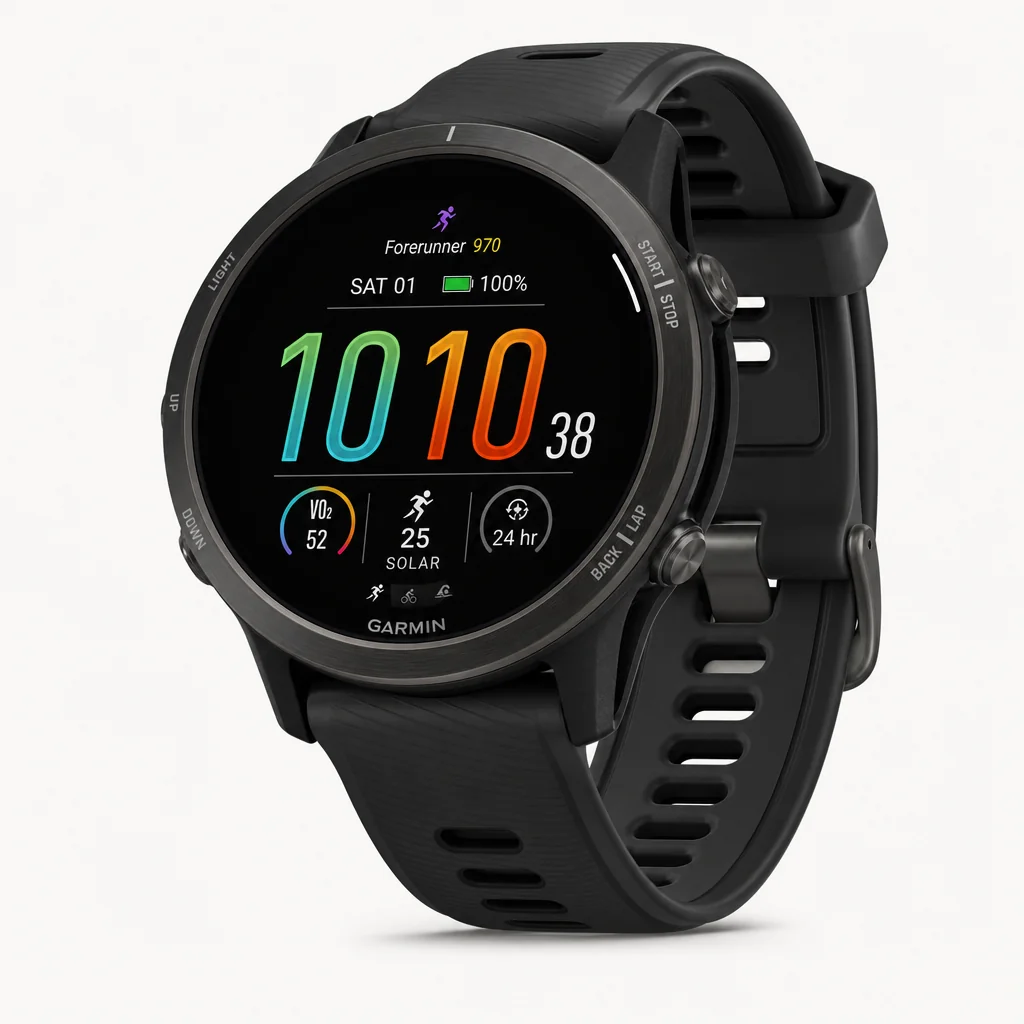
For pure running performance, the Forerunner 970 is the smarter pick than a Fenix for most people. Announced in May 2025, it inherits the speaker, microphone and LED flashlight that previously felt exclusive to the Fenix line, adds the newer Garmin Elevate Gen 5 optical heart-rate sensor with ECG, and crucially introduces a fresh suite of running metrics focused on running economy, running tolerance and step speed loss. It still gives you full topographic maps, multi-band GNSS, music, Garmin Pay, a sapphire crystal and a 1.4-inch AMOLED display, with up to 15 days of battery in smartwatch mode.
For my money, the running economy metric is the headline feature. Where running power tries to estimate effort, running economy attempts to quantify how efficiently you're using that effort over time — and over a marathon block, watching that number trend in the right direction is genuinely motivating.
The Forerunner 570 is the watch for runners who want most of the 970's polish without paying flagship prices. Available in 42mm and 47mm cases, it shares the same 1.4-inch AMOLED, the Elevate Gen 5 sensor, multi-band GNSS, speaker and microphone, but it does not have the Forerunner 970's LED flashlight. What you give up is full mapping (you only get breadcrumb navigation), ECG (it lacks the metal-bezel contact) and the fancy running economy and projected race-pace metrics. For most club runners and marathon hopefuls, that's a perfectly sensible trade.
| Feature | Forerunner 970 | Forerunner 570 | Forerunner 170 |
|---|---|---|---|
| Display | 1.4" AMOLED | 1.4" AMOLED | 1.2" AMOLED |
| HR Sensor | Elevate Gen 5 (ECG) | Elevate Gen 5 | Elevate Gen 4 |
| GPS | Multi-band GNSS | Multi-band GNSS | Single-frequency multi-GNSS |
| Full Maps | Yes | No (breadcrumb) | No |
| Speaker & Mic | Yes | Yes | No |
| No flashlight | Yes | Yes | No |
| Running Economy | Yes | No | No |
| Best For | Serious / elite runners | Marathon trainers | New runners |
The Forerunner 570 hits a genuine sweet spot for the dedicated club runner.

See Garmin Forerunner 970 (Titanium Whitestone) on Amazon UK
Check today's price & availability on Amazon UK
Venu 4 and Venu X1: Lifestyle Smartwatches Done Garmin's Way
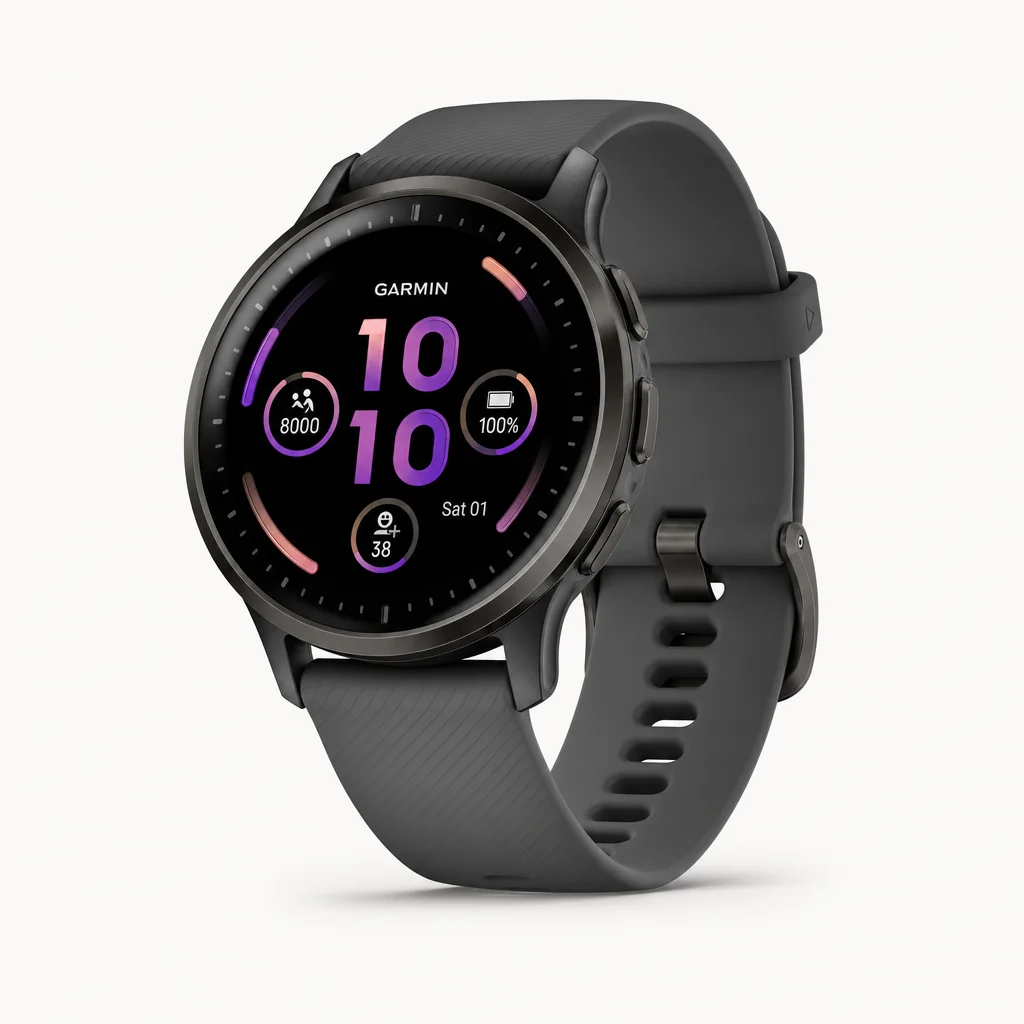
If you're more interested in steps, sleep, stress, recovery and the occasional Park Run than splits and intervals, the Venu line is where Garmin wants your attention. The Venu 4 builds on the well-loved Venu 3 by adding multi-band GNSS and a brighter AMOLED display, and — for the first time in a Venu — slipping in an LED flashlight. ECG, microphone and speaker support all carry over. In feature terms it now sits remarkably close to the Forerunner 570; the difference is positioning. Where the 570 leans into structured run training, the Venu 4 prioritises wellness, sleep coaching and lifestyle smartwatch behaviour.
Then there's the Venu X1 — the watch that's most obviously chasing the Apple Watch Ultra crowd. It's an ultra-thin rectangular AMOLED smartwatch, a complete departure from Garmin's traditional round chassis, and despite the fashion-led shape it includes full mapping. Garmin shares the same software platform across the Venu X1, Forerunner 970, Forerunner 570 and Vivoactive 6, so the day-to-day interface feels consistent across the four.
The Venu X1's rectangular shape is divisive. Some testers love the screen real estate; others find it less ergonomic for hard exercise than Garmin's round watches. If you can, try one on in person before committing.

See Garmin Venu 4 on Amazon UK
Check today's price & availability on Amazon UK
Instinct 3: The Rugged Choice

See Instinct 3 on Amazon UK
Check today's price & availability on Amazon UK
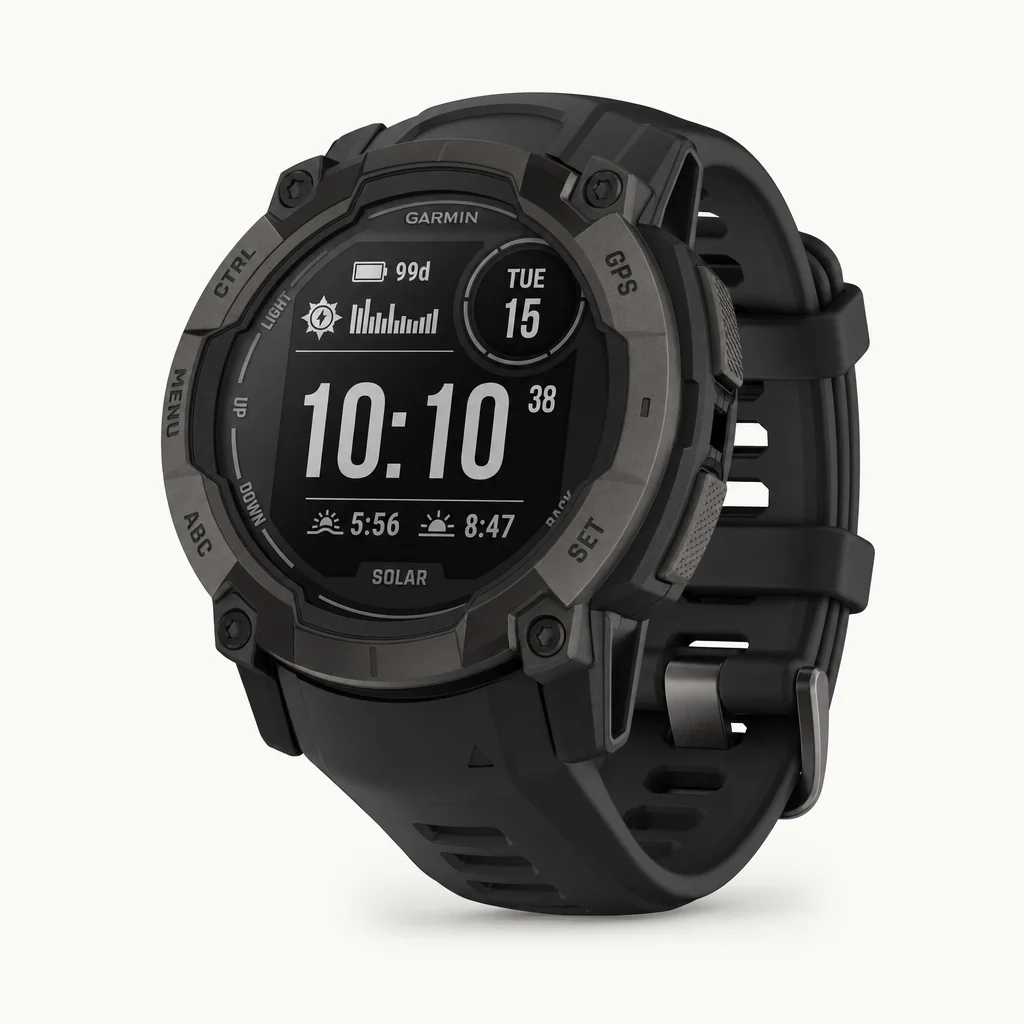
The Instinct 3 is what you buy when you'd rather not worry about the watch surviving you. It comes in 45mm and 50mm sizes and, mirroring the Fenix split, lets you choose between an AMOLED display or a memory-in-pixel solar version. The MIP solar model is the real curiosity here: you sacrifice the punchy modern screen, but in exchange solar charging can extend runtime dramatically. How far depends entirely on how you use it — hours of GPS, high-frequency sensors and always-on features will outpace what the panel harvests, while light daily wear in genuine sunshine is where the "endless" figures come from. For bike-packers, thru-hikers and anyone doing genuinely long expeditions, that's still a meaningful argument.
Compared with a Fenix, the Instinct misses out on the metal-bezel ECG, on full topographic maps and on some of the more sophisticated training science features. It makes up for it with a tougher, simpler character and a price point that's much easier to swallow.
Instinct 3 Pros
- Genuinely rugged build designed for abuse
- AMOLED or MIP solar — pick your poison
- Two case sizes to suit smaller wrists
- Substantially cheaper than the Fenix line
- Solar variant excels on multi-day trips
Instinct 3 Cons
- No full topographic mapping
- Lacks the Fenix's training-science depth
- MIP screen looks dated next to AMOLED rivals
- No ECG functionality
From running to gym training, Garmin's heart-rate, GPS and recovery metrics are class-leading at every price tier.

See Garmin Instinct 3 on Amazon UK
Check today's price & availability on Amazon UK
Entry-Level: Forerunner 70, FR170 and Vivoactive 6
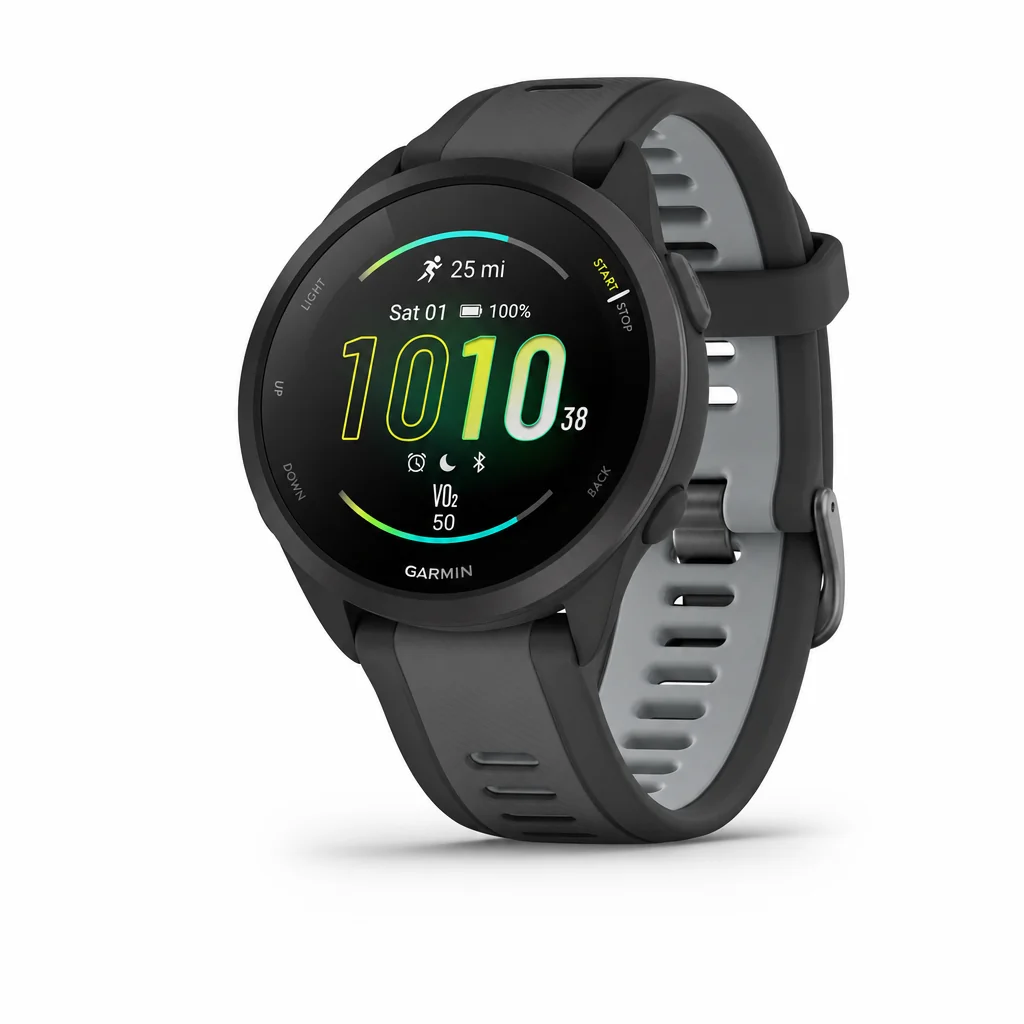
You don't need to spend flagship money to get a properly competent Garmin — and the entry tier had a big reshuffle in May 2026. The new Forerunner 70 is now my default recommendation for newcomers to running. Launched on 15 May 2026 to replace the Forerunner 55, it brings a 1.2-inch 390×390 AMOLED display and — surprisingly for the budget tier — Garmin's full physio stack, including Training Readiness, Training Status, HRV status, Body Battery, daily suggested workouts and Garmin Coach run/walk plans. It uses the Elevate Gen 4 optical sensor (no ECG), single-frequency multi-GNSS and offers up to 13 days in smartwatch mode. It's the watch I'd hand to a couch-to-5k convert without hesitation.
Stepping up, the Forerunner 170 (and music-equipped Forerunner 170 Music) replaces the old Forerunner 165. It keeps everything the FR70 offers and adds a barometric altimeter, a compass and Garmin Pay, with the Music version stuffing in 4GB of storage for offline Spotify, Amazon Music and Deezer playback. It still cuts a couple of corners against pricier Forerunners — no multi-band GPS and the Gen 4 (rather than Gen 5) heart-rate sensor — but for everyday training it's a sweet spot. The old Forerunner 165 may still be found at a discount while stock lasts, and remains a fine buy if the price is right.
The Vivoactive 6 meanwhile slots in below the Venu 4 as the entry-level lifestyle smartwatch, with an AMOLED display, 50+ sport modes, music storage and Garmin Pay (though no barometric altimeter). It runs the same software platform as the Venu X1, FR570 and FR970, which means a consistent interface and good feature parity for the price.
The new Forerunner 70 is the smartest entry point for new runners in 2026.

See Garmin Forerunner range on Amazon UK
Check today's price & availability on Amazon UK
Head-to-Head: Which Garmin Wins on What?
Putting these watches through the same training block is genuinely instructive. Here's how the flagships stack up across the dimensions that actually matter day to day.
| Watch | Display | Maps | Standout Feature | Best Suited To |
|---|---|---|---|---|
| Fenix 8 Pro | AMOLED / MicroLED | Full topo | LTE + satellite messaging | Off-grid adventurers |
| Fenix 8 | AMOLED or MIP Solar | Full topo | Three case sizes, ECG | Multisport athletes |
| Forerunner 970 | 1.4" AMOLED | Full topo | Running economy metric | Serious runners |
| Forerunner 570 | 1.4" AMOLED | Breadcrumb only | Speaker, mic, torch | Marathon trainers |
| Venu 4 | AMOLED | No | Lifestyle wellness focus | Health-led users |
| Venu X1 | Rectangular AMOLED | Yes | Slim form factor | Smartwatch crossover buyers |
| Instinct 3 | AMOLED or MIP Solar | No full maps | Rugged + solar option | Outdoor pragmatists |
| Forerunner 70 / 170 | 1.2" AMOLED | No | Coach plans on a budget | New runners |
Performance, Build and Day-to-Day Living
Where Garmin still pulls ahead of pretty much everyone else — Apple Watch Ultra included — is in genuine sports-watch performance. Multi-band GNSS across the Fenix 8, Forerunner 970, Forerunner 570 and Venu 4 means tracks through dense city streets and beneath tree cover are noticeably tighter than they were two years ago. The Elevate Gen 5 heart-rate sensor on the FR570, FR970 and Fenix 8 is also a meaningful step up, especially during the high-intensity intervals that older optical sensors used to muddle. The budget FR70 and FR170 stick with the older Elevate Gen 4 sensor, so heart rate during hard efforts is a touch less reliable on those.
Build-wise, the Fenix line continues to set the standard with sapphire-glass options and a metal bezel that doubles as the ECG electrode. The Instinct 3 takes a more utilitarian approach, with a chunky, fibre-reinforced polymer body that genuinely shrugs off knocks. The Venu X1 sits at the other extreme — slim, light and clearly designed to be worn day-to-day rather than smashed against rocks.
Garmin Connect remains arguably the best companion app in fitness tech, tying every model together.
UK Availability and Buying in 2026
All of the watches discussed here are available through Garmin's UK web store, the usual high-street suspects (Currys, Argos, John Lewis, Halfords for selected models), specialist running and outdoor retailers, and Amazon UK. Stock for the newest 2026 launches — the Forerunner 70, 170 and 170 Music arrived on 15 May — is settling in nicely, while the Fenix 8 Pro can still be variable on specific case sizes and strap colours, so it's worth checking a couple of sources before committing.
One genuinely useful UK quirk: Garmin tends to refresh promotional pricing fairly aggressively around the late spring marathon season and again over Black Friday, so older but still excellent models like the outgoing Forerunner 165 and the Instinct 3 often see meaningful discounts. The Fenix 8 Pro MicroLED has already had an official price cut to around £1,500, so don't assume the flagship sticker is fixed.
Check the latest price and any current bundles on Amazon for the model you're considering — promotional pricing on Garmin watches changes frequently.
Multi-day battery life is the headline reason fitness-first buyers pick Garmin over Apple or Samsung.
Who Should Buy Which Garmin?
The Off-Grid Adventurer
Get the Fenix 8 Pro. Satellite messaging, LTE, full mapping and ECG make it the most self-sufficient watch Garmin has ever sold.
The Serious Runner
The Forerunner 970. Running economy, projected race pace and full topo mapping in a lighter, more focused chassis than a Fenix.
The Marathon Hopeful
The Forerunner 570 nails the sweet spot — same 1.4" AMOLED and Elevate Gen 5 as the 970, minus the maps you may not need.
The Wellness-First Wearer
The Venu 4. ECG, multi-band GNSS, brighter screen and the first Venu flashlight wrap into a polished lifestyle package.
The Smartwatch Crossover
The Venu X1 is Garmin's most Apple-like watch yet, with a slim rectangular AMOLED and full mapping included.
The Outdoor Pragmatist
The Instinct 3. Rugged, sensibly priced, and the MIP solar variant runs and runs on multi-day trips.
The First-Time Runner
The Forerunner 70 (or step up to the FR170 for Garmin Pay and an altimeter). A modern AMOLED display, Garmin Coach plans and the core analytics — no fluff.
The Golfer
The Approach S50 mid-range golf watch, or pair it with the Approach G82 handheld launch monitor for serious practice.
Frequently Asked Questions
The Verdict
Final Word
The 2026 Garmin range is the most complete sports-watch lineup money can buy. The Fenix 8 Pro is the new high-water mark, with satellite messaging genuinely changing what a wrist computer can do off-grid — and a MicroLED variant that's now a little easier to swallow at around £1,500. The Forerunner 970 is the runner's choice if you want every metric Garmin currently knows how to measure, while the Forerunner 570 remains the smart-money pick for marathon hopefuls. The Venu 4 and Venu X1 finally make Garmin a credible lifestyle option, the Instinct 3 stays the rugged everyman, and the new Forerunner 70 and 170 are comfortably the best entry points for new runners now that the whole Forerunner line has gone AMOLED.
For most British buyers reading this, the question isn't whether Garmin is the right brand — it almost certainly is — but which of these excellent watches matches your wrist and your weekend. Start with the buyer cards above, work backwards from the features you'll genuinely use, and you'll end up with the right one.
From first 5k to ultra-distance — there's a Garmin in the 2026 range that fits your story.
Ready to pick yours? Check the latest price and any current bundles on Amazon.
- Garmin Forerunner 970 (Titanium Whitestone)View on Amazon
- Garmin Venu 4View on Amazon
- Garmin Instinct 3View on Amazon
- Garmin Forerunner rangeView on Amazon
- Instinct 3View on Amazon