
OpenAI and Jony Ive AI Device Rumours: What We Know So Far
A pocketable, screenless companion designed by the man behind the iPhone — and powered by the company behind ChatGPT. Here's everything the leaks have spilled.
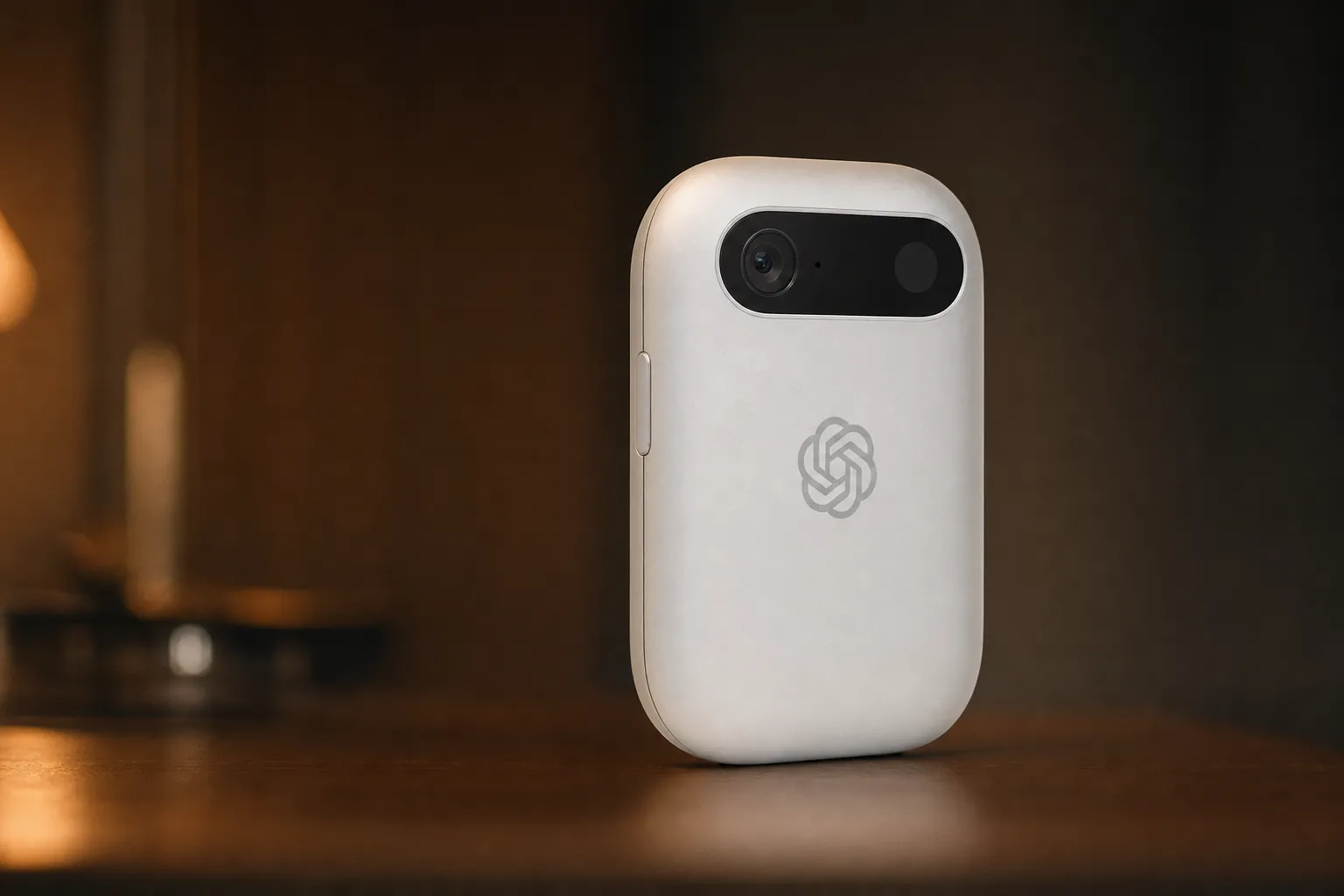 Illustrative concept image, not an official photo
The OpenAI x Jony Ive collaboration is shaping up to be the most-watched hardware debut since the first iPhone.
Let me be upfront from the start: nothing here is for sale yet. As I write this in mid-2026, there is no box to unwrap, no retail listing to scroll through, and no review unit on my desk. What there is, however, is a remarkably consistent stream of leaks pointing toward a family of devices that could genuinely reshape how we interact with AI. OpenAI's Chief Global Affairs Officer Chris Lehane confirmed at Davos that the company has said a hardware reveal in the second half of 2026 is likely; court reporting says first shipment is not expected before February 2027 — so this is no longer a question of if, but when and what.
Throughout this piece I'll be candid about which claims feel solid and which are still in the realm of educated guesswork. If you're the sort of reader who likes their tech coverage with a dose of healthy scepticism, you're in the right place. Let's dig in.
Concept visualisation for illustration — based on rumoured specs, not a confirmed design.
Status: OpenAI may reveal hardware in the second half of 2026, but court reporting says first shipments are not expected before February 2027. Form factor, processor, volume and controls remain unconfirmed and reports conflict.
The Story So Far: How We Got Here
The collaboration between OpenAI and Jony Ive is, on paper, a dream pairing. Ive defined the visual and tactile language of modern consumer electronics across two decades at Apple, and OpenAI has done more than anyone to bring conversational AI into everyday life. The premise behind their joint effort is deceptively simple: if AI is going to be your constant companion, the hardware that delivers it shouldn't look or feel like a smartphone bolted onto a chatbot. It should be something new.
That ambition explains why the early signals point so firmly away from screens. The devices in development reportedly lean into voice, context and ambient awareness rather than the tap-and-scroll paradigm we've lived with since 2007. It's a bold bet, and one that immediately invites comparison to the high-profile AI hardware flops that came before — but more on those later, because the comparison is more flattering to this project than you might assume.
What we've learned has trickled out through a combination of factory leaks, reporting from outlets like The Information, and the odd official soundbite. The headline takeaway is that this isn't a single gadget — it's a roadmap. There are at least three distinct hardware concepts in the pipeline, each with its own internal codename and its own role to play.
Everything in this article is drawn from leaks, supply-chain reports and official timelines. None of these devices has been formally launched, so treat specifications as provisional until OpenAI confirms them on stage.
The Devices in Development
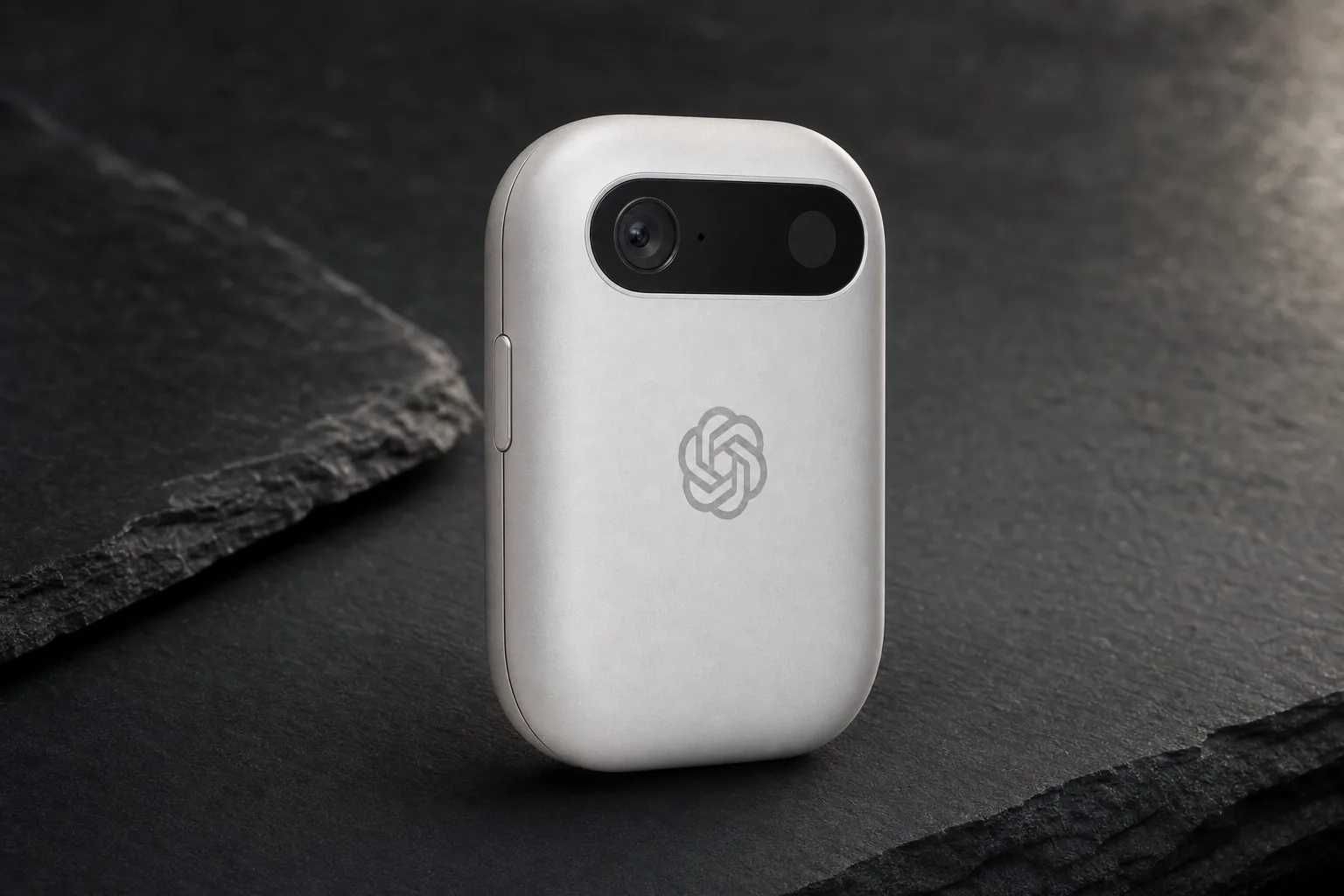
Let's lay out the lineup as it currently stands. Rather than launching one hero product and hoping it sticks, OpenAI appears to be building a small ecosystem of AI-first devices, staggered across 2026 and 2027.
The star of the show — and the device most likely to land first — is codenamed "Sweetpea," with a commercial name rumoured to be "Dime." It's reportedly a "special audio product" sitting somewhere in the earbud or "open-ear headphones" zone. Think of it less as a pair of AirPods and more as a wearable AI you can talk to, listen through, and carry without ever pulling out a phone.
Sitting alongside it is "Gumdrop," a pen-shaped device that's a little more enigmatic. It's said to be roughly the size of an Apple iPod Shuffle and, like its sibling, is entirely bereft of a dedicated screen. The third concept is a smart speaker pencilled in for early 2027, and beyond that OpenAI is reportedly exploring a smart lamp and even AI glasses. It's an ambitious spread, and it tells you the company isn't thinking about a single product so much as a new category.
Three distinct form factors, one shared philosophy: ambient, screenless, voice-led AI.
Sweetpea: A Reported Audio Concept With Conflicting Form-Factor Claims
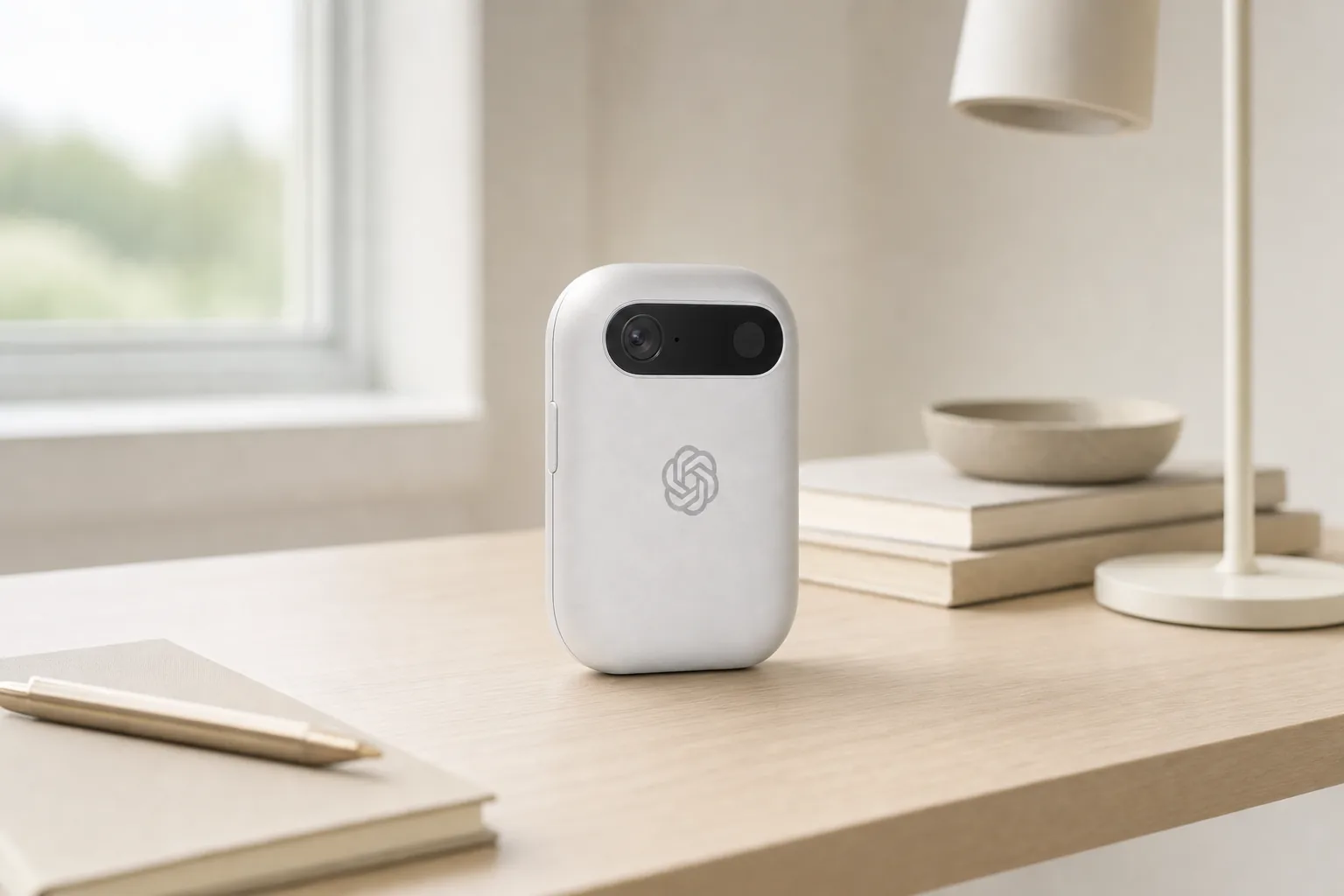
If you only remember one device from this article, make it Sweetpea. This is the one OpenAI is reportedly betting the farm on, and the leaks around it are the most detailed of the bunch.
Physically, the picture that's emerging is rather lovely — which, given Ive's involvement, should surprise nobody. Reports describe two objects, one for each ear, paired with a little egg-shaped, dental-floss-holder-sized charging dock. The whole thing is said to be small enough to wear around the neck or slip into a pocket, on roughly the same scale as an iPod Shuffle. There's even talk of a metal design "reminiscent of an eggstone," which is exactly the kind of poetic, slightly precious phrasing you'd expect to attach to an Ive product.
Under the hood, the rumoured silicon is genuinely interesting. Sweetpea is said to use a 2nm Samsung Exynos chip for some on-device processing, whilst leaning heavily on cloud-based AI for the heavy lifting. That hybrid arrangement makes a lot of sense for a device this small: you want enough local intelligence to handle wake-word detection and low-latency responses, but the truly demanding reasoning happens on OpenAI's servers where there's no battery or thermal ceiling to worry about.
Perhaps the most intriguing detail concerns what Sweetpea is actually for. The custom processor is reportedly designed to let Sweetpea "replace iPhone actions by commanding Siri." Read that again, because it's a fascinating strategic move — rather than trying to rip your phone out of your life entirely, the first device may work through your existing handset, issuing commands and automating tasks via the voice assistant you already have. That's a far more pragmatic on-ramp than the all-or-nothing pitch that sank earlier AI gadgets.
Why the "command Siri" approach is clever
The biggest reason standalone AI wearables have struggled is that they ask you to abandon a phone that already does everything. By positioning Sweetpea as something that can drive your existing device rather than replace it overnight, OpenAI sidesteps the single hardest problem in the category. You keep your apps, your notifications and your data plan — the wearable just becomes a smarter, hands-free front end.
Gumdrop: The Pen-Shaped Wildcard
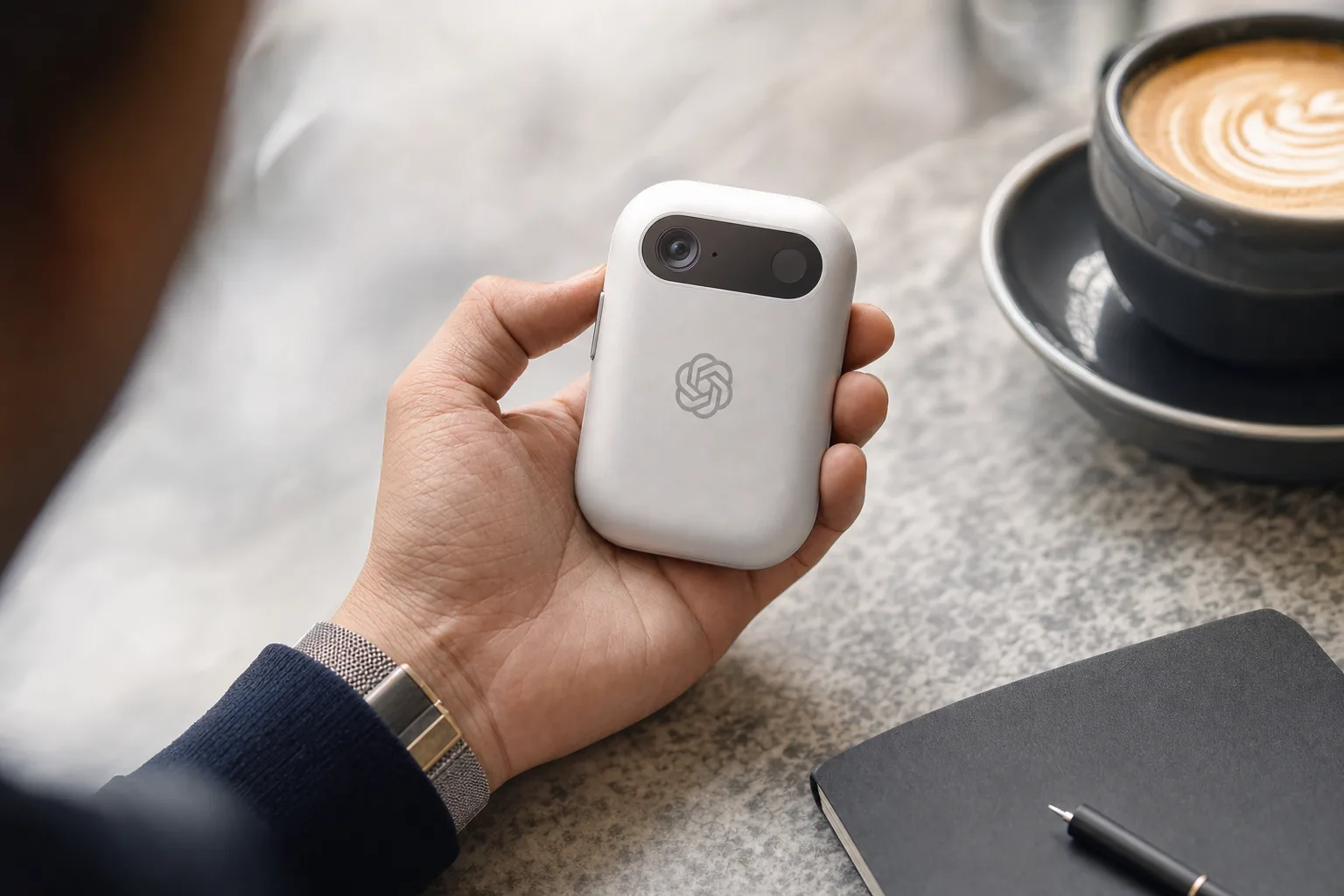
Where Sweetpea is the crowd-pleaser, Gumdrop is the one that's got me genuinely curious. A pen-form AI device sounds like a gimmick until you read what it's reportedly capable of — at which point it starts to look like the most quietly radical idea in the whole lineup.
Gumdrop is described as roughly iPod Shuffle-sized, pocketable or wearable around the neck, and — like Sweetpea — completely screenless. So far, so familiar. But the standout feature is its contextual awareness: it reportedly packs a suite of sensors including cameras and microphones, giving it an understanding of its surroundings that a pair of earbuds simply can't match.
Handwriting capture
Gumdrop is said to convert handwritten notes into text and instantly upload them to ChatGPT — bridging the analogue scribble and the digital model in a single gesture.
Contextual sensing
A sensor suite including cameras and microphones gives the device situational awareness, so it can reason about what's actually around you rather than just what you say.
Local model execution
It will reportedly run OpenAI's tailored AI models locally, calling on cloud computational support only for the more compute-intensive tasks.
Pocketable, wearable design
Compact enough to carry in a pocket or wear around the neck, keeping the AI quite literally to hand throughout the day.
That ability to run models locally and only escalate to the cloud when necessary is a meaningful design choice. It hints at faster responses, better privacy for routine tasks, and graceful behaviour when your connection drops. The handwriting-to-ChatGPT trick, meanwhile, is the kind of small but delightful feature that could win over a specific crowd — students, journalists, anyone who still thinks better with a pen in hand.
My take on Gumdrop's positioning
I suspect Gumdrop is the more experimental of the two lead devices — a way for OpenAI to explore richer, sensor-driven interactions without staking the whole launch on them. If Sweetpea is the mainstream play, Gumdrop is the enthusiast's curio. Its release window reportedly sits somewhere between the close of 2026 and 2027, behind Sweetpea in the queue.
The Smart Speaker and the Wider Ecosystem
A third reported concept moves the action from your pocket to your home. OpenAI is reportedly developing a smart speaker for an early 2027 release, with a smart lamp and AI glasses also somewhere on the drawing board.
The speaker is the most "Big Tech" device of the lot, and it comes with a feature set that's equal parts impressive and eyebrow-raising. It reportedly includes an integrated camera and is designed to learn about who is using it and what's around them. There's even talk of a facial recognition feature similar to Face ID, allowing it to identify individual household members.
What sets this apart from the Echos and Nests of the world is the proactivity. Rather than simply answering questions, the speaker is said to observe users and suggest actions to help them reach their goals — the oft-cited example being a nudge toward an early bedtime when you've got a morning meeting on the calendar. That's a genuinely different relationship with a home device: less a voice-activated kitchen timer, more an ambient assistant that watches, learns and intervenes.
I'll be honest — that's also where my enthusiasm meets my caution. An always-on camera with facial recognition that proactively offers life advice is a lot of trust to place in any device, however elegantly designed. How OpenAI handles the privacy framing here will make or break the speaker's reception, and it's the area I'll be scrutinising hardest when it eventually ships.
Smart Speaker (entry)
Lower end of the rumoured range
Smart Speaker (upper)
Top of the rumoured range, Feb 2027 earliest
The £169–£259 target undercuts a premium HomePod whilst sitting comfortably above the budget smart-speaker crowd — a sensible position for a device that's trying to feel special without scaring off mainstream buyers. UK pricing hasn't been mentioned, but a straight conversion would land it somewhere in the region of £160–£240, before the usual tax and import adjustments that tend to nudge US-to-UK numbers upward.
The rumoured smart speaker swaps the touchscreen for cameras, facial recognition and proactive suggestions.
How It Stacks Up Against Rivals
No AI device launches in a vacuum, and OpenAI's hardware will inevitably be measured against the gadgets that tried this first. The two most obvious reference points are the Humane Ai Pin and the Rabbit R1 — both of which arrived with enormous hype and, to put it kindly, mixed results. Here's how the rumoured OpenAI approach compares on the things that actually matter.
| Feature | OpenAI "Sweetpea" | Humane Ai Pin | Rabbit R1 |
|---|---|---|---|
| Form factor | Ear-worn pair + egg dock | Magnetic chest pin | Handheld square |
| Display | Screenless | Laser projector | 2.88in touchscreen |
| Designer pedigree | Jony Ive | Ex-Apple team | Teenage Engineering |
| Processing | On-device + cloud hybrid | Cloud-heavy | Cloud-heavy |
| Phone strategy | Commands your existing phone | Aims to replace phone | Companion device |
| AI backbone | OpenAI's own models | Third-party models | Third-party models |
| Status | H2 2026 (rumoured) | Released | Released |
The crucial difference jumps out of that table immediately: where Humane tried to convince you to ditch your phone, Sweetpea reportedly wants to work with it. That single strategic choice addresses the number-one criticism levelled at the Ai Pin — that it asked too much, too soon, for too little payoff. Pair that with first-party AI models and Ive-grade industrial design, and OpenAI has at least set itself up to avoid the most obvious traps.
A note of caution
It's worth remembering that both the Ai Pin and the R1 also looked compelling on paper. Slick demos and famous names don't guarantee a good product — real-world latency, battery endurance and the sheer reliability of voice interaction are where these things live or die. Until I've had one in hand, I'm keeping my expectations measured.
Reading the Signals: A Speculative Scorecard
Since there are no benchmarks to report — no review units exist, and OpenAI hasn't published a single performance figure — I want to be completely transparent about what the bars below represent. This is not a measured test. It's my read on how strong the various signals are around each aspect of the project, based on how consistent and credible the leaks have been. Treat it as an informed confidence gauge, not a lab result.
The pattern here mirrors my overall feeling about the project. The top end — design and AI — is about as strong as a pre-launch story gets, thanks to the calibre of the people involved. The bottom end — privacy, reliability, the nitty-gritty of daily use — is exactly where we have the least visibility, and exactly where these devices will ultimately be judged. That gap is the whole story of AI hardware in 2026.
Manufacturing, Scale and What It Tells Us
Sometimes the most revealing leaks aren't about features at all — they're about logistics. And the manufacturing signals around Sweetpea are loud.
The device is reportedly being built by Foxconn, the same manufacturing giant behind the iPhone, with projected first-year production volumes of 40–50 million units. To put that in perspective: that is not the order book of a cautious experiment. It's the kind of volume you commit to when you genuinely believe you're launching a mainstream consumer hit. Humane and Rabbit shipped a tiny fraction of that. If these numbers are accurate, OpenAI is planning for Sweetpea to be a genuinely high-street product, not a niche curiosity for early adopters.
That September possibility is the one I'd circle on the calendar. It's at the early, optimistic edge of the second-half-of-2026 window, but it would line up neatly with the autumn launch cadence the industry has trained us all to expect. Whether OpenAI hits that or slips toward the back end of the year, the broader takeaway is the same: this is a serious, large-scale hardware effort with the supply chain to match.
Production targets are an indicator of ambition, not a guarantee of demand. Plenty of products have been built in vast numbers only to sit on shelves — so while 40–50 million units signals confidence, it's the early reviews and word of mouth that will determine whether that confidence is justified.
The Case For and Against Getting Excited
Let me put my cards on the table with a balanced look at why this project deserves your attention — and why you should keep one eyebrow raised.
Reasons for optimism
- Jony Ive's industrial design pedigree is unmatched, and the early "eggstone" descriptions sound genuinely desirable.
- First-party OpenAI models mean tighter integration than rivals relying on third-party AI.
- The hybrid on-device-plus-cloud architecture should help with latency and privacy on routine tasks.
- Working with your phone rather than replacing it is a smart, low-friction strategy.
- Foxconn building 40–50 million units signals real mainstream intent, not a side project.
- A staggered roadmap (wearable, pen, speaker) suggests a thought-through ecosystem rather than a one-off punt.
Reasons for caution
- Not a single specification has been officially confirmed — everything remains a rumour.
- Battery life, the Achilles' heel of every AI wearable so far, is completely unknown.
- The smart speaker's camera and facial recognition raise serious privacy questions.
- The category has a poor track record — both the Ai Pin and R1 underwhelmed.
- Screenless interaction is hard to get right and frustrating when it fails.
- Launch timing could still slip well into late 2026 or beyond.
Star power and supply-chain muscle are on OpenAI's side — but the category's track record demands caution.
Who Should Be Paying Attention?
Since you can't actually buy any of this yet, "who should buy it" becomes "who should keep a close eye on it." Here's how I'd break it down.
The early adopter
If you queue for launch-day hardware and love being first, Sweetpea's H2 2026 window — possibly as early as September — should be firmly on your radar. Just budget emotionally for first-generation rough edges.
The note-taker
Writers, students and inveterate scribblers should watch Gumdrop closely. Handwriting-to-ChatGPT could be a genuinely useful workflow if the recognition holds up in practice.
The smart-home enthusiast
The early-2027 speaker, with its proactive suggestions and Face ID-style recognition, is the one to track if you want ambient AI woven into your home — privacy comfort permitting.
The privacy-conscious
If always-on cameras and facial recognition make you uneasy, wait for the detailed privacy disclosures before forming an opinion. There's plenty here worth scrutinising.
Keen to be ready the moment it lands? Check the latest price and any current bundles on Amazon.
Frequently Asked Questions
Anticipation Rating
Since I can't rate a product I haven't used, this is an "anticipation rating" — my honest read on how promising the project looks from where we stand today, weighing the strength of the people and signals against the genuine unknowns.
The high marks reflect the extraordinary calibre of the team and the cleverness of the phone-companion strategy. The lower marks are honest acknowledgements that we simply don't know how these devices perform, how long they last on a charge, or how OpenAI intends to handle the privacy implications of always-listening, sometimes-watching hardware. Promise is sky-high; proof is non-existent. That's the tension that defines this entire project right now.
Enormous promise, plenty of unanswered questions — the defining tension of OpenAI's hardware push.
The Verdict (For Now)
OpenAI and Jony Ive's hardware venture is the most exciting thing happening in consumer tech that you can't yet buy. The combination of the world's leading AI company, the most revered designer of his era, and a manufacturing partner gearing up for 40–50 million units is not a recipe you can ignore. Add in a genuinely smart strategy — working alongside your phone rather than demanding you abandon it — and the foundations look stronger than anything its predecessors managed.
But I'd be doing you a disservice if I let the hype run unchecked. Not one specification has been officially confirmed. Battery life, the persistent killer of AI wearables, remains a complete blank. And the smart speaker's cameras and facial recognition raise privacy questions that OpenAI hasn't yet answered. The category's history is littered with beautiful, well-funded devices that simply didn't deliver in daily use.
My advice? Watch this one closely, get genuinely excited, but keep your wallet holstered until the first independent reviews land. If Sweetpea arrives in the second half of 2026 and lives up to even half of what the leaks promise, it could be the device that finally makes AI hardware click. If it doesn't, it'll be another cautionary tale. Either way, it's going to be one of the most fascinating launches of the decade — and I'll be first in the queue to put it to the test.
I'll be updating my coverage the moment OpenAI moves from rumour to reveal. Until then, take every specification here as the provisional, leak-derived best guess it is — and enjoy the speculation, because there's plenty more of it to come before this thing finally lands on a shelf near you.