
Global AI chip sell-off cuts semiconductor index 11% in a week
A sharp retreat in AI-linked shares has erased more than $1 trillion in chip-sector value as investors reassess the returns from vast computing spend.
What you need to know
- The Philadelphia Semiconductor Index is down 11% this week, its steepest weekly fall since March 2025 if current levels hold.
- Concerns over AI spending were compounded by Google's delayed Gemini 3.5 Pro model and Moonshot AI's Kimi K3 launch.
- Asian chip shares also fell sharply, with Kioxia down more than 16% after a US patent verdict.
Global semiconductor shares are heading for their worst week in more than a year after an AI-fuelled rally abruptly reversed. The Philadelphia Semiconductor Index was down 11% for the week to Friday 17 July, its largest one-week fall since March 2025 if current levels hold.
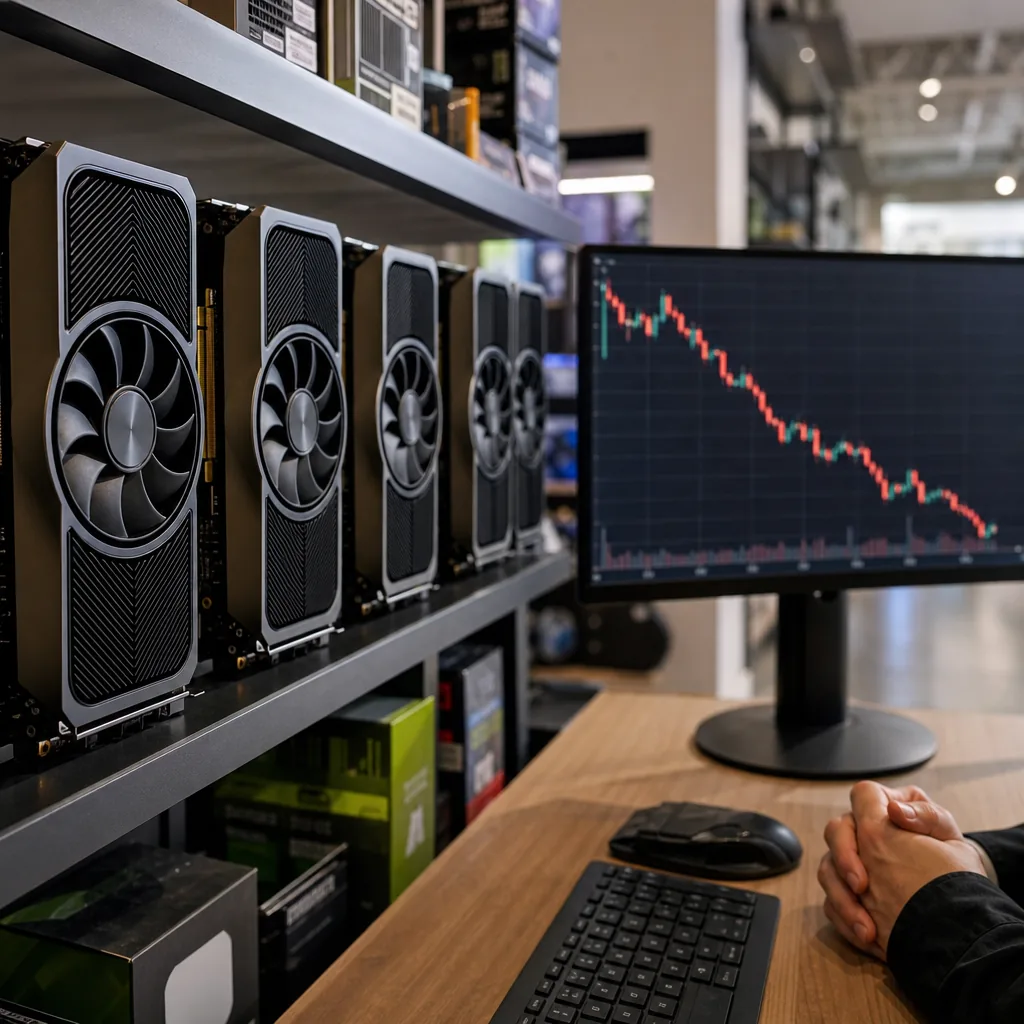
The index is also nearly 24% below its late-June record, putting it on course to confirm a bear market. Across the sector, more than $1 trillion in market value has been erased, while the VanEck Semiconductor Index had fallen 13% over ten trading sessions.
It is a sharp change of direction for a group that had delivered its best quarter on record only weeks ago. The Philadelphia index rose 88% in the second quarter of 2026, before beginning the third quarter with a rapid two-day reversal that included a fall of as much as 6% in one session.
Google delay adds to AI spending worries
The latest leg down followed a Bloomberg News report on Thursday that Google is months behind schedule with Gemini 3.5 Pro, its most powerful flagship AI model. Engineers are working to improve its coding abilities, Bloomberg reported, at a time when rivals OpenAI and Anthropic are said to have taken a clear lead in that commercially important area.
Alphabet shares fell 4.4% on 16 July, wiping roughly $200 billion from the company’s market value. The Nasdaq Composite dropped 1.47% on the day, with Google down 4.44% and SanDisk down 12.63%.
The report landed awkwardly against Alphabet’s own huge commitment to AI infrastructure. Chief financial officer Anat Ashkenazi had previously cited “unprecedented internal and external demand for AI compute resources” while raising the company’s 2026 spending guidance to between $180 billion and $190 billion.
For investors, the concern is not simply whether a model arrives later than expected. It is whether the vast sums being directed at chips, data centres and computing capacity will deliver returns quickly enough to justify the valuations already placed on the companies supplying that infrastructure.
China’s Kimi K3 unsettles investors
Sentiment was also hit by Moonshot AI’s unveiling of Kimi K3, a next-generation large language model backed by Chinese technology groups including Alibaba and Tencent. Moonshot says the model uses a new Mixture-of-Experts architecture, has roughly 2.8 trillion total parameters and a one-million-token context window.
Two versions were announced: K3 Max for chat and agent tasks, and K3 Swarm Max for large-scale parallel processing. Moonshot said its model outperforms all rivals except Anthropic’s Claude Fable 5 and OpenAI’s GPT-5.6 on overall capability. Those are company claims, and the model’s weights are not due to be released until 27 July, meaning developers cannot yet independently inspect, modify or run it themselves.
Reported API pricing is $3 per million input tokens and $15 per million output tokens, although Moonshot has not published official figures. The launch nevertheless intensified concern that Chinese AI companies are closing the gap with leading US labs, potentially changing assumptions about who will require the most advanced computing capacity.
“Despite persistent hardware/compute capacity constraints in China, K3 demonstrates that pre-training scaling, paired with architectural innovation, can still deliver step-change gains for flagship Chinese models,” Bank of America analysts said in a note led by Alex Liu.
Asian shares follow Wall Street lower
The retreat spread rapidly through Asian markets on Friday. Japan’s Nikkei 225 fell more than 4%, marking its worst weekly decline since April 2025, while SoftBank dropped more than 9% in Tokyo, according to CNBC.
Taiwan’s TSMC fell 7.29% on Friday, despite reporting a sharp profit increase that beat market expectations the previous day. SK Hynix had closed more than 11% lower on Thursday. In Hong Kong, Tencent fell 4.8%, Meituan lost 4.6%, Kuaishou dropped more than 7%, and Baidu and Alibaba eased 3.7% and 3.9% respectively.
Kioxia was among the hardest-hit individual names, falling more than 16% after a federal jury in Texas ordered the Japanese memory-chip maker to pay Viasat $229 million over a flash-memory patent. The jury found Kioxia had infringed US Patent No. 8,615,700, with the award covering past infringement through 30 March 2026.
Kioxia said it “strongly disagree[s] with Viasat’s claims and the verdict in this case that certain Kioxia products infringe the single patent claim that Viasat presented to the jury.”
Reset or a deeper warning?
The sell-off has revived arguments about dot-com-era valuations, a hawkish Federal Reserve and the sustainability of record AI capital expenditure. Earlier this month, a Bloomberg report that Meta Platforms was building a cloud business to sell excess AI computing capacity had already raised questions about whether big technology companies had overinvested.
Marvell Technology has been the steepest decliner from its June high, down nearly 40%, though it remains up 121% for 2026. Corporate insider activity has added to unease: US insiders sold a combined $77.6 billion of stock in the first half of the year, the second-largest divestment wave in nearly two decades.
Not all analysts see a lasting collapse. Toni Meadows, head of investment at BRI Wealth Management, said the pullback reflected “profit-taking and rising scrutiny of AI capex sustainability”. Charles Schwab strategist Kevin Gordon said the decline did not qualify as an extreme bearish signal, while other analysts have described it as a mid-cycle reset and retained substantial 12-month targets for major chipmakers.
The next test will be whether earnings and spending plans from the largest AI buyers can restore confidence that demand for advanced computing remains as strong as companies have argued. For now, the market is demanding more evidence.
Why it matters
For UK buyers, the sell-off does not by itself signal imminent changes to laptop, phone or PC component prices. But it is a warning that investors are questioning whether the enormous spending behind AI features will produce sufficient returns. That scrutiny could affect how quickly chipmakers and big technology firms fund the next wave of AI hardware and services.