
Do You Really Need a Faraday Pouch for Your Car Keys?
Keyless theft now dominates modern car crime. Here's how relay attacks actually work, whether signal-blocking pouches genuinely stop them, and exactly which one to buy.
We link to the exact model on Amazon UK. Prices change often, so check the live price before you buy. As an Amazon Associate we earn from qualifying purchases.
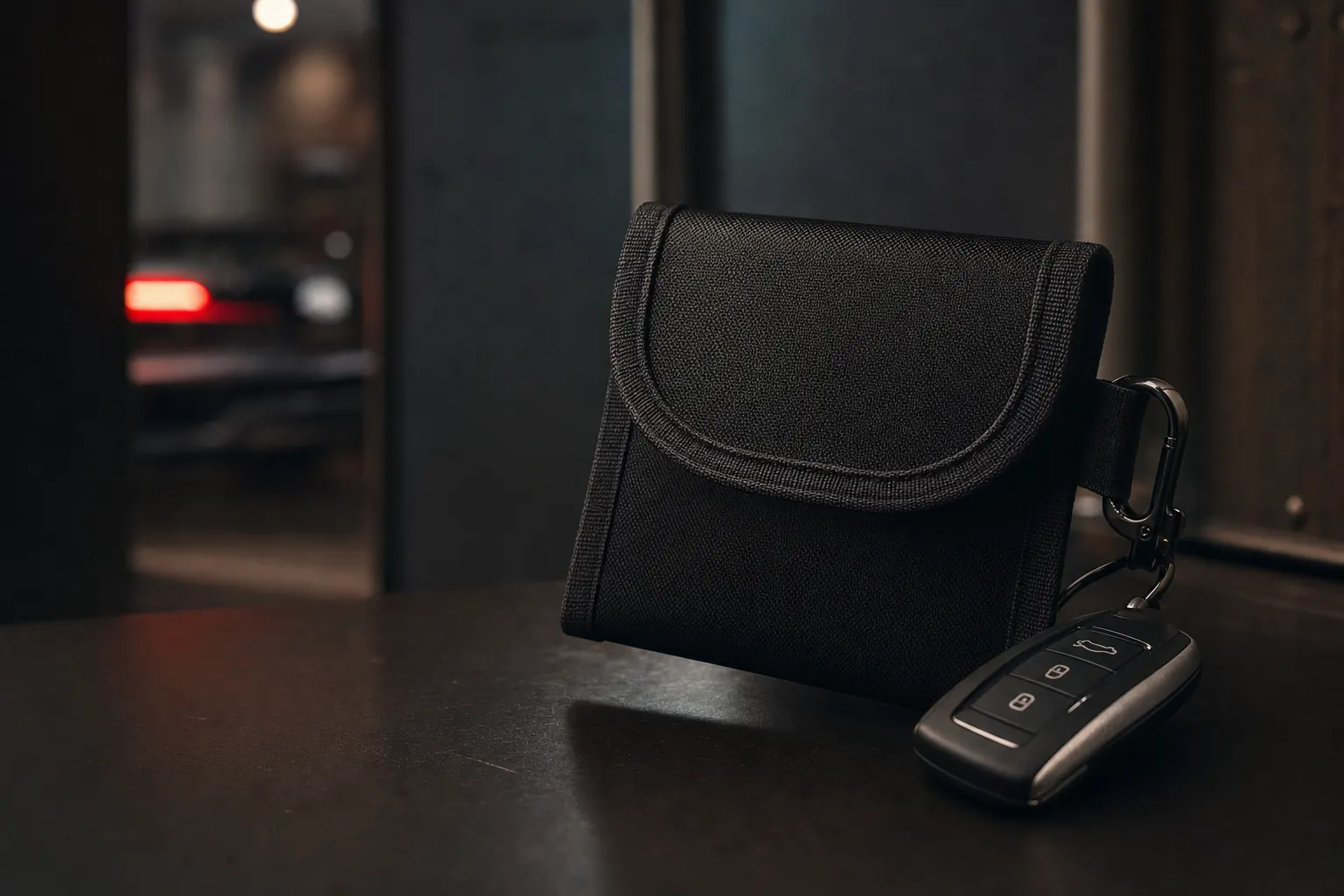
A modern key fob dropped into a shielded pouch — the single cheapest defence against relay theft.
The problem: how keyless theft actually works
Passive keyless entry is one of those features that feels like magic until you understand the mechanics. Your modern car and its fob are in a constant low-power conversation. The vehicle periodically pings out a short-range radio signal, and when your fob is close enough to hear it, it answers — proving you're standing there and telling the car it's safe to unlock and, in many cases, start.
The convenience is real. So is the flaw. That fob will answer any genuine ping from the car, and it has no idea how far away the car actually is. It just knows it heard a valid request. Criminals exploit precisely this trust gap with a technique called a relay attack.
Here's the choreography, and it's genuinely a two-person job:
- One thief stands close to your house or office — near a door, a window, or wherever your keys usually live — holding a small relay device that captures the faint signal leaking out of your fob.
- The second thief stands right beside your car with a paired relay unit that rebroadcasts that captured signal.
- The car believes the fob is next to it. The doors unlock. The engine starts. The car is driven away — silently, with no forced entry and no damage.
What makes this so grim is that your keys never leave the bowl in your hallway. The fob's signal is amplified straight through your front door. You wake up, the car's gone, and there's not a scratch on the driveway to show for it.
Relay and signal-amplification attacks are common enough that UK police forces and Thatcham Research both advise keeping keyless fobs in a signal-blocking pouch. We have seen the “over 80%” figure quoted widely, but we could not tie it to a current, named UK dataset, so we are not repeating it as fact. This isn't a fringe risk — for keyless cars it has become the default method of theft.
Just how big a threat is this in 2026?
Bluntly: bigger than it has ever been. Keyless car theft via relay attack has become the dominant method of car theft across most major US metros, and it's one of the fastest-growing security threats we're tracking this year. The uncomfortable truth is that the barrier to entry for criminals has collapsed. The hardware needed to run a relay attack is available online for under thirty dollars, and the whole theft takes less than ninety seconds from approach to drive-off.
Think about that economic equation from a thief's point of view. A sub-£25 kit, ninety seconds of work, and the potential prize is a car worth tens of thousands. There's almost no risk of a noisy break-in and no specialist skill required. That's exactly why relay theft scaled so fast — it's cheap, quiet and quick.
The insurance industry has noticed too. Carriers in some US states now explicitly ask at renewal whether you store your fob in a shielded pouch overnight, because the difference in claim rates between households that do and those that don't is large enough to show up in actuarial tables. When insurers start pricing behaviour like that, you know the effect is measurable and real — not marketing hype.
Relay theft is a two-person operation: one captures the fob signal at the house, the other relays it to the car.
What is a Faraday pouch, and does it actually work?
A Faraday pouch is, at heart, a beautifully simple bit of physics wrapped in fabric. Named after the Faraday cage principle, it lines a small pouch with conductive, signal-blocking material. When you drop your fob inside and seal it, the pouch forms a shielded enclosure that stops radio-frequency signals getting in or out. No signal escaping means no signal for a relay device to capture — and no capture means no relay attack. The conversation between fob and car simply cannot happen while the key is sealed inside.
So do they work? The honest answer, which I'm always slightly relieved to be able to give, is a clear yes. Faraday pouches for car keys do block the radio frequencies thieves exploit in relay attacks — provided they're properly designed and, crucially, used correctly. In hands-on testing, every single Faraday pouch tested successfully blocked the signal emitted from a key. The blocking is immediate and total: with the key sealed inside, the car wouldn't unlock even when the tester was standing right next to the vehicle.
The two-word catch: "used correctly"
A Faraday pouch only works when it's fully sealed. Every layer of shielding matters, and a pouch that's left half-open — or one where the Velcro isn't pressed properly closed — leaves a gap for the signal to leak through. Getting into the habit of sealing it completely, every single time, is the difference between protection and a false sense of security.
How the testing was done
The way to trust a pouch is to test it the way a thief would attack it. Testers put the key fob into each pouch or box, carried it right up to the vehicle, and watched whether the car's electronics detected the fob at all. Then a second test was run from inside the vehicle to see whether the engine would start with the sealed key present. On top of the raw signal-blocking, testers weighed up build quality, how effective and reliable the seal was, the cost, and whether the product carried any official security ratings.
That layered approach matters because a pouch that blocks the signal on day one but falls apart after a fortnight isn't actually protecting you. Which brings us neatly to durability.
Do they wear out? Understanding degradation
Yes, they wear out — and this is the part most buyers overlook. A Faraday pouch works because of an intact conductive lining and a clean seal. Both of those degrade with handling. Every time you shove keys in, drag them out and slap the flap shut, you're flexing that shielding fabric a fraction. Do it twice a day for a year and the wear adds up.
To simulate real-world life, researchers replicated roughly 18 months of being handled twice a day by tumbling the pouches 1,200 times with keys inside, then repeated the whole open-and-start test — placing the worn pouches right next to the car's sensors to see if anything now leaked through. It's a genuinely brutal test, and it's the sort of thing that separates a pouch you can trust for the long haul from one that's fine for a photo shoot.
How long should a pouch last?
Well-made pouches last one to two years with regular use. Cheaper models may degrade within six to twelve months as the fabric wears or the seal weakens. The practical takeaway: whatever you buy, treat it as a consumable. Diarise a replacement, and test it periodically (more on that below).
How to choose the right Faraday pouch
Not all pouches are created equal, and the differences that matter aren't always the ones the marketing pushes. Here's what I actually look at, in order of importance.
Genuine signal blocking
Non-negotiable and the whole point. The good news is that in testing this is the bar nearly every pouch clears — the real differentiators are the factors below.
Seal strength and design
The seal is the weakest link. A strong, chunky Velcro closure that's easy to press fully shut beats a flimsy flap every time. Look for a design that makes a complete seal the natural, effortless action rather than something you have to fuss over.
Build quality and materials
Tough outer fabric and multiple layers of shielding cloth survive daily abuse. This is what buys you those two years rather than six months. Waterproof or water-resistant construction is a bonus if the pouch lives in a coat pocket or by a draughty door.
Size for your fob
Modern fobs vary wildly in size. A compact pouch pockets beautifully but may not swallow a chunky fob; a larger pouch handles big fobs and even a phone but won't slip into skinny jeans. Match it to your key, not to the picture.
Official security recognition
Some pouches carry accreditation from recognised security bodies. It's not essential, but where two pouches are otherwise close, an official rating is a genuine tiebreaker that tells you the product has been independently scrutinised.
Two-packs and colour coding
Most households have more than one fob, so twin packs are the norm and the sensible buy. Different-coloured stitching or finishes let you tell your keys from your partner's at a glance — a small touch that saves daily faff.
The Faraday pouches worth buying
Here are the models that stood out across testing, grouped by tier so you can match one to your budget and your fob. Every one of these blocks the signal — the differences are in build, seal quality, size and accreditation.
From no-frills twin packs to police-accredited British-made pouches, the choice is wider than you'd think.
Disklabs KS1 Faraday Pouch
If you want the reassurance of a properly serious pouch, this is the one I keep coming back to. Disklabs is a British company that specialises in Faraday bags, its products are made in the UK, and — this is the clincher — the KS1 carries the enviable distinction of being approved by Secured by Design, the official police recognition initiative for security products.
Beyond the badge, the hardware backs it up. The chunky canvas pouch is compact but shaped almost perfectly for key fobs, so there's no wasted bulk. Its Velcro fastener feels noticeably stronger than any rival, which matters enormously given that the seal is the part most likely to fail over time. An extra tab makes it easy to open up and pull your keys out, so you're not fighting the thing every morning. When you factor in the accreditation and the seal strength, it's the pouch I'd trust for the long haul.
Go Dark Faraday Pouch Set
Released in January 2026, this 2-pack is the newcomer here, and it's aimed at people who want to shield a phone as well as their car keys. During testing the Go Dark pouches blocked all signals — RFID, WiFi, Bluetooth, GPS and EMF — with the double-layer construction providing reliable shielding. Complete blocking was confirmed when the Velcro was fully sealed, which reinforces that golden rule about closing the pouch properly.
The usable interior measures 4.9 x 8.4 inches, comfortably accommodating most phones without a bulky case, so it doubles as a privacy pouch when you want to go genuinely off-grid. It's earned an exceptional 4.9-star rating from early adopters, though the low total review count reflects just how new it is — worth bearing in mind if you like a long track record behind your purchases.
Stoplock RFID Key Pouch
If your fob is on the chunky side, or you want a single pouch that can also swallow a phone, the Stoplock is the pragmatic choice. It's a budget-friendly way to keep thieves at bay if they ever attempt a relay attack on your keyless car. Measuring 192mm x 100mm x 9mm, it looks more like a slim purse than a pouch — and that larger footprint is exactly the point, giving it room for bigger key fobs and smartphones that would never fit the compact designs.
Lanpard Faraday Pouch (2-Pack)
For a wallet-friendly, proven option, the Lanpard 2-pack is hard to fault. It's made of carbon fibre material with double military-grade RF shielding cloth, and it's waterproof — so it'll shrug off a coat pocket or a rainy dash to the car. It blocks WiFi (2.4 and 5 GHz), Bluetooth, GPS, RFID and car-key signals, ticking every box you'd want.
At 3.15 x 4.5 inches (8 x 11.5cm) it's smaller than most rivals, which is a genuine plus if you want it to disappear into most trouser pockets, though do double-check your fob fits before you commit. The confidence-booster here is the sheer weight of user feedback: a 4.5-star rating from 12,336 reviews is about as battle-tested as this category gets.
Hilka Pro-Craft Faraday Car Key Signal Blocker
Sometimes you just want two pouches that work, without any fuss. That's the Hilka Pro-Craft in a nutshell. With two pouches in the pack it's decent value, and while it has no frills whatsoever, it does the one job that matters well. If you're kitting out a two-fob household on a budget and don't care about extras, it's a sensible, honest choice.
Streetwize Faraday Pouch (Twin Pack)
The Streetwize comes as a twin pack in a single size, but that size is generous enough to hold car keys or even a mobile phone. It's a single-compartment, no-frills item — no hooks, no keyrings, just an easy-to-load, easy-to-close large pouch. If simplicity is what you're after, and you'd rather not fiddle with tabs and rings, its plain design is a virtue rather than a shortcoming.
Temu Faraday Pouches
The bargain-bin option that punches above its price. The Temu pouches wear a smart carbon-look finish with chunky chrome clips and rings, so they don't look cheap even though they are. The genuinely useful touch is the different-coloured stitching on each one, which means you can tell your keys apart from your partner's at a glance — a small convenience that pricier pouches often skip entirely.
Jooross Faraday Pouch
If you simply want protection landing on your doorstep tomorrow, the Jooross is the cheapest Faraday pouch available on Amazon with next-day Prime delivery. It's the definition of a low-commitment starter pouch — grab one, get protected, and upgrade later if you want something more premium.
Head-to-head comparison
Here's how the standout pouches stack up on the factors that actually influence a buying decision.
| Feature | Disklabs KS1 | Go Dark Set | Stoplock RFID | Lanpard 2-Pack |
|---|---|---|---|---|
| Signal blocked in test | Yes | Yes | Yes | Yes |
| Police / official recognition | Secured by Design | — | — | — |
| Made in UK | Yes | — | — | — |
| Seal type | Extra-strong Velcro + tab | Double-layer Velcro | Purse-style | Flap |
| Fits a phone too | — | Yes (4.9 x 8.4in) | Yes | — |
| Best suited to | Long-term, serious buyers | Phone + keys shielding | Large fobs | Pocket carry, budget |
| User confidence | Accreditation-led | 4.9★ (early, low count) | Budget staple | 4.5★, 12,336 reviews |
How to use a Faraday pouch properly
Buying the pouch is the easy bit. Actually getting protected depends on a handful of habits that take seconds but make all the difference. Follow these steps and you'll get every ounce of protection the pouch can offer.
- Put both fobs away, every time. Spare keys are a favourite blind spot. A drawer full of shielded main keys means nothing if the spare fob is sitting on the sideboard broadcasting merrily. Pouch every fob that can start the car.
- Seal it completely. Press the Velcro fully closed along its entire length. A half-open pouch is barely better than no pouch at all — the shielding only works as a complete enclosure.
- Store keys away from doors and windows. Even with a pouch as your primary defence, keeping keys away from the front of the house adds a sensible second layer, reducing the signal available for a relay device to grab if the seal ever fails.
- Test it on day one. Seal your key inside, walk up to the car and try the handle. If the door won't unlock and the car doesn't respond, the pouch is doing its job. If it does unlock, the pouch is faulty or not sealed — sort it before you rely on it.
- Re-test every few months. Because shielding degrades with handling, repeat that door test periodically. It takes thirty seconds and it's the only way to catch a pouch that's silently worn out.
- Replace on schedule. Treat the pouch as a consumable. Budget models may need replacing within six to twelve months; better ones stretch to one or two years. When in doubt, the door test is your referee.
Pro tip: the tin test in a pinch
Waiting for a pouch to arrive? A metal biscuit tin or a metal box can offer partial, imperfect shielding as a stopgap — it's not a substitute for a properly designed pouch, but keeping keys sealed inside metal and away from windows is better than leaving a fob broadcasting freely by the door overnight.
The honest pros and cons
No product is a silver bullet, and I'd rather you buy with eyes open. Here's the balanced view.
Pros
- Genuinely blocks relay attacks — every pouch tested stopped the signal completely
- Cheap relative to the value of the car it protects
- No installation, no wiring, no subscription — it just works out of the pack
- Blocks other signals too (RFID, Bluetooth, GPS, WiFi) on multi-layer models
- Twin packs cover the whole household including spare fobs
- Can lower your relay-theft risk enough to matter to insurers
Cons
- Only works if you seal it every single time — human error is the real weakness
- Shielding degrades; budget models may fade within six to twelve months
- You must remember to pouch the spare key too
- Compact pouches may not fit chunky fobs — check dimensions first
- Doesn't protect against other theft methods (OBD attacks, towing, physical theft)
How the tiers score
Here's a rough visual of how the categories rate against each other across the factors that matter — signal blocking, seal durability, everyday convenience and long-term value.
The door test: seal the key, walk to the car, try the handle. If nothing happens, you're protected.
Who should buy one?
Keyless car owners
If your car unlocks and starts without you touching a button on the fob, this is aimed squarely at you. You're the exact target of relay theft, and a pouch is the cheapest meaningful defence you can buy.
Anyone who parks on a driveway or street
A car visible from the road, with keys stored near the front door, is the textbook relay scenario. A pouch plus sensible key placement neutralises it.
The insurance-conscious
With some carriers now asking about shielded storage at renewal, a pouch is a low-cost way to answer that question honestly — and potentially keep your premium sensible.
Privacy-minded phone users
If you also want to shield a handset from tracking signals occasionally, a phone-sized model like the Go Dark set does double duty.
Who doesn't need one? If your car uses a traditional key you physically turn or press to unlock, you're not vulnerable to relay attacks in the same way — the pouch offers little benefit. This is a keyless-entry problem first and foremost.
Frequently asked questions
It stops relay attacks specifically, which are the dominant method for keyless cars. It won't defend against every technique — physical theft, towing or diagnostic-port attacks are separate problems — but since relay theft accounts for the majority of modern car crime, it closes the biggest single door.
Yes — in testing, every pouch across every price point blocked the signal on day one. The difference with cheaper models is longevity: they may degrade within six to twelve months, whereas better-made pouches last one to two years. Blocking isn't the issue; staying reliable over time is.
Run the door test. Seal your key inside, walk up to the car and try to open it. If it stays locked and won't start with the key sealed, the pouch is working. If it unlocks, the pouch has either failed or wasn't sealed properly. Repeat this test every few months.
Absolutely. A spare fob can start the car just as easily, so an unshielded spare left on a sideboard undermines your whole setup. This is exactly why twin packs are the sensible buy — one pouch per fob.
Larger models can. The Go Dark set, for instance, has a 4.9 x 8.4 inch usable interior that fits most phones without a bulky case and blocks WiFi, Bluetooth, GPS and RFID. The Stoplock and Streetwize pouches are also big enough to hold a phone alongside — or instead of — keys.
It's not essential, but it's a strong tiebreaker. The Disklabs KS1's Secured by Design approval — a police recognition initiative — means it has been independently scrutinised against a recognised standard, which is reassuring when you're trusting it to protect a car.
Category rating for Faraday pouches as a car-key security measure.
A pouch by the door, keys sealed inside — a sub-£10 habit that shuts down a ninety-second theft.
The verdict: yes, you probably do need one
Let's answer the question in the headline plainly. If you own a keyless-entry car, then yes — a Faraday pouch is one of the smartest, cheapest security decisions you can make. Relay theft is now the dominant method of car crime for modern vehicles, the kit costs thieves under thirty dollars, and the whole job is over in ninety seconds. Against all of that, a pouch that blocks the signal completely is an almost absurdly good bit of value.
The caveats are real but manageable: it only works if you seal it every time, you must pouch your spare fob too, and the shielding wears out — so buy a decent one, run the door test occasionally, and replace it when it's had its day. Every pouch tested blocked the signal, so the choice really comes down to how much reassurance and longevity you want.
My steer? For long-term peace of mind, the Disklabs KS1 earns its keep with police-recognised Secured by Design approval, UK manufacture and the strongest seal in the group. If you want to shield a phone as well, the Go Dark Faraday Pouch Set is the versatile pick. And if you just want proven protection on a budget, the Lanpard 2-Pack — with a 4.5-star rating across more than 12,000 reviews — is the safe, sensible buy. Whichever you choose, pouch your keys tonight. It's the rare security upgrade that pays for itself the very first night nothing gets stolen.
 Stoplock RFID Key PouchView on Amazon
 Lanpard Faraday PouchView on Amazon
 Streetwize Faraday PouchView on Amazon