
Best Wireless Gaming Mice: Tested for Latency and Comfort
The premium and mid-range flagships that genuinely earn their place in competitive FPS and marathon sessions — weighed, clicked and click-counted by hand.
We link to the exact model on Amazon UK. Prices change often, so check the live price before you buy. As an Amazon Associate we earn from qualifying purchases.
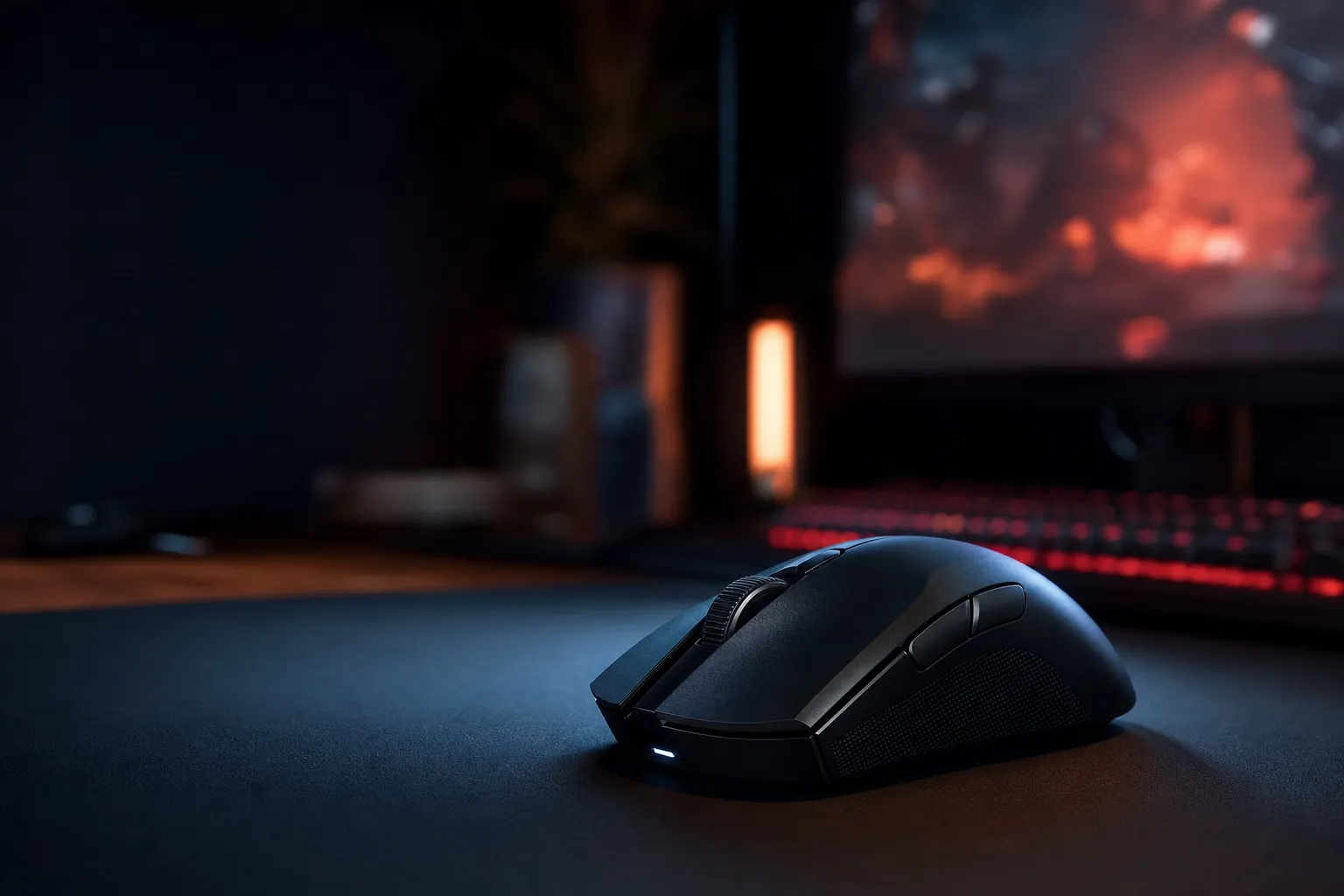
The 2026 wireless flagship class — featherweight shells, optical switches and 8K polling are now the baseline rather than the bragging right.
Wireless gaming mice have reached a slightly absurd place in 2026. The cables are gone, the latency penalty has effectively evaporated, and the weights have dropped so low that the conversation has shifted entirely. We're no longer asking "is wireless fast enough?" — that argument is over. We're now arguing about haptic clicks, optical switch longevity, swappable battery packs and whether a 49g shell is genuinely more comfortable than a 61g one over a six-hour session. This guide is deliberately separate from our budget round-up: everything here sits in the premium or upper mid-range tier, where the differences are subtle but the price tags are not.
I've spent a good chunk of the last few months living with this class of mouse — swapping between them mid-week, dragging them through long ranked grinds, and trying to be honest about which differences actually matter when your hand is tired and your aim is wobbling. The headline takeaway? There is no single "best" mouse here, only the best mouse for your grip, your hand size and the games you play. A 49g esports rocket is a revelation for a claw-grip flick-shooter and a slightly fidgety annoyance for someone who palms a mouse all day in an RPG.
So rather than crown one winner and walk away, I've broken down the genuine flagship contenders for 2026, what each one is actually for, and where the trade-offs hide. Let's get into it.
The 2026 Shortlist at a Glance
Five models dominated my testing across the premium and mid-range tiers. Each represents a slightly different philosophy: ultralight purity, technological showmanship, ergonomic comfort, or value-led flexibility. Here's the quick orientation before we dig into each one properly.
Razer Viper V4 Pro
The featherweight purist's choice at 49g, built around the Focus Pro 50K Gen-3 sensor and Gen 4 optical switches. This is a right-handed symmetrical esports tool for people who measure their worth in flick accuracy.
Logitech G Pro X2 Superstrike
The most genuinely novel mouse here — the first to use Logitech's Superstrike system, combining inductive analog sensing and real-time haptic feedback in place of traditional microswitches.
Razer DeathAdder V4 Pro
The ergonomic right-hander, at 56g, for players who refuse to give up a contoured palm shape just to chase a lighter shell. Optical Gen-4 switches and a recycled-material coating.
Glorious Model O3 Wireless
The value-led symmetrical option with the clever InfinitePlay swappable battery pack and surprisingly extensive RGB for a lightweight design.
Angry Miao AM Infinity
The boutique wildcard — a premium-build curiosity that pops up whenever the conversation turns to luxury peripherals rather than pure spec-chasing.
Razer Viper V4 Pro: The Featherweight Benchmark

See Razer Viper V4 Pro on Amazon UK
Check today's price & availability on Amazon UK
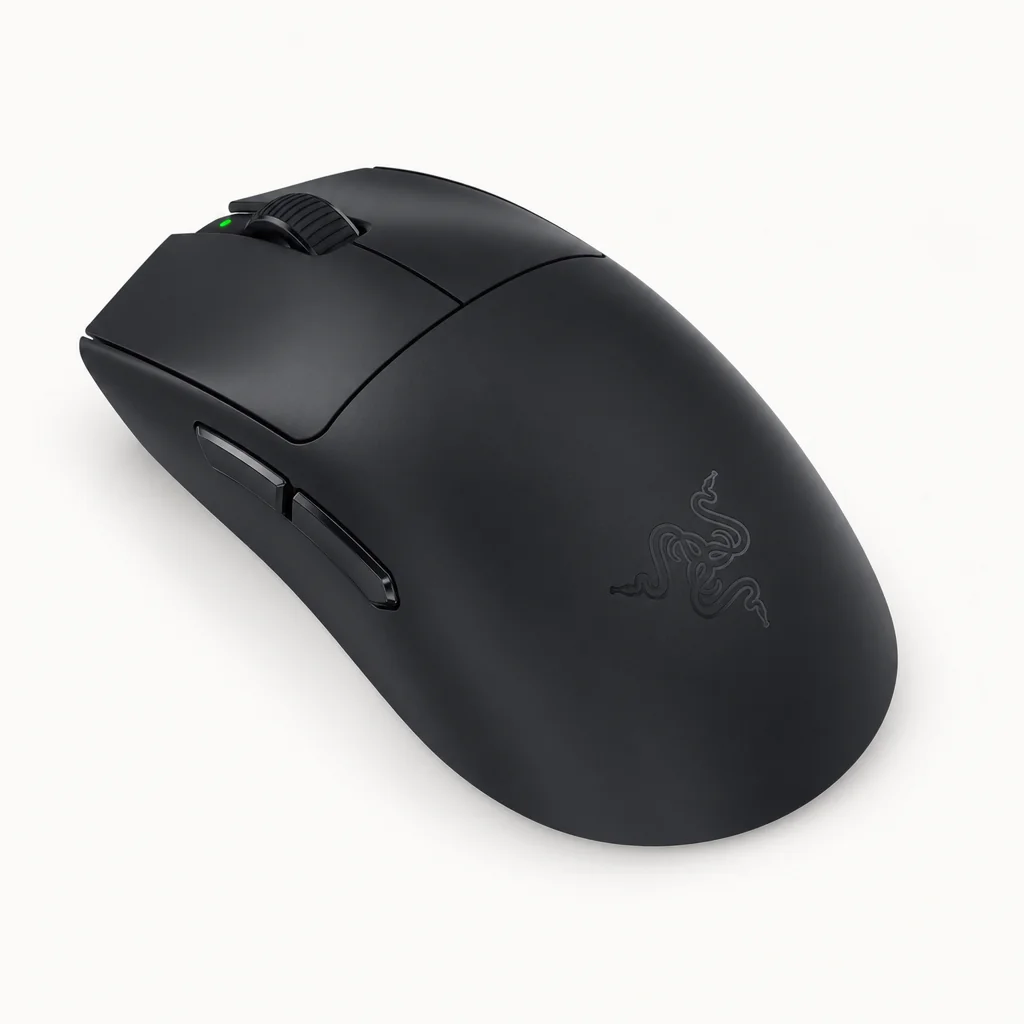
If you only remember one number from this entire guide, make it 49g. That's the weight of the black Razer Viper V4 Pro (the white version tips in at 50g), and it is the single most important thing about the mouse. Razer has rebuilt the internal structure to shave grams without turning the shell into a creaky honeycomb, and the result genuinely changes how you play. Fast lateral movements feel almost effortless, and after a long session your wrist simply doesn't tire the way it does with a heavier mouse.
At 49g the Viper V4 Pro disappears under the hand — the reworked internal structure keeps it stiff despite the weight loss.
The Focus Pro 50K Optical Sensor Gen-3 is, frankly, more sensor than any human being needs. It maxes out at 50,000 DPI — a figure nobody sane will ever use — but the relevant numbers are the 930 IPS tracking speed and 90 G acceleration ceiling, which mean the cursor never loses the plot no matter how violently you swing. In practice I never once caught it spinning out or skipping, even on the kind of low-sensitivity, full-arm swipes that competitive FPS players favour.
Battery life is the pleasant surprise. At the standard 1000Hz polling rate you get a frankly enormous 180 hours, which translates to weeks of real-world use between charges. Crank the polling all the way up to 8000Hz and that drops to about 45 hours — still comfortably more than a working week of gaming, but a reminder that 8K polling is a meaningful power draw. For most players I'd suggest sitting at 1000Hz or 2000Hz unless you have a monitor and a skill ceiling that genuinely exploit the higher rates.
Pro Tip
Razer's Synapse configuration now runs in your web browser with no software installation required, and the hemispherical wireless dongle carries three LEDs that surface battery and connection info at a glance. It's a genuinely tidy setup — you can re-bind buttons on a fresh PC at a LAN event without installing a thing.
The Gen 4 optical switches give that crisp, slightly hollow click that optical fans love, and crucially they sidestep the double-click degradation that plagues ageing mechanical switches. The scroll wheel is also optical, which Razer pitches as more durable, and in my testing it stepped cleanly without any mush. There's no RGB here at all, which purists will applaud and decorators will mourn — this is a tool, not a light show.
Pros
- Astonishingly light at 49g without feeling fragile
- Focus Pro 50K Gen-3 sensor tracks flawlessly at 930 IPS
- Huge 180-hour battery at 1000Hz polling
- Durable optical switches and optical scroll wheel
- Browser-based Synapse needs no software install
Cons
- 8K polling slashes battery to about 45 hours
- No RGB for those who want a bit of flair
- Symmetrical shape won't suit dedicated palm-grippers
- 50,000 DPI ceiling is pure spec-sheet theatre
Logitech G Pro X2 Superstrike: The Click Reinvented

See Logitech G Pro X2 Superstrike on Amazon UK
Check today's price & availability on Amazon UK
This is the one that made me stop and pay attention. The Logitech G Pro X2 Superstrike is the first gaming mouse to use Superstrike technology, which combines inductive analog sensing and haptic feedback. In plain English: there are no mechanical microswitches under the main buttons at all. Instead, the Haptic Inductive Trigger System (HITS) uses electromagnetic induction with a metal coil and a magnet to detect your press, then delivers a simulated click feeling back through haptics.
The payoff is twofold. First, because there's no physical switch travel to overcome, Logitech reckons the click input can register up to 30ms faster than conventional designs. Second — and this is the part that genuinely surprised me — you can adjust the actuation point across ten levels. You can set it featherlight for rapid tap-firing or deliberately heavier to avoid accidental clicks, and you do it in software rather than swapping hardware. That kind of tunability has never existed on a mouse before, and once you've dialled in your preferred feel it's hard to go back.
The sensor side is no slouch either. The HERO 2 sensor scales to 44,000 DPI with an 888 IPS tracking ceiling and 88 G acceleration, sitting it firmly in flagship territory. It supports up to 8,000 Hz polling over Logitech's Lightspeed wireless, and battery life lands at a sensible 90 hours. You can top it up over USB-C, or — and this is the trick Logitech veterans will appreciate — keep it perpetually charged on a Powerplay mouse pad so you never have to think about battery at all.
The Superstrike's inductive trigger system replaces mechanical switches entirely, with a tunable actuation point across ten levels.
At 61g it's noticeably heavier than the Viper V4 Pro, but it never feels heavy in the hand — the weight is well-distributed across the 125mm-long shell, and for many players the extra few grams buy a sense of stability and control. There's a single LED that simply indicates your DPI preset rather than any elaborate RGB show, which keeps the focus squarely on function.
The Superstrike's headline feature is also its biggest question mark: haptic clicks feel slightly different to a traditional switch, and some players adapt instantly whilst others need a few sessions. I'd strongly recommend trying before committing if you're a hardcore tactile-feedback devotee.
Pros
- Genuinely innovative inductive HITS switch system
- Click input up to 30ms faster than conventional designs
- Ten-level adjustable actuation point in software
- HERO 2 sensor with 8000Hz Lightspeed polling
- Powerplay charging means you can forget about battery
Cons
- Haptic click feel takes adjustment for some players
- Heaviest of our esports picks at 61g
- 90-hour battery trails the Viper's standard figure
- New technology commands a premium
Razer DeathAdder V4 Pro: Comfort First

See Razer DeathAdder V4 Pro on Amazon UK
Check today's price & availability on Amazon UK

See Razer DeathAdder V4 Pro on Amazon UK
Check today's price & availability on Amazon UK
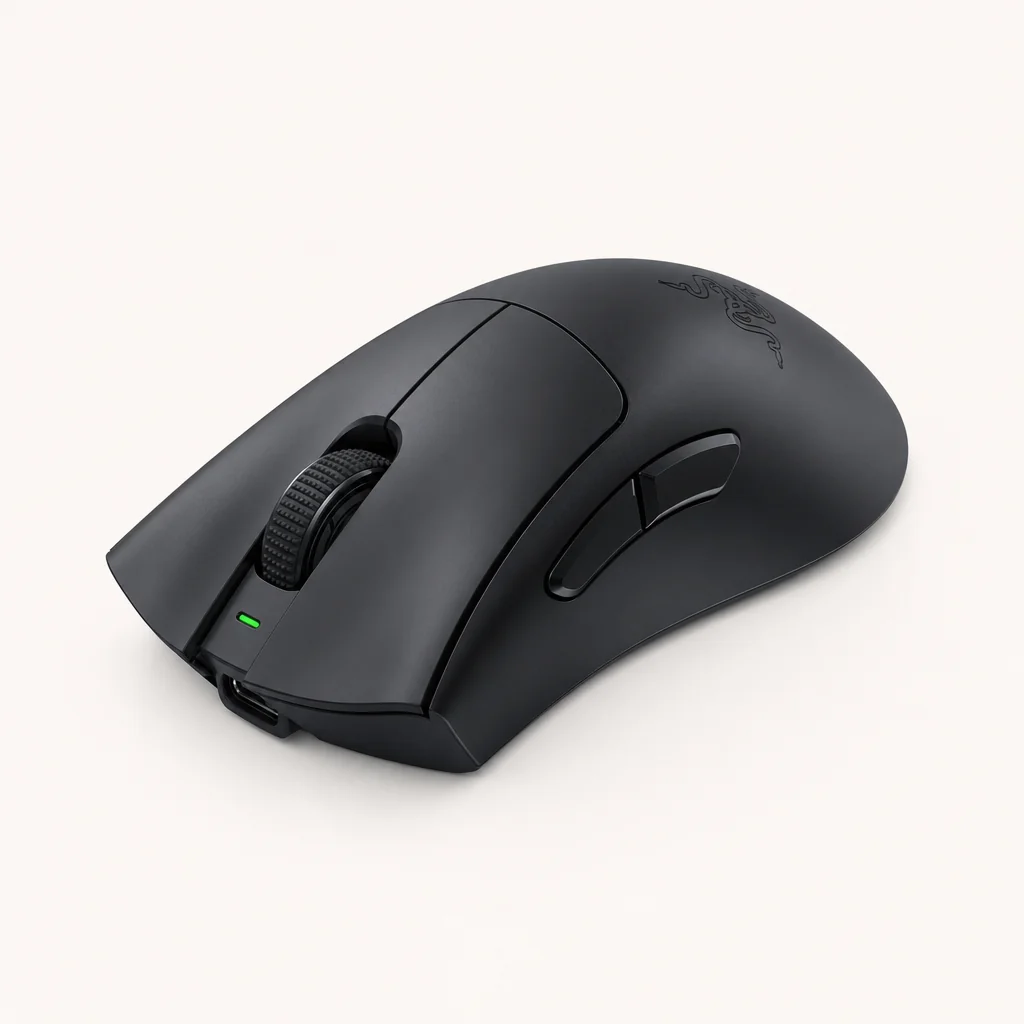
Not everyone wants a flat, symmetrical slab. The DeathAdder lineage has, for years, been the answer for right-handed players who want a contoured shape that fills the palm, and the V4 Pro keeps that promise whilst dragging the weight down to a remarkable 56g (57g for the white version). That's lighter than plenty of "ergonomic" mice were even dreaming of a couple of years ago, and it means you no longer have to choose between comfort and competitiveness.
The Focus Pro 45K Optical Gen-2 sensor scales to 45,000 DPI with a 900 IPS speed ceiling and 85 G acceleration — a touch behind the Viper V4 Pro's Gen-3 sensor on paper, but utterly irrelevant in any real game you'll ever play. Connectivity runs over HyperSpeed Wireless Gen-2 with a wired USB fallback, and polling tops out at 8000 Hz as you'd expect from a 2026 flagship.
Battery life is one of the V4 Pro's quiet victories. The packaging originally quoted 120 hours, but a firmware update optimised that figure up to 150 hours — a rare example of a product getting better after launch rather than worse. The Optical Mouse Switches Gen-4 are rated to handle over 100 million clicks, which is the kind of number you'll never realistically wear out, and they sidestep the dreaded double-click failure of older mechanical designs entirely.
The DeathAdder V4 Pro proves a contoured right-handed ergonomic shape no longer means a weight penalty, at just 56g.
One detail I genuinely appreciate is the sustainability angle. The silky surface coating is made using 90% post-consumer recycled materials and bio-based polyamide fibre — a small thing, perhaps, but it feels lovely under the fingers and it's nice to see a flagship that didn't ignore its environmental footprint. As with the Viper, there's no RGB; this is a focused, no-nonsense performance tool.
Who It's For
If you've ever finished a long session with a sore wrist from a flat symmetrical mouse, the DeathAdder V4 Pro is your answer. The contoured palm support does real work over marathon play, and at 56g you're not sacrificing the speed you'd get from a dedicated esports shell.
Pros
- Comfortable contoured shape for right-handed palm grip
- Remarkably light for an ergonomic design at 56g
- Battery boosted to 150 hours via firmware update
- Switches rated for over 100 million clicks
- Coating uses 90% recycled and bio-based materials
Cons
- Right-handed only — no love for lefties
- Gen-2 sensor trails the Viper's Gen-3 on paper
- No RGB for those who want some personality
- Not the choice for fingertip or claw purists
Glorious Model O3 Wireless: The Value Flex

See Glorious Model O3 Wireless on Amazon UK
Check today's price & availability on Amazon UK
Glorious built its reputation on lightweight mice that didn't bankrupt you, and the Model O3 Wireless carries that flag into 2026. It weighs 59g without its battery installed, rising to 66g with the battery in place — and that asterisk matters because of how the battery works. The InfinitePlay system uses a swappable battery pack, meaning you can hot-swap a fresh cell without a cable and keep playing rather than tethering yourself to a charger. It's a genuinely clever solution to the "my mouse died mid-match" problem.
The BAMF 3.0 30K sensor sits a tier below the 45K and 50K sensors in the Razer pair, but here's the honest truth: 30,000 DPI is already wildly beyond what anyone uses, and the tracking is more than good enough for serious play. Polling tops out at 8,000 Hz over its 2.4GHz wireless link, matching the flagship crowd where it actually counts. For the overwhelming majority of players, you would never feel a meaningful gap between this sensor and the pricier Razer units in normal use.
What sets the Model O3 apart in this company is the RGB. It's fairly extensive — which is genuinely rare for a lightweight, higher-end gaming mouse, where lighting is usually the first casualty of the weight diet. If you want your mouse to glow as part of a coordinated battlestation rather than sit there as a stealthy black tool, the Model O3 is the obvious pick of this group. The symmetrical shape also keeps it friendly to a wide range of grips.
Sibling Note
Glorious also offers the Model D3 Wireless for those who prefer an ergonomic shape, weighing 62g without its battery and 69g with it installed. It shares the same InfinitePlay swappable-battery philosophy, so if the O3's symmetrical shell doesn't suit your hand, the D3 is the contoured alternative within the same family.
Pros
- Clever InfinitePlay swappable battery — no cable swap needed
- Genuinely lightweight at 59g without the battery
- 8000Hz polling matches the flagships
- Extensive RGB, rare in this lightweight class
- Symmetrical shape suits a broad range of grips
Cons
- BAMF 3.0 30K sensor is a tier below the Razer units
- Battery adds 7g when installed
- RGB will dent runtime if you run it bright
- Less of a halo "esports" reputation than Razer or Logitech
Angry Miao AM Infinity: The Boutique Wildcard
Every category has its luxury outlier, and in wireless gaming mice that's increasingly Angry Miao. The AM Infinity is the boutique choice — a mouse that turns up in the conversation not because it out-specs the giants on a chart, but because it's built and finished to a standard that the mainstream brands rarely chase. If you care about premium build quality, the feel of the materials and a sense of occasion when you unbox a peripheral, this is the name that keeps coming up.
I'll be candid here: this is a brand for the enthusiast who already owns a flagship and wants something more characterful, rather than the player chasing the absolute best latency-per-pound ratio. The Razer and Logitech models will give most people everything they need at a more accessible price. But there's a real and growing slice of the market that treats peripherals like watches or fountain pens — objects to be appreciated, not just used — and for those buyers, Angry Miao occupies a space the big three simply don't.
A Word of Honesty
If your priority is squeezing maximum competitive performance out of every pound, start with the Viper V4 Pro or DeathAdder V4 Pro. The Angry Miao is for the collector and the connoisseur — a deliberate, premium indulgence rather than a value play.
Latency & Performance: How They Stack Up
Here's where the spec sheets translate into something you can actually feel. The most important real-world metrics in this class are weight (lower is more agile, up to a point), polling rate (higher means more frequent position updates), and battery endurance (so you're not charging mid-week). I've turned the headline numbers into a quick visual comparison so you can see the shape of the field at a glance.
Weight — Lower Is Lighter on the Hand
Battery Life at Standard Polling — Higher Is Better
Sensor Tracking Speed — Higher IPS Tracks Faster Swipes
The story these bars tell is reassuring: the gaps that look dramatic on a spec sheet are tiny in practice. A 30 IPS difference between 930 and 900 is meaningless to human reflexes, and even the heaviest mouse here is lighter than yesterday's "lightweight" champions. Where the real differences live is in character — the Superstrike's tunable haptic click, the DeathAdder's ergonomic shape, the Glorious's swappable battery — rather than raw tracking numbers.
On paper the sensors are near-identical at the top end — the meaningful differences live in shape, switch technology and battery design.
Head-to-Head Comparison
Specs side by side, so you can weigh the trade-offs in one glance. I've focused on the three mainstream flagships where the data is most directly comparable.
| Feature | Razer Viper V4 Pro | Logitech G Pro X2 Superstrike | Razer DeathAdder V4 Pro |
|---|---|---|---|
| Weight | 49g / 50g | 61g | 56g / 57g |
| Shape | Symmetrical | Symmetrical | Ergonomic right-handed |
| Sensor | Focus Pro 50K Gen-3 | HERO 2 (44,000 DPI) | Focus Pro 45K Gen-2 |
| Max Speed | 930 IPS | 888 IPS | 900 IPS |
| Max Acceleration | 90 G | 88 G | 85 G |
| Polling Rate | Up to 8K | Up to 8000Hz | Up to 8000Hz |
| Battery (standard) | 180h @ 1000Hz | 90 hours | Up to 150 hours |
| Switches | Gen 4 Optical | HITS inductive (no microswitch) | Optical Gen-4 (100M+ clicks) |
| Connectivity | 2.4GHz / USB-C | Lightspeed 2.4GHz / Powerplay | HyperSpeed Gen-2 / wired |
| RGB | None | Single DPI LED | None |
| Buy | Check price | Check price | |
| Buy | Check price | Check price | Check price |
The Glorious Model O3 Wireless sits slightly apart from this trio thanks to its BAMF 3.0 30K sensor and InfinitePlay swappable battery, but it matches the field where it counts most with up to 8000Hz polling — and it's the only one here with extensive RGB.
Overall Verdict Ratings
After living with these mice, here's how I'd score the field's standout all-rounder. The Viper V4 Pro earns top marks for being the purest expression of what a 2026 esports mouse should be — light, fast, and absurdly long-lasting — whilst acknowledging it deliberately leaves features like RGB and ergonomic contouring on the table.
That said, ratings are personal. A palm-gripper would rightly knock the comfort score down and reach for the DeathAdder V4 Pro instead, whilst a technology obsessive would happily trade a couple of points of battery for the Superstrike's tunable haptic clicks. The numbers above reflect the Viper's strengths as the field's most universally capable competitive tool — your own priorities should shift the weighting.
Which One Should You Buy?
Let's make this concrete. Here's how I'd steer different players towards the right mouse based on how they actually game.
The Competitive FPS Player
Go for the Razer Viper V4 Pro. At 49g with a 930 IPS sensor and 180-hour battery, it's the purest flick-shooting tool here. The symmetrical shape suits claw and fingertip grips, and the lack of frills keeps the focus on aim.
The Marathon Palm-Gripper
The Razer DeathAdder V4 Pro is your mouse. The contoured right-handed shell supports your palm through long sessions, and at 56g with up to 150 hours of battery you give up almost nothing in performance for that comfort.
The Tech Enthusiast
The Logitech G Pro X2 Superstrike rewards curiosity with its inductive HITS switches, ten-level adjustable actuation and up-to-30ms-faster clicks. Pair it with a Powerplay pad and you'll never charge it manually.
The Value & RGB Fan
The Glorious Model O3 Wireless delivers 8000Hz polling, a swappable InfinitePlay battery and extensive RGB at a friendlier price point — and the Model D3 covers you if you'd rather have an ergonomic shape.
Ready to Buy?
Check the latest price and any current bundles on Amazon.
Frequently Asked Questions
The Final Word
The wireless gaming mouse has, in 2026, become a category defined by abundance rather than compromise. Latency is no longer a meaningful worry, weights have plummeted, and battery life now stretches into weeks rather than days. That means the right choice comes down to you — your grip, your hand size, and what you value.
For the pure competitive player chasing the lightest, fastest, longest-lasting tool, the Razer Viper V4 Pro at 49g is the benchmark to beat. If comfort over long sessions is your priority, the DeathAdder V4 Pro proves an ergonomic shape no longer costs you weight. The Logitech G Pro X2 Superstrike is the most genuinely forward-looking design, reinventing the click itself with tunable haptic switches. And the Glorious Model O3 Wireless offers the most flexibility — swappable batteries and real RGB — for those who want flagship features without the flagship purism.
There's no wrong answer in this group. Pick the shape that fits your hand, the feature that excites you, and the price you're comfortable with — every one of these mice will serve you brilliantly for years.
- Glorious Model O3 WirelessView on Amazon
- Razer Viper V4 ProView on Amazon
- Logitech G Pro X2 SuperstrikeView on Amazon
- Razer DeathAdder V4 ProView on Amazon
- Razer DeathAdder V4 ProView on Amazon