
Best Smart Light Bulbs for Alexa and Google Home
Philips Hue, TP-Link Tapo, Govee and the new wave of Matter-ready bulbs, compared on cost-per-bulb, brightness and how neatly they slot into your existing smart home.
Smart lighting has gone mainstream — but the right bulb depends entirely on which ecosystem you've already bought into.
What we'll cover
- How the four brands actually differ
- Philips Hue: the premium benchmark
- Hue Essential: cheaper Hue, explained
- TP-Link Tapo: the value champion
- Govee: colour and creativity
- Why Matter changes everything
- Brightness and dimming compared
- Ecosystem fit: Alexa vs Google
- Who should buy what
- The verdict and FAQs
The Four Brands at a Glance
Before we get into individual bulbs, it helps to understand the philosophy behind each brand, because that's what really determines whether you'll be happy a year down the line.
Philips Hue is the premium, Zigbee-based system that's been the gold standard for the best part of a decade. It works best with a Hue Bridge, supports Bluetooth for smaller setups, and now talks Matter through that Bridge. TP-Link Tapo takes the opposite approach — pure 2.4GHz Wi-Fi, no hub, low prices, and a tidy app that also ties into Tapo's cameras and doorbells. Govee is the colour-and-effects specialist, with Wi-Fi plus Bluetooth bulbs in every shape you can imagine, including filament and candelabra formats. And then there's the broader Matter-ready category — bulbs from Tapo, Linkind, OREiN, Nanoleaf, WiZ and Govee built to play nicely across every major platform.
Philips Hue — premium & reliable
Zigbee + Bluetooth, Hue Bridge for the full feature set, market-leading app and the deepest dimming on test (down to 0.2%). The most expensive route, but the most polished.
TP-Link Tapo — value & simplicity
No hub, pure Wi-Fi, in-app energy monitoring and an Away Mode. The L535E even adds Matter certification, making it CNN Underscored's top Matter pick.
Govee — colour & variety
RGBWW across A19, BR30 flood, candelabra and Edison filament shapes, with several models now Matter-compatible and a high-output A21 hitting 1,600 lumens at CRI 90.
Matter-ready — future-proofing
A growing field — Linkind, OREiN, Nanoleaf (with Thread) and WiZ from Hue's own parent Signify — designed to work seamlessly across Alexa, Google Home and Apple Home alike.
Philips Hue: The Premium Benchmark
See Philips Hue on Amazon UK
£41.99 · 16% offprice at 23 Aug, may change
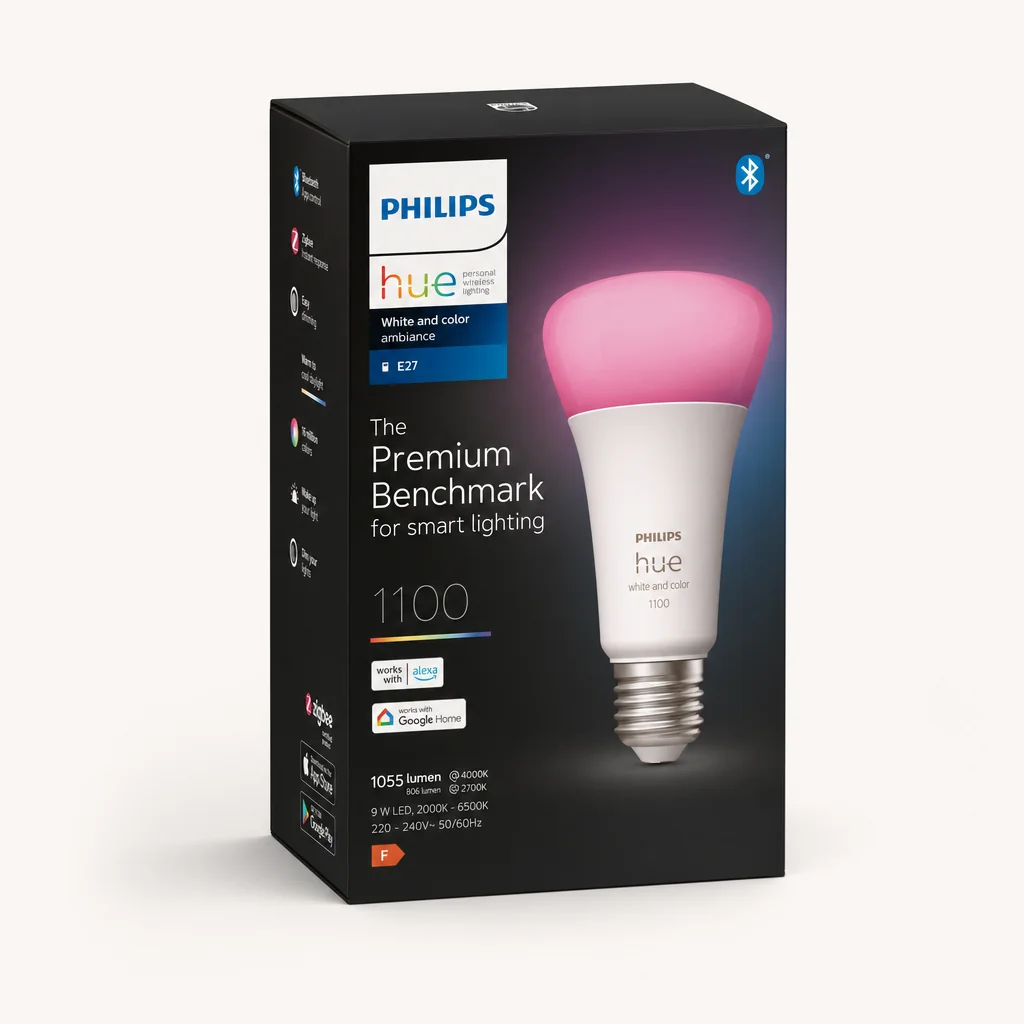
If money were no object, the Philips Hue White & Color Ambiance A19 would be on most people's shelves. It's the flagship colour bulb, and it earns the title. Rated at 9.5W, it pumps out a punchy 1,100 lumens — comfortably brighter than the 800 lm you'll get from most rivals — and it offers full-spectrum white from a remarkable 1000K all the way to 20000K thanks to Philips' Chromasync technology.
The Hue flagship A19 dims down to a near-candlelight 0.2% — the lowest figure I measured anywhere in this round-up.
That 0.2% dimming floor matters more than the spec sheet suggests. In a bedroom, the ability to drop a bulb down to a barely-there glow without it flickering or cutting out is the kind of thing you only appreciate once you've lived with it. Govee and Tapo dim well — Tapo's L530E goes from 1% to 100% — but nothing here matches Hue's depth.
If you want more brightness, the Hue White & Color Ambiance A21 is the brightest bulb in the entire Hue catalogue. It draws 16W and delivers 1,521 lumens — equivalent to a 100W incandescent — making it the one to reach for in large living rooms or open-plan spaces where a standard A19 just doesn't fill the room.
Pro Tip: Bridge or Bluetooth?
Hue bulbs work over Bluetooth straight out of the box for up to 10 bulbs per room — perfect for a single lamp or a small flat. But to unlock Matter, Hue Sync TV integration and the new MotionAware features, you'll want the Hue Bridge. If you plan to grow your setup beyond a handful of bulbs, buy the Bridge from day one.
Hue Essential: Cheaper Hue, Explained
For years the knock against Hue was simply the price. Philips finally answered that in September 2025 with the Hue Essential range — a budget tier that runs the exact same app and Zigbee + Bluetooth stack as the flagship bulbs, but trims a few specs to hit a lower price.
The Essential A19 is an 8.8W bulb producing 800 lumens, with a white range of 2200K to 6500K. So you lose a chunk of brightness compared to the 1,100 lm flagship, the white spectrum is narrower, and the dimming doesn't go quite as low. What you keep is arguably the most important bit: it's a fully supported member of the Hue family. It joins the same Bridge, shows up in the same app, and behaves identically in your routines and automations.
Hue Essential Pros
- Same Hue app and software experience as flagship
- Genuine Zigbee + Bluetooth, not a Wi-Fi compromise
- Full colour at a far more accessible entry point
- Slots into existing Hue setups seamlessly
- GU10 spotlight version available for ceiling fittings
Hue Essential Cons
- 800 lm versus the flagship's 1,100 lm
- Narrower 2200K–6500K white spectrum
- Higher dim floor — can't go as dark as flagship
- Still pricier per bulb than budget Wi-Fi rivals
In practice, the Essential range is the bulb I'd recommend to anyone who likes the idea of Hue's polish but balks at kitting out a whole house at flagship prices. Mix Essentials into secondary rooms and save the flagship A19 and A21 for the spaces where you actually notice colour accuracy and deep dimming.
TP-Link Tapo: The Value Champion
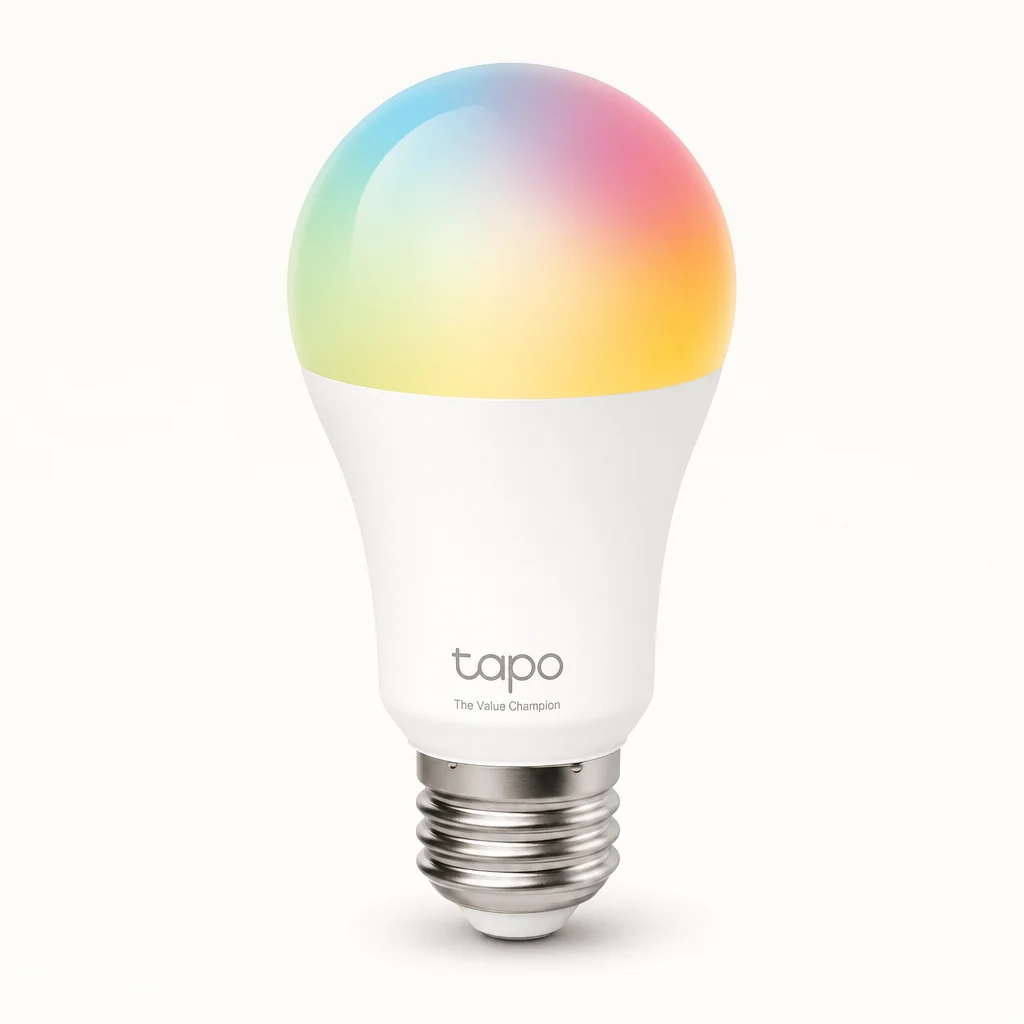
If Hue is the connoisseur's choice, Tapo is the pragmatist's. These are pure 2.4GHz Wi-Fi bulbs — no hub, no Bridge, just screw them in and pair them through the Tapo app. The mainstream L530E (E26 screw) and L530B (B22 bayonet, for UK fittings) have been around since September 2020 and remain a brilliant baseline.
Tapo's hubless approach means a single bulb is genuinely plug-and-play — no extra boxes plugged into your router.
The L530E's spec sheet is genuinely impressive for the money: 16 million colours, true-white RGBW LEDs, a CRI above 90 (so colours in the room look natural rather than washed out), a wide 220° beam angle and full 1% to 100% dimming. Standby draw is under 0.2W, and the app throws in energy monitoring and an Away Mode that randomly cycles lights to make an empty house look occupied. It also plays nicely with Tapo's wider range of cameras and doorbells, which is a quiet advantage if you're building a budget smart home from one brand.
The newer star, though, is the Tapo L535E. It bumps brightness up to 1,100 lumens — matching the Hue flagship — and crucially adds Matter certification. That combination of brightness, price and future-proofing is why it gets singled out as a top Matter pick. If you want one Tapo bulb to buy today and not worry about, it's this one.
For the most cost-conscious, the L510E and L510B drop colour entirely — they're dimmable white-only bulbs — which is plenty for hallways, cupboards and utility spaces where rainbow lighting would be wasted.
Worth knowing: The original L530E/L530B do not support Matter — only the L535E does. If cross-platform compatibility matters to you, double-check the model number before you buy, because the names are easy to confuse.
Govee: Colour, Shapes and Effects
Govee occupies a fun middle ground — Wi-Fi plus Bluetooth bulbs that lean hard into colour and form factor variety. If you want smart lighting in shapes that Hue and Tapo simply don't offer, Govee is where you look.
Govee's range stretches from standard A19 bulbs to candelabra, BR30 floods and vintage filament shapes — handy when your fittings aren't standard.
The everyday workhorse is the Govee H6008, a 9W RGBWW bulb pushing 800 lumens, available in both E26 and B22 bases. Step up to the H600A and you get a brighter 12W bulb at 1,200 lumens. For recessed and downlight fittings, the H6010 is a BR30 flood-format bulb, again at 1,200 lumens — ideal for kitchen ceilings and recessed cans where a standard bulb shape looks wrong.
Where Govee gets genuinely interesting is the Matter-compatible lineup. The H600B is an E12 candelabra bulb for chandeliers and wall sconces (450 lumens, the dimmer output suiting decorative fittings), and there's a Matter-compatible GU10 spotlight at 400 lumens for UK ceiling tracks. Top of the pile is the Matter-compatible Govee A21, a high-output bulb rated at a hefty 1,600 lumens with CRI 90 — the brightest single bulb mentioned in this guide. And for anyone chasing that exposed-bulb aesthetic, the Matter-compatible Edison ST19 Filament brings RGBW colour to a vintage shape, which is a lovely trick.
Govee H600A — bright standard bulb
12W RGBWW delivering 1,200 lumens for living rooms that need real output.
Govee H6010 BR30 — recessed flood
1,200 lumens in a flood format built for downlights and recessed cans.
Govee A21 — high-output Matter
1,600 lumens, CRI 90 and Matter compatibility in one E26 bulb.
Govee Edison ST19 — vintage filament
RGBW colour in a retro filament shape, also Matter-compatible.
Govee Pros
- Widest range of bulb shapes and bases
- High-output A21 reaches 1,600 lm at CRI 90
- Several Matter-compatible models
- No hub — Wi-Fi + Bluetooth straight to the app
- Candelabra and filament options for decorative fittings
Govee Cons
- Several core bulbs (H6008, H600A, H6010) lack Matter
- Candelabra and GU10 outputs are modest (400–450 lm)
- Matter support varies model-by-model — check carefully
- Less of a unified "system" feel than Hue
Why Matter Changes the Game
Matter is the cross-industry smart home standard designed to make all of this less painful. The promise is simple: a Matter-certified bulb should pair with Alexa, Google Home and Apple Home without you caring which brand made it. That's a genuine shift, because historically you had to check each bulb against each platform.
For this round-up, the Matter-ready field is broader than just the big three brands. The Tapo L535E leads the pack as a bright, certified, hubless bulb. Beyond it, Linkind's Matter A19 is an RGBTW 9W bulb at 800 lumens that frequently turns up around the £7-ish mark on offer — about as cheap as certified smart lighting gets. The OREiN Matter A21 mirrors Govee's high-output approach with 1,600 lumens, 14W draw and a CRI of 90 or better. Nanoleaf's Essential BR30 goes a step further with both Matter and Thread for the most responsive, mesh-networked control, sitting at the premium end. And WiZ — from Signify, the very company behind Hue — offers Matter compatibility with no hub required, making it a clever budget-friendly sibling to Hue itself.
| Bulb | Brightness | Matter | Hub Needed | Standout |
|---|---|---|---|---|
| Hue White & Color A19 | 1,100 lm | Via Bridge | Recommended | 0.2% dimming, Chromasync |
| Hue Essential A19 | 800 lm | Via Bridge | Same as Hue | Budget Hue, full app |
| Tapo L535E | 1,100 lm | Certified | No | Top Matter value pick |
| Tapo L530E | 800 lm | No | No | CRI >90, energy monitoring |
| Govee A21 | 1,600 lm | Compatible | No | Brightest, CRI 90 |
| Linkind Matter A19 | 800 lm | Certified | No | Cheapest certified option |
| Nanoleaf Essential BR30 | 1600 lumens | + Thread | No | Thread for responsiveness |
The Matter caveat
"Matter-compatible" and "Matter-certified" aren't always the same thing, and with Govee in particular, support varies by individual model. Always check the specific SKU rather than assuming a brand is wholesale Matter-ready. The Tapo L535E and Linkind A19 are explicitly certified, which makes them safe bets if cross-platform freedom is your priority.
Brightness & Dimming Compared
Lumens are the single most under-appreciated spec in smart lighting. The default for most colour bulbs is 800 lm, which is fine for a bedside lamp but underwhelming as a room's main light. Here's how the headline figures stack up — note how the high-output models pull well ahead.
The lesson here is to match brightness to the room. For a main living-room light I'd want the Govee A21 or the Hue A21 every time; for ambient lamps, the 800 lm crowd is perfectly pleasant. And remember dimming works both ways — the Hue flagship's 0.2% floor and Tapo's 1% floor are what let you set a soft evening mood without the lights feeling harsh. A bright bulb that also dims deeply gives you the best of both worlds.
CRI matters too: Tapo's L530E (CRI >90), the Govee A21 and the OREiN A21 (both CRI 90) all render colours in your room more naturally than cheaper bulbs. If you cook, do makeup or care about how your décor looks under light, prioritise CRI 90+.
Ecosystem Fit: Alexa vs Google Home
All four brands work with both Alexa and Google Home, so you won't be left out whichever assistant you've chosen. The real differences are in how they connect and how that affects reliability.
Wi-Fi bulbs (Tapo, Govee) connect directly to your 2.4GHz network. That's gloriously simple for a few bulbs, but every bulb is another device on your router — fill a house with thirty of them and a budget router can start to grumble. Zigbee bulbs (Hue, via the Bridge) form their own mesh network that doesn't touch your Wi-Fi, which is why big Hue setups stay rock-solid even at scale. Thread (Nanoleaf Essential) is the newest mesh option, and combined with Matter it offers some of the snappiest local control around.
Best with Alexa
All four brands integrate cleanly. Tapo earns extra points if you also run Tapo cameras and doorbells, since everything lives in one ecosystem and surfaces together in Alexa routines.
Best with Google Home
Matter-certified bulbs like the Tapo L535E and Linkind A19 are the safest long-term bets, joining Google Home directly without per-brand quirks.
Best for large homes
Hue's Zigbee mesh (via Bridge) keeps dozens of bulbs reliable without flooding your Wi-Fi — still the most dependable choice at scale.
Check the latest price and any current bundles on Amazon.
Who Should Buy What
The Perfectionist
Buy Philips Hue flagship. You want Chromasync colour accuracy, 0.2% dimming and the most reliable big-home experience. Pair the A19 with the A21 for bright rooms, and get the Bridge.
The Value Hunter
Buy the Tapo L535E. It matches Hue's 1,100 lm brightness, needs no hub and is Matter-certified — the smartest money in the whole guide. Drop in L510E white bulbs for hallways.
The Creative
Buy Govee. The 1,600 lm A21, BR30 floods, candelabra and Edison filament shapes mean you can light unusual fittings with vibrant colour the others can't match.
The Future-Proofer
Go Matter-certified — Tapo L535E, Linkind A19 or Nanoleaf Essential with Thread. You'll never be locked to one assistant again.
The Hue-Curious Saver
Buy Hue Essential. You get the genuine Hue app and Zigbee reliability with full colour at 800 lm, for noticeably less than flagship bulbs.
The Beginner
Start with a single Tapo L530E or WiZ bulb. Hubless, cheap and dead easy to set up — the lowest-risk way to dip a toe in.
Ratings Breakdown
These scores reflect the category as a whole — taken together, these four brands cover practically every smart-lighting need between them. Where any individual bulb loses marks, another picks up the slack: Hue for reliability, Tapo for value, Govee for variety, and the Matter field for longevity.
The right answer is usually a mix — flagship bulbs where they count, budget bulbs everywhere else.
The Verdict
There's no universal winner here, and that's actually good news — it means there's a right answer for every budget and setup. If you want the best, most reliable experience and you're building out a whole home, Philips Hue remains the benchmark, with the flagship A19's 0.2% dimming and the A21's 1,521 lumens leading on quality and output. If you're cost-conscious but refuse to compromise on brightness or future-proofing, the Tapo L535E is the standout buy of the entire guide — 1,100 lumens, no hub and Matter certification for a fraction of the premium.
For colour lovers and anyone with unusual fittings, Govee wins on sheer variety, topped by the 1,600 lm CRI-90 A21. And if you're determined never to be locked to a single voice assistant, lean into the Matter-certified field — Tapo L535E, Linkind A19 or Nanoleaf Essential with Thread. My honest advice? Mix and match. Put flagship bulbs where you'll notice them, budget bulbs everywhere else, and prioritise Matter for anything you buy from here on.