
Best Smart Displays: Echo Show vs Google Nest Hub Compared
Which countertop smart screen actually suits your home — room by room, use case by use case — whether you're firmly Team Alexa or all-in on Google.
We link to the exact model on Amazon UK. Prices change often, so check the live price before you buy. As an Amazon Associate we earn from qualifying purchases.
Smart displays have quietly become the most useful screens in the modern home — but the right one depends entirely on your ecosystem and your room.
I've spent a long time living with smart displays dotted around the house — on the kitchen counter, the bedside table, the home-office desk — and the more I use them, the more I'm convinced that the "best" one isn't a single product. It's whichever one fits your ecosystem, your room, and the way you actually behave at 7am with porridge bubbling over. This guide pits Amazon's Echo Show family against Google's Nest Hub line, and rather than crowning one universal champion, I'll help you match the right screen to the right job.

See Echo Show 5 (3rd Generation) on Amazon UK
Check today's price & availability on Amazon UK
The smart display category has matured enormously. What began as voice speakers with a screen bolted on has grown into a genuinely diverse range of devices, from a tiny 5.5-inch nightstand companion right up to a 21-inch slab with a built-in Fire TV. Amazon and Google have taken markedly different philosophies, too. Amazon leans into hardware variety, cameras, and a recent push into on-device AI. Google leans into restraint — fewer models, a stronger privacy stance, and some genuinely clever sensor tech that nobody else does.
So let's get into it properly. I'll cover the full line-ups, the specs that matter, how each screen performs by room, and — crucially — which ecosystem deserves your loyalty if you're starting fresh.
The Two Line-Ups at a Glance
Before we dive into individual models, it's worth understanding the shape of each range, because that shape tells you a lot about each company's strategy.
Amazon's Echo Show family is broad and deliberately tiered by screen size. You've got the diminutive Echo Show 5, the mainstream Echo Show 8, the motorised Echo Show 10, the newer Echo Show 11, the wall-friendly Echo Show 15, and the enormous kitchen-anchoring Echo Show 21. There's almost a model for every conceivable surface in your home.
Google's Nest Hub line is far leaner. There's the compact Nest Hub (2nd Generation) with its 7-inch screen, and the larger Nest Hub Max with a 10-inch display and a camera. That's it. Two devices, two clear roles. Whether that simplicity is a strength or a frustration depends largely on what you're after — but it does mean less analysis-paralysis when you're shopping.
The Echo Show range spans six distinct sizes, whilst Google keeps things to just two carefully judged devices.
Both ranges are mains-powered. None of these displays runs on a battery, so wherever you put one, you'll need a nearby socket and you'll be living with a visible cable. Plan your placement around plugs, not just aesthetics.
Echo Show: Model-by-Model Breakdown
Amazon's breadth is its biggest selling point, so let's walk through the line-up in order of size and figure out where each one earns its place.
Echo Show 5 (3rd Generation)
See Echo Show 5 (3rd Generation) on Amazon UK
Check today's price & availability on Amazon UK
The little one. The Echo Show 5 carries a 5.5-inch screen at 960 x 480 resolution and a modest 2-megapixel camera. It's the screen I'd put on a nightstand or a cramped desk where a larger display would feel oppressive. The third-generation model arrived in 2023 with a 1.75-inch speaker — slightly larger than the second-gen's 1.65-inch driver — which translates into clearer vocals and a touch more bass than you'd expect from something this dinky.
Performance got a meaningful bump, too. Amazon reckons it's around 20% faster than the second-gen, with snappier touchscreen response and quicker Alexa replies. In practice that means glancing at the time, checking the weather, setting a timer, or controlling a couple of lights feels fluid rather than laggy. It's not a media powerhouse and it was never meant to be — this is a bedside or desk companion, and a rather good one at the price point it occupies.
Echo Show 8 (4th Generation, 2025)

See Amazon Echo Show 8 (2025) on Amazon UK
Check today's price & availability on Amazon UK
This is the model I'd point most people towards if they want one display to do a bit of everything. The 2025 refresh brought a larger 8.7-inch screen at 1,340 by 800 pixels, up from the previous generation's 8 inches and 1,280 by 800. It measures 7.9 inches (20 cm) wide, 5.4 inches (13.5 cm) tall and 3.9 inches (9.9 cm) deep, weighing 1kg.
The audio is where this generation really steps up. There are two full-range drivers and a 2.8-inch woofer in a front-facing stereo arrangement, and Amazon claims up to double the bass compared with the previous Echo Show 8. Spatial audio is on board, too. For a kitchen or living-room background-music role, that's a genuinely satisfying little speaker.
The camera has gone proper, too: a 13-megapixel sensor with auto-framing and 3x zoom, plus advanced noise filtering powered by the new AZ3 Pro chip. That chip — which Amazon pairs with an AI Accelerator — is the headline change. It enables faster on-device processing and the more conversational, contextual Alexa experience the company has been pushing. One thing to flag clearly, though: the 2025 model dropped the physical privacy shutter to allow that thinner screen design. If a physical camera cover is a deal-breaker for you, that matters.
Pro Tip
The Echo Show 8 (2025) packs a Thread Border Router, Zigbee radio and Matter support right inside it. If you're building a smart home from scratch, that means it can act as the hub for compatible bulbs, sensors and plugs without you buying a separate bridge. It's one of the most quietly valuable features in the whole range.
Echo Show 11 (2025)

See Amazon Echo Show 11 (2025) on Amazon UK
Check today's price & availability on Amazon UK
New for 2025, the Echo Show 11 bumps you up to an 11-inch screen and inherits the same well-judged audio architecture as the Echo Show 8 — front-facing stereo speakers with a custom woofer. It adds enhanced spatial audio and what Amazon calls Omnisense technology, plus auto-framing video calls with a slightly wider 3.3x zoom and ambient noise reduction. Think of it as the Echo Show 8's bigger sibling for people who want a more substantial screen for recipes, video calls and dashboard duty without leaping all the way to the 15-inch models.
Echo Show 10 (3rd Generation)
See Amazon Echo Show 10 (3rd Gen) on Amazon UK
The Echo Show 10 is the quirky, clever one. It has a 10.1-inch HD screen mounted on a rotating motorised base, and that base genuinely moves — the screen and 13MP auto-framing camera physically follow you around the room. For video calls where you're pottering about a kitchen rather than sitting still, it's brilliant. You're not pinned to one spot in the frame.
It also has, in my experience, the best speaker performance of any Echo Show. The trade-off is a large footprint and a price that sits at more than twice that of the Echo Show 8. The motor mechanism also means it needs clear space around it to swivel. It's a specialist device — wonderful in the right room, overkill in the wrong one.
The Echo Show 10's motorised base lets the screen and camera rotate to follow you, which transforms hands-free video calls in a busy kitchen.
Echo Show 15 (2nd Gen, 2024)

See Amazon Echo Show 15 on Amazon UK
Check today's price & availability on Amazon UK
The Echo Show 15 is a different beast entirely. It's a 15.6-inch display at a full 1,920 by 1,080 resolution, with a slim 1.4-inch photo-frame design that can be mounted in portrait or landscape. The late-2024 update gave it a 13MP camera and Wi-Fi 6E along with Matter compatibility. This isn't a countertop device so much as a wall-mounted family command centre — calendars, sticky notes, shopping lists, smart-home controls and photo slideshows. It's also rather good for streaming entertainment when you want a second screen in the kitchen or hallway.
Echo Show 21 (2024)

See Amazon Echo Show 21 on Amazon UK
Check today's price & availability on Amazon UK
And then there's the giant. The Echo Show 21 is a 21-inch Full-HD (1080p) smart display with a built-in Fire TV and Alexa, squarely aimed at the kitchen. If you want a proper telly you can watch whilst cooking, with all the smart-display recipe and timer functions layered on top, this is the one. It's a niche product, but a clear one — it's a kitchen TV that happens to be a smart display.
| Model | Screen | Camera | Best Role |
|---|---|---|---|
| Echo Show 5 (3rd Gen) | 5.5" / 960×480 | 2MP | Nightstand, small desk |
| Echo Show 8 (4th Gen) | 8.7" / 1340×800 | 13MP | All-rounder |
| Echo Show 11 | 11" | Auto-framing 3.3x | Larger all-rounder |
| Echo Show 10 (3rd Gen) | 10.1" HD | 13MP auto-frame | Active video calls |
| Echo Show 15 (2nd Gen) | 15.6" / 1080p | 13MP | Wall command centre |
| Echo Show 21 | 21" / 1080p | 13MP auto-framing camera | Kitchen Fire TV |
Nest Hub: Google's Pared-Back Pair
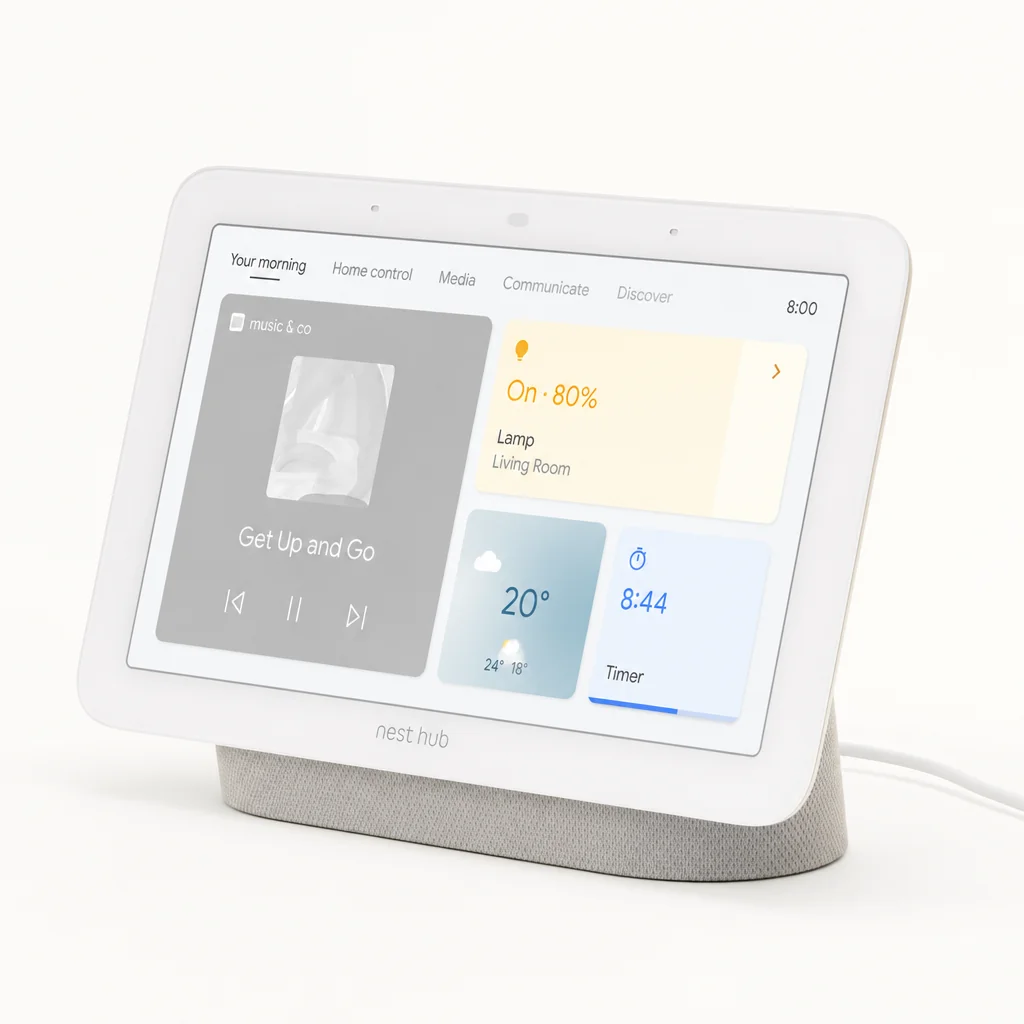
Google's approach couldn't be more different. Two devices, both with a strong design identity, and one genuinely distinctive feature you won't find anywhere in Amazon's range.
Nest Hub (2nd Generation, 2021)
See Google Nest Hub (2nd Gen) on Amazon UK
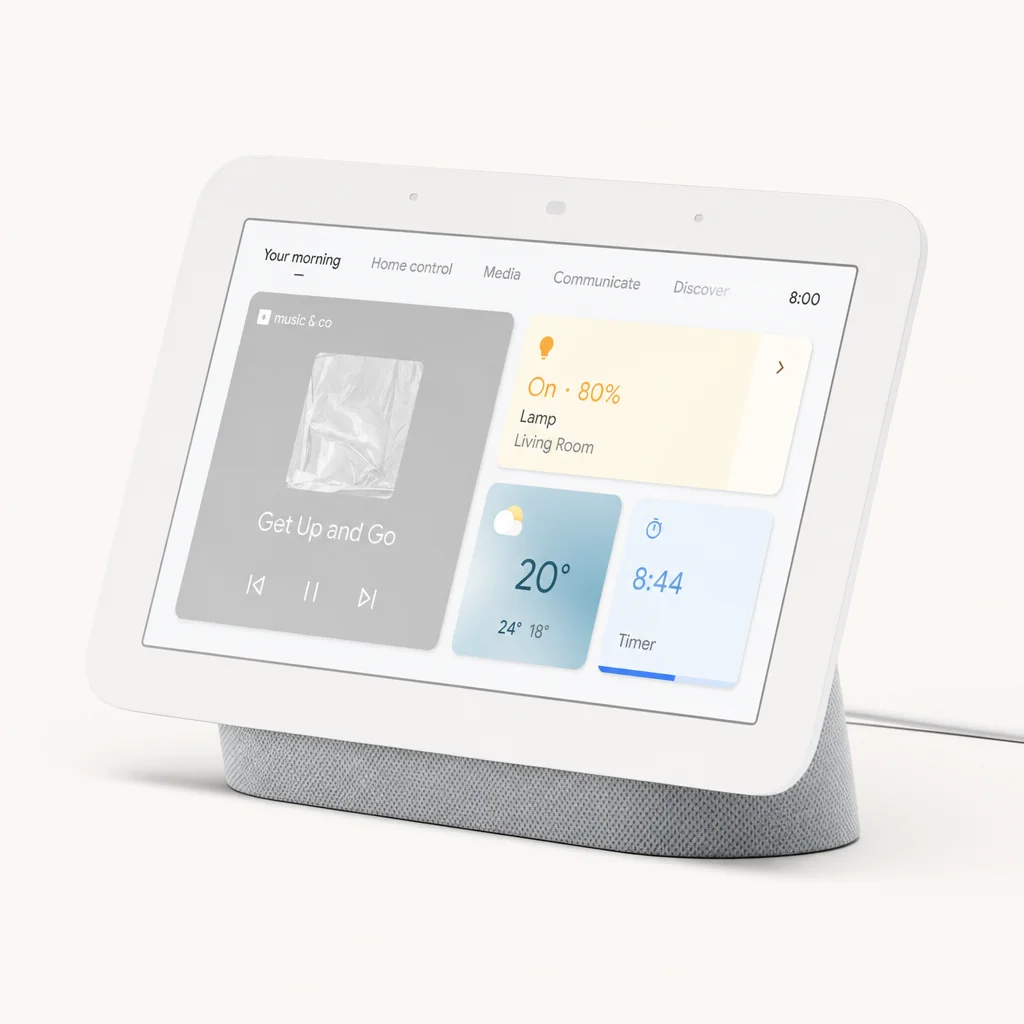
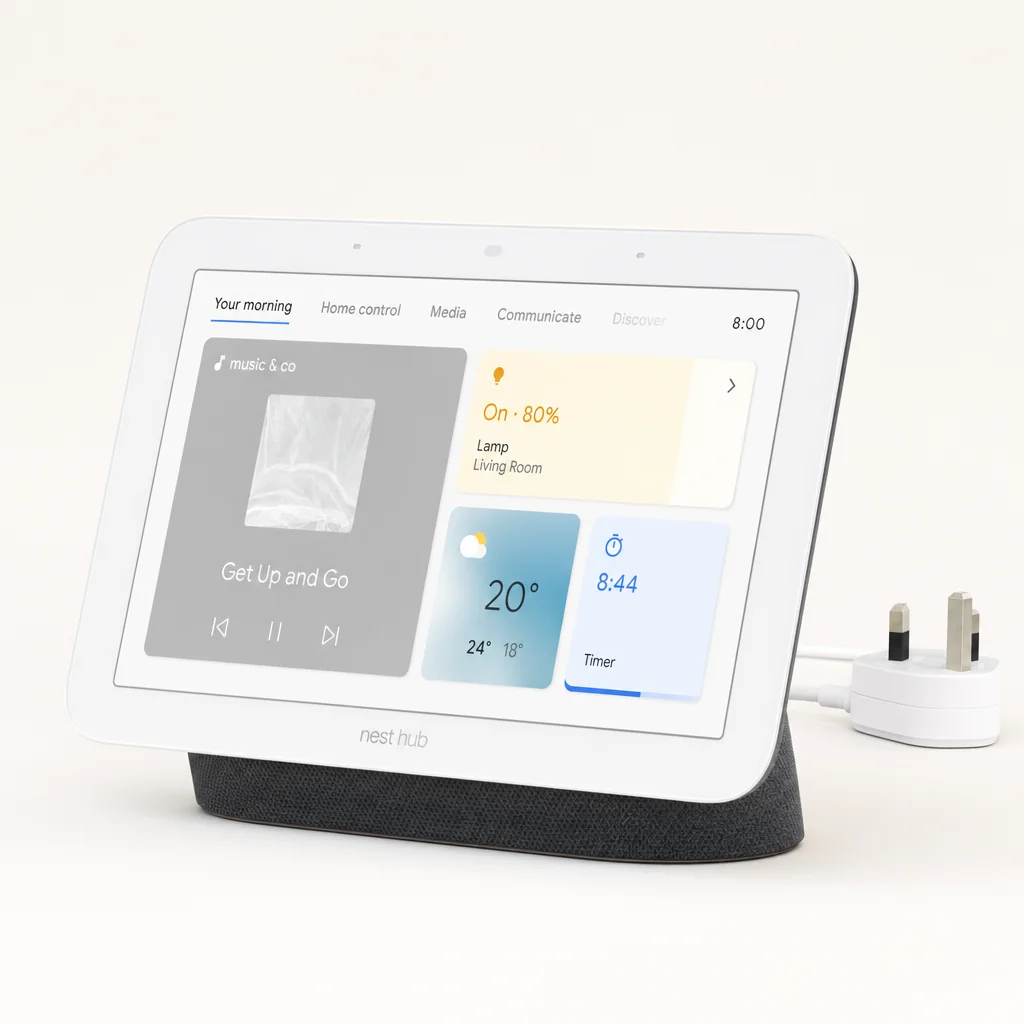
The 2nd-gen Nest Hub, launched in March 2021, has a 7-inch LCD touchscreen at 1024 x 600 resolution. It measures 177.4 × 120.4 × 69.5mm and weighs 558g, wrapped in that lovely soft fabric finish with a minimalist oval shape and no lip around the display for a seamless look. It's one of the better-looking smart displays you can put on a bedside table — it genuinely belongs in a bedroom rather than looking like a gadget that's wandered in.
The audio improved over the first generation, with Google claiming 50% more bass, delivered through a full-range speaker with a 1.7-inch driver and three microphones for voice recognition. But the standout feature is the Soli radar sensor. Rather than a camera, the Nest Hub uses radar waves to track your sleep — detecting motion and breathing patterns — so it can offer sleep-tracking insights without ever pointing a lens at you in bed. That same Soli tech also powers Motion Sense gesture control, letting you wave your hand to pause music or snooze an alarm.
The deliberate no-camera choice
The 2nd-gen Nest Hub has no camera at all. This is a privacy decision, and a smart one for a bedroom device. The catch is obvious: you can't make video calls on it. If video calling matters to you, this isn't your device — but as a bedside companion, the absence of a camera is genuinely reassuring.
It's also nicely connected, with Bluetooth 5.0, dual-band Wi-Fi, an Ambient EQ light sensor, far-field microphones, and built-in support for Matter and Thread, but not Zigbee or Ethernet. It runs on a 1.9GHz quad-core processor, and like everything here, it must be plugged into a wall outlet — there's no battery.
Nest Hub Max (2019)
Shop Nest Hub Max (2019) on Amazon UK
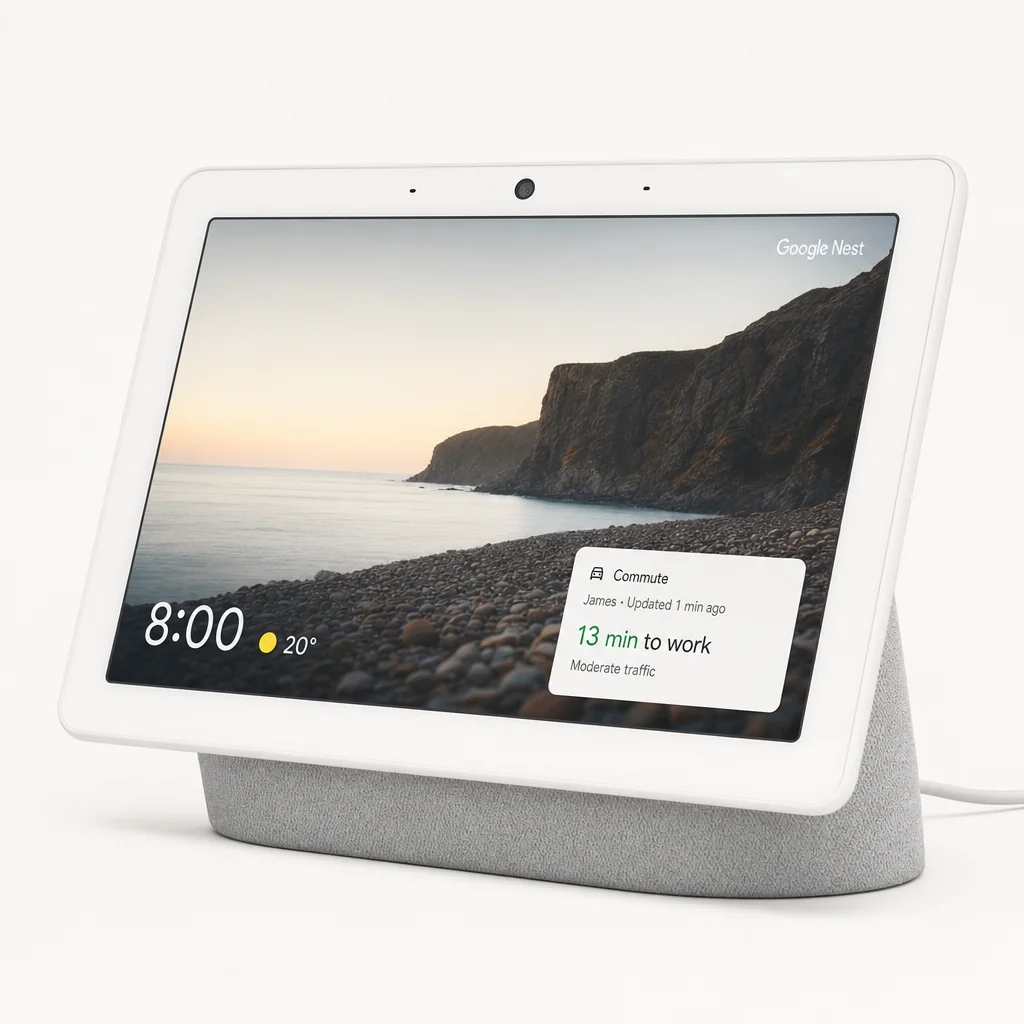
The Nest Hub Max, released in September 2019, is the bigger, more capable sibling. It has a 10-inch display at 1280 x 800, larger speakers with a rear-facing subwoofer, and crucially a 6.5-megapixel camera that automatically pans and adjusts to keep you in frame during calls. It delivers great sound quality on supported video calling services (Zoom support ended in 2023), and the auto-framing is a real boon when you're moving around.
What makes the Max especially interesting is its double life as a security camera. Via the Google Home app it can act as a Nest indoor home security camera, and a Nest Aware subscription unlocks Familiar Face detection and smart alerts. So when you're out, the device that helps you cook dinner becomes a camera keeping an eye on the room. It's an elegant bit of dual-purpose design that Amazon doesn't quite match in the same integrated way.
The Nest Hub Max doubles as a Nest indoor security camera, with auto-framing video calls and Familiar Face detection via Nest Aware.
Display, Sound and Smarts Compared
Let's put the headline models head to head. For most buyers the real fight is Echo Show 8 (2025) versus Nest Hub (2nd Gen) at the compact end, and Echo Show 10 versus Nest Hub Max at the larger end. The bars below give a rough sense of how I'd weight each device across the things that matter day to day, based on living with these screens.
The headline takeaway from a pure spec standpoint: the Echo Show 8's 8.7-inch, 1,340-by-800 panel is bigger and sharper than the Nest Hub's 7-inch, 1024-by-600 display. If you simply want the most screen real estate at the compact end, Amazon wins. But the Nest Hub's smaller, softer-edged design and camera-free build make it the more comfortable bedroom resident, and that's not something a spec sheet captures neatly.
On-device AI (Echo Show 8 / 11)
The AZ3 Pro chip with its AI Accelerator powers a more conversational, contextual Alexa and faster local processing — the most forward-looking silicon in either range.
Soli radar (Nest Hub 2nd Gen)
Camera-free sleep tracking that monitors motion and breathing patterns, plus Motion Sense gesture control. Genuinely unique to Google's compact display.
Motorised tracking (Echo Show 10)
A rotating base that physically turns the screen and 13MP camera to follow you, ideal for hands-free calls whilst you move around a room.
Security camera mode (Nest Hub Max)
Doubles as a Nest indoor home camera through Google Home, with Familiar Face detection and smart alerts on a Nest Aware plan.
Built-in smart-home hubs (both)
Matter and Thread support varies by model; Zigbee is present on relevant Echo Show models but not Nest Hub 2, so each can serve as a control point for compatible devices without an extra bridge.
Best Smart Display by Room
This, for me, is the heart of the decision. Forget "which brand is best" for a moment and think about where the screen is actually going to live.
The Bedroom / Nightstand
My top pick here is the Nest Hub (2nd Generation), and it's not especially close. The camera-free design means you're not putting a lens beside your bed. The Soli radar sleep tracking is a thoughtful bonus, the fabric-wrapped oval shape looks like furniture rather than tech, and the Ambient EQ light sensor dims the screen gracefully overnight. Motion Sense lets you wave to snooze an alarm without fumbling for a button. If you're an Alexa household, the Echo Show 5 (3rd Gen) is the equivalent nightstand choice — smaller, capable, and a decent option for the bedside, though it does have a 2MP camera.
The Kitchen
The kitchen is where smart displays earn their keep — recipes, timers, music, video calls with floury hands. For a balanced countertop choice, the Echo Show 8 (2025) is my recommendation: that bigger, sharper screen and the upgraded stereo-plus-woofer audio handle recipes and background music beautifully. If you want the screen to follow you whilst you move between hob and sink during a call, the Echo Show 10 is unmatched. And if your kitchen is really your second living room and you want to watch telly whilst you cook, the Echo Show 21 with its built-in Fire TV is purpose-built for exactly that.
The Living Room / Hallway Command Centre
For a wall-mounted family hub — calendars, lists, smart-home dashboard, photo frame — the Echo Show 15 (2nd Gen) is the obvious answer with its 15.6-inch 1080p panel and slim, mountable design. Google doesn't have a direct rival to the 15 here, which is a notable gap in its range.
The Home Office / Desk
For video calls at a desk, the Nest Hub Max is a strong shout thanks to its auto-framing 6.5MP camera and solid call audio, plus the handy security-camera duty when you step away. In an Alexa home, the Echo Show 8's 13MP camera with auto-framing and 3x zoom does the same job nicely on a desk.
The Light Sleeper
Nest Hub 2nd Gen. No camera, Soli sleep tracking, and a gentle ambient-dimming display that won't glare at 2am.
The Home Cook
Echo Show 8 (2025) for everyday use, or Echo Show 21 if you want a full Fire TV experience whilst you cook.
The Frequent Caller
Echo Show 10 for motorised tracking, or Nest Hub Max for auto-framing within the Google world.
The Family Organiser
Echo Show 15 (2nd Gen) wall-mounted as a shared calendar, list and smart-home command centre.
Pros and Cons: Echo Show vs Nest Hub
Stepping back to the ecosystem level, here's how the two stack up.
Echo Show family
Pros
- Six screen sizes from 5.5" to 21" — a model for nearly every room
- Bigger, sharper compact screen (8.7" / 1340×800 on the Show 8)
- Strong audio with stereo drivers and a 2.8" woofer on the Show 8
- 13MP auto-framing cameras on the larger models
- Forward-looking AZ3 Pro chip with AI Accelerator
- Built-in Matter, Thread and Zigbee hub on the latest models
- Unique options like the motorised Show 10 and Fire TV Show 21
Cons
- 2025 Echo Show 8 dropped the physical camera privacy shutter
- The Echo Show 10 carries a large footprint and a high price
- So many models can make choosing genuinely confusing
- No camera-free option for the privacy-conscious bedroom buyer
Nest Hub family
Shop Nest Hub family on Amazon UK
Pros
- Camera-free Nest Hub is ideal and reassuring for the bedroom
- Soli radar sleep tracking and Motion Sense gestures are unique
- Lovely fabric, minimalist design that suits living spaces
- Nest Hub Max doubles as a Nest indoor security camera
- Auto-framing camera and strong call audio on the Max
- Matter and Thread on the 2nd Gen; no Zigbee or Ethernet
Cons
- Only two models — no large wall-mounted or jumbo kitchen option
- The compact Nest Hub can't make video calls at all
- The Nest Hub Max dates back to 2019 and is overdue a refresh
- Lower compact-screen resolution than the Echo Show 8
Privacy, Cameras and Peace of Mind
This deserves its own section because it's where the two philosophies diverge most sharply. Google's compact Nest Hub takes the unusual step of having no camera whatsoever. For a bedroom or a child's room, that's a genuinely meaningful design choice — there's simply no lens to worry about, and the sleep tracking is handled by radar instead.
Amazon, by contrast, has leaned into cameras across most of its range, from the 2MP sensor on the Echo Show 5 right up to the 13MP shooters on the Show 8, 10 and 15. The cameras enable proper video calling and auto-framing, which Google's compact device can't do at all. But there's a wrinkle worth knowing: the 2025 Echo Show 8 removed its physical privacy shutter to allow that thinner design. Earlier Echo Show models had a sliding cover you could physically close; this one relies on software controls instead. If a mechanical shutter is your idea of true peace of mind, that's a point in favour of older designs.
The Nest Hub Max's camera is a feature rather than a worry for many people: via the Google Home app it becomes a Nest indoor security camera, and a Nest Aware subscription adds Familiar Face detection and smart alerts. It's a useful second life for the device when you're out.
So the honest summary is this: if camera anxiety is your priority, the camera-free Nest Hub is uniquely positioned. If you value video calling and don't mind managing camera settings in software, the Echo Show range gives you far more options — you just lose the reassurance of a physical shutter on the newest Show 8.
Overall Ratings
Here's how I'd score the two flagship compact models against the criteria that matter most for a countertop smart display. These reflect my own weighting after living with the devices, not a lab measurement.
Ready to choose your smart display?
Models, bundles and availability change frequently across both ranges.
Check the latest price and any current bundles on AmazonFrequently Asked Questions
For most homes the choice comes down to ecosystem and room — and happily, both Amazon and Google make excellent screens for the right job.
The Verdict
There's no single winner here, and anyone telling you otherwise is oversimplifying. The honest answer is that your existing ecosystem should lead the decision, and the room should refine it.
If you're an Alexa household, the range is unbeatable for choice. The Echo Show 8 (2025) is the smart all-rounder I'd recommend to most people — bigger, sharper screen than Google's compact rival, genuinely good audio, a capable 13MP camera and a built-in smart-home hub. Scale up to the Echo Show 10 for moving video calls, the Echo Show 15 for a wall command centre, or the Echo Show 21 for a kitchen Fire TV.
If you're a Google household, the line-up is leaner but beautifully judged. The Nest Hub (2nd Gen) is the best bedroom smart display going, thanks to its camera-free build and Soli sleep tracking, whilst the Nest Hub Max handles video calls and doubles as a Nest security camera. The only real frustration is the lack of a large wall-mounted or jumbo kitchen option.
My closing advice: pick the assistant you already use and trust, then choose the screen that matches the room it'll live in. Do that, and you'll be delighted whichever badge is on the box.
- Echo Show 5 (3rd Generation)View on Amazon
- Amazon Echo Show 8 (2025)View on Amazon
- Amazon Echo Show 11 (2025)View on Amazon
- Amazon Echo Show 15View on Amazon
- Amazon Echo Show 21View on Amazon