Apple Sues OpenAI Over Alleged Hardware Trade Secret Theft
Apple filed a federal lawsuit on Friday accusing OpenAI, its chief hardware officer, and an engineer of systematically stealing confidential information about unreleased Apple products.
What you need to know
- Apple sued OpenAI on 10 July 2026 over alleged theft of hardware trade secrets, naming OpenAI's Chief Hardware Officer Tang Yew Tan and engineer Chang Liu.
- Tan is accused of coaching Apple employees to smuggle physical hardware components — including logic boards and unreleased System-in-Package modules — into job interviews as "show and tell."
- Apple says more than 400 of its former employees have joined OpenAI, and the AI firm's interview process is allegedly structured to extract confidential Apple information.
Apple filed a sweeping federal lawsuit against OpenAI on Friday, accusing the artificial intelligence company of orchestrating a systematic campaign to steal the iPhone maker's most closely guarded hardware secrets. The 41-page complaint, lodged on 10 July 2026 in the US District Court for the Northern District of California, names OpenAI Chief Hardware Officer Tang Yew Tan, engineer Chang Liu, and IO Products — the hardware startup co-founded by Tan and later acquired by OpenAI — as defendants.
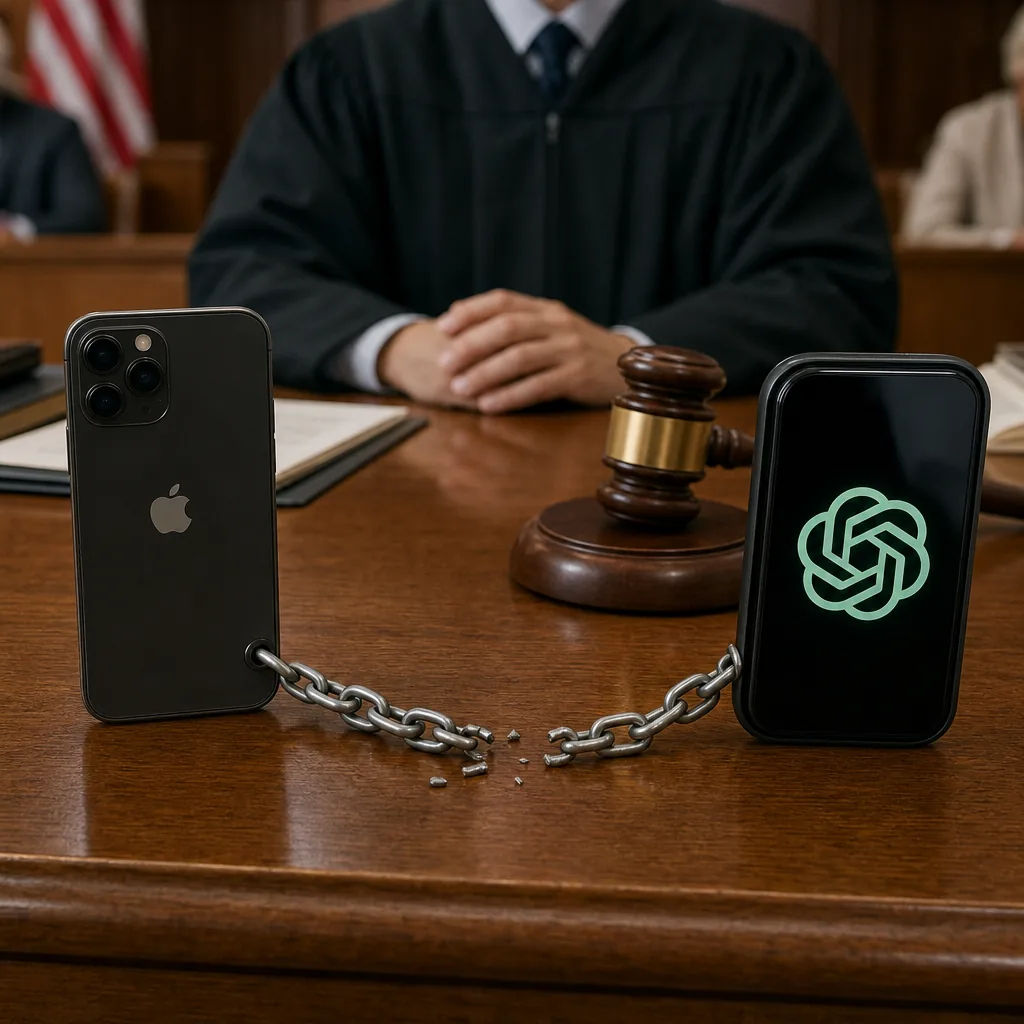
Apple brought four claims under the federal Defend Trade Secrets Act alongside two breach-of-contract claims. It is asking the court to bar OpenAI from using or disclosing its trade secrets, require the destruction of any proprietary Apple materials, and demand a jury trial. Under federal law, the complaint also opens the door to exemplary damages where conduct is found to be wilful and malicious.
The allegations against Tang Yew Tan
The lawsuit's most explosive accusations are levelled at Tan, who spent 24 years at Apple before departing to co-found IO Products and subsequently become OpenAI's Chief Hardware Officer. At Apple, he served most recently as Vice President of product design for the iPhone and Apple Watch.
According to the complaint, Tan ran what amounts to an intelligence-gathering operation during OpenAI's hiring process. Apple alleges he used confidential Apple project code names when recruiting candidates, coached departing employees on how to evade the company's security procedures at exit, and circulated an Apple offboarding document — which he allegedly retained or obtained — to help incoming OpenAI hires dodge security checks.
Perhaps the most striking allegation is that Tan directed Apple employees who were interviewing at OpenAI to bring physical hardware components from unreleased Apple products into their interviews. As Apple's filing puts it, Tan told candidates to bring actual parts — including batteries, logic boards, and System-in-Package modules — for what are described as "show and tell" sessions. Apple's filing states:
"He has directed job candidates still working for Apple to bring 'actual parts' from Apple to their interviews for 'show and tell' sessions in which he and his team at OpenAI can elicit still more Apple confidential information."
Tan also allegedly forwarded Apple supplier information to his personal email before his departure and made contact with Apple's contract manufacturers — in one case, the suit claims, persuading a manufacturer to perform a proprietary metal-finishing process by falsely representing that Apple had sanctioned the request. Bloomberg's Mark Gurman has reported that Tan and incoming Apple CEO John Ternus had a rocky relationship for years, with Tan having reportedly been in contention for the hardware engineering leadership role that Ternus ultimately took. The vast majority of employees said to have been poached by OpenAI came from Ternus's division, according to Gurman.
The allegations against Chang Liu
Liu worked at Apple for eight years before joining OpenAI in January 2026. The complaint alleges that after his departure he failed to return a company laptop and then discovered that an authentication flaw still gave him access to Apple's internal network storage. According to the filing, Liu messaged a former colleague: "LOL, I found out I can access the [network storage], so funny."
Apple claims that while working on OpenAI hardware, Liu accessed and downloaded dozens of confidential files — many explicitly marked as confidential — from Apple's network. He is also accused of sharing Apple's confidential information with other Apple employees who were applying for jobs at OpenAI, and of advising at least one of them on what to study before their interview.
The scale of the alleged operation
Apple says more than 400 of its former employees have taken jobs at OpenAI, and contends that OpenAI's interview process is deliberately structured to extract confidential Apple information. The stolen materials allegedly included technical specifications, engineering presentations, and proprietary data relating to unannounced technologies and products. The alleged misconduct continued as recently as June 2026, when OpenAI hired Paul Meade, Apple's smart glasses chief — a move that saw Apple immediately walk Meade out rather than allow a standard transition period.
Apple's filing is unsparing in its characterisation of OpenAI's conduct:
"This much is clear, however: at every level, from members of its Technical Staff to its Chief Hardware Officer, and in coordination with business partners, OpenAI has been stealing Apple's trade secrets and confidential information."
The filing adds: "This is the tip of the iceberg. Apple lacks visibility into what's been happening behind closed doors at OpenAI, where such misconduct is normalized and exemplified by leadership."
IO Products and Jony Ive
IO Products — the hardware startup co-founded by Tan and acquired by OpenAI last year in a $6.5 billion deal — is named as complicit in what the filing describes as "a coordinated pattern of misconduct at an institutional level." Jony Ive, Apple's former chief design officer who began collaborating with OpenAI in 2023 and whose startup IO Products became the vehicle for OpenAI's hardware ambitions, is not named in the suit.
How did we get here?
The lawsuit is a remarkable reversal. As recently as June 2024, Apple and OpenAI announced a high-profile partnership at Apple's Worldwide Developers Conference, integrating ChatGPT into Siri and the iPhone's Visual Intelligence feature. That relationship soured quickly: Bloomberg reports OpenAI grew frustrated that the integration had been difficult to find and that revenue from the deal fell far short of projections. In January 2026, Apple announced it was switching to Google for its Apple Intelligence AI efforts. According to the complaint, Apple wrote to OpenAI in February 2026 raising its trade secret concerns and received no response.
OpenAI responded to the lawsuit with a brief public statement posted on X by Drew Pusateri, its Director of Strategic Communications: "We have no interest in other companies' trade secrets. We remain focused on building innovative technology that empowers people everywhere."
Apple noted in a footnote to the complaint that its existing agreement allowing ChatGPT to be integrated into Apple's devices "is not at issue" in the case — offering some reassurance that the lawsuit is targeted at alleged hardware espionage rather than the software partnership itself. But with both companies now openly at war in a federal courtroom, the era of Apple-OpenAI collaboration looks well and truly finished.
Why it matters
For UK iPhone owners, the lawsuit raises real questions about the future of ChatGPT inside Siri and Apple Intelligence — though Apple has noted that its existing OpenAI integration agreement is not directly at issue in this case. More broadly, it signals that the two companies' once-celebrated partnership has collapsed entirely, with Apple having already switched to Google for its AI efforts in January 2026. If the courts grant Apple's demand that OpenAI destroy products built using its alleged secrets, the shape of OpenAI's forthcoming consumer hardware — already eagerly anticipated in the UK — could change dramatically.