
The Best AR Glasses for UK Buyers
From tethered cinema-on-your-face to full 6DoF spatial computing and Ray-Ban's AI-camera Wayfarers — the honest UK shortlist, with the availability quirks and pricing realities nobody else mentions.
We link to the exact model on Amazon UK. Prices change often, so check the live price before you buy. As an Amazon Associate we earn from qualifying purchases.
AR glasses have finally moved from sci-fi cosplay to genuinely useful kit — but the gap between the marketing reels and what actually arrives in your living room is still huge.
Today's AR glasses range from big-screen 'wearable monitors' to lightweight notification displays.
This guide is laser-focused on what's actually buyable in the UK right now, with realistic expectations of what each pair will and won't do. I'll cover the Xreal Air 2 Ultra for genuine spatial computing, the Xreal Air 2 as the lightweight cinema pick, the Rokid Max 2 for spectacle-wearers, the Viture One, Viture Pro and Viture Beast as the most polished living-room ecosystem, and finally the Ray-Ban Meta Gen 2 for anyone who actually wants a camera and AI on their face rather than a virtual screen.
What's in this guide
- The three categories of "AR glasses"
- Xreal Air 2 Ultra — spatial flagship
- Xreal Air 2 — lightweight cinema pick
- Rokid Max 2 — best for spectacle-wearers
- Viture One, Pro and Beast — full ecosystem
- Ray-Ban Meta Gen 2 — the AI alternative
- Head-to-head comparison
- Who should buy what
- Frequently asked questions
First, Let's Be Honest About What "AR Glasses" Means
Here's the thing nobody tells you on TikTok: in 2026, "AR glasses" is a category that lumps together three products that have almost nothing in common. If you don't sort out which one you actually want before you spend money, you will be unhappy.
1. Tethered display glasses (Xreal Air 2, Rokid Max 2, Viture Pro)
A monitor strapped to your face. Plug them into a phone, Steam Deck, MacBook or PS5 via USB-C and they project a huge virtual screen. No AI, no overlays in the real world, no apps of their own. Just a brilliant private screen.
2. Spatial / mixed reality glasses (Xreal Air 2 Ultra)
Tethered glasses plus depth cameras and 6DoF tracking. They actually understand the room — walls, floor, your sofa — and can anchor virtual objects in space. Closer to a lightweight Quest-style experience than a TV substitute.
3. AI camera glasses (Ray-Ban Meta Gen 2)
No display at all. Instead you get a camera, microphones, speakers and Meta AI in a normal-looking Wayfarer. Brilliant for photos, music and asking questions about what you're looking at — but they show you absolutely nothing.
Most UK buyers want category 1. If you searched "AR glasses" because you saw someone watching Netflix on a train with a giant invisible screen, you want tethered display glasses, not a Meta-style camera. They are the opposite of each other.
Xreal Air 2 Ultra — The Spatial Flagship
Shop Xreal Air 2 Ultra on Amazon UK

If you've read anything about AR glasses in the last year, the Xreal Air 2 Ultra has probably come up. It's Xreal's developer-grade pair — the model the company itself positions as the "mixed reality" answer to the otherwise-display-only Air range. In practice, that translates to two specific things: dual 3D environment sensors on the front of the frame, and full 6DoF positional tracking rather than the simple 3DoF head-orientation tracking on cheaper glasses.
What does that actually mean when you put them on? The glasses understand where they are in your room. Virtual windows you place stay where you put them when you walk around. The on-board mesh generation builds a low-poly model of your environment in real time, and the semantic scene understanding actively classifies surfaces — wall, floor, table — so context-aware apps can put a video on a wall or a 3D model on your coffee table without you faffing about with manual placement.
The titanium frame on the Air 2 Ultra is far more substantial than it looks in photos — the dual depth cameras either side of the bridge are what unlock proper 6DoF tracking.
The display itself is excellent. Sony's 0.68" Micro-OLED panels give you a per-eye 1080p image, and Xreal pushes them to 120Hz in flat 2D display mode and 90Hz in 3D / spatial mode. The 500-nit ceiling — paired with three-stage electrochromic dimming at 0%, 35% and 100% — means you can actually see what you're doing on a sunlit train as well as in a darkened bedroom. Colour accuracy is calibrated to a ΔE of less than 3, and the whole assembly carries TÜV Rheinland certifications for flicker-free output, low blue light and eye comfort. 100% UV protection too, which is the sort of thing you forget to check until you've spent six hours in them.
At 83g in a titanium frame they are not light by spectacle standards but they're remarkable for a pair of glasses doing this much. The zero-pressure nose pads come in three sizes, the temples have a three-position adjustment, and there's a detachable prescription lens frame for nearsighted users — though one annoying note: the Air 2 Ultra prescription frames are not cross-compatible with the regular Air or Air 2 inserts. If you've already bought lens inserts for a previous pair, you'll need a fresh set.
Connectivity is USB-C DisplayPort, the stereo speakers do a decent job with directional sound-leakage reduction (so the person next to you on a flight doesn't get a private screening of your film), and developers get access to the Nebula SDK for building actual mixed reality apps.
Pros
- The only genuinely spatial pair on this list — proper 6DoF and depth sensing
- Sony Micro-OLED with ΔE <3 colour calibration looks gorgeous
- Three-stage electrochromic dimming handles bright environments
- TÜV Rheinland eye-comfort certifications and 100% UV protection
- Titanium frame feels properly premium for the price tier
- Nebula SDK opens the door to real mixed-reality applications
Cons
- Heavier (83g) than the lighter Xreal Air 2
- No internal battery — always tethered via USB-C
- Prescription frames don't transfer from older Xreal Air models
- Software ecosystem is still maturing compared to a Quest
- 3D mode caps at 90Hz vs 120Hz in flat display mode
Xreal Air 2 — The Lightweight Cinema Pick
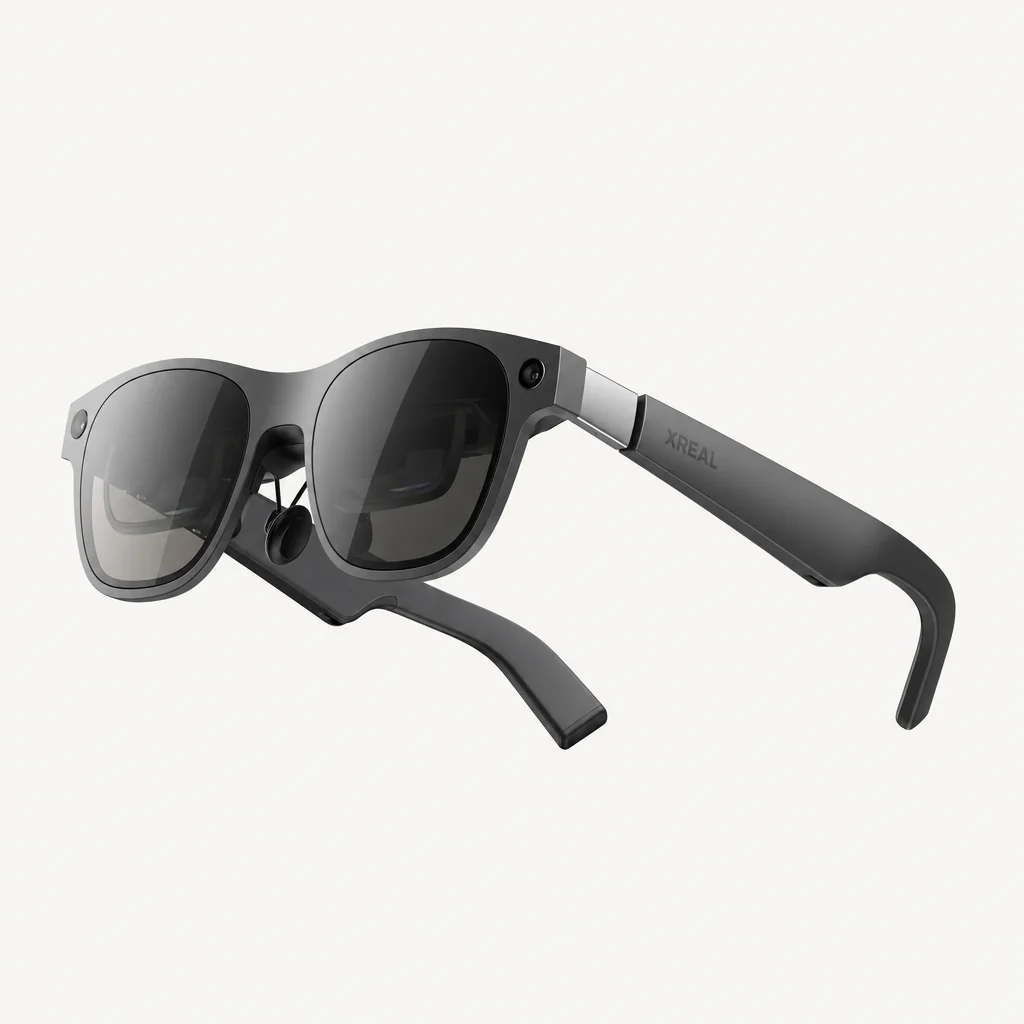
If the Ultra is the showpiece, the regular Xreal Air 2 is the one I'd most often actually recommend. It's the model that sells in volume, and for very good reason: it does the one thing most buyers actually want — give you a giant private screen on the move — and it does it cheaply and lightly.
The Air 2 uses a smaller 0.55" Sony Micro-OLED panel with a 46° field of view and Xreal's older Optic Engine 2.0. Resolution is still a sharp 1920×1080 per eye with a 120Hz refresh rate, so for films, TV and most gaming you genuinely won't see a meaningful difference in image quality between this and its bigger brother. Where you do feel the difference is in the head: the Air 2 is noticeably lighter and slimmer on the face. Tracking is 3DoF only — these don't understand your room, just the orientation of your head — which is fine for media but means you need Xreal's separate Beam or Beam Pro accessory if you want a virtual screen that stays put in space rather than floating with your gaze.
It currently sells at £199 direct from Xreal's UK store, which is the most reasonable entry point into the whole category.
For most people, the cheaper Xreal Air 2 is the smart buy — same Sony Micro-OLED tech, half the weight on your wallet.
Rokid Max 2 — The Best Pick for Spectacle-Wearers
The Rokid Max 2 is the pair I keep coming back to specifically for one feature almost nobody else does properly: a built-in diopter dial on each lens, adjustable from 0.00D to −6.00D. If you're nearsighted within that range — which covers a huge slice of the UK adult population — you can just spin the wheels and get a sharp image. No prescription inserts to order, no waiting two weeks for lenses, no faff. That alone makes them a genuinely different proposition for glasses-wearers.
The rest of the spec is squarely in flagship territory. Sony Micro-OLED panels, 50° field of view, 120Hz refresh rate, 600 nits of manually-adjustable brightness and a claimed 100,000:1 contrast ratio. The simulated screen size is rated at 215 inches at a six-metre virtual distance, which is silly in the best possible way. At 75g they're actually lighter than the Air 2 Ultra, and the titanium-alloy hinges feel hard-wearing in a way that a lot of plastic-heavy competitors don't.
Compatibility is excellent. The Max 2 will plug into Android phones running Android 10 or later, iPhone 15 onwards (anything with USB-C, basically), 2020-or-newer iPads, USB-C MacBooks, Windows laptops, Nintendo Switch, Steam Deck, and PS4/5 or Xbox Series X/S via the appropriate adapter. HDCP is supported, so Netflix and Disney+ playback works properly without dropping to a black screen — a surprisingly common failure mode on cheaper rivals.
Two specific things to know. First, there's no electrochromic dimming — instead, Rokid bundles a physical blackout shade that clips over the front. It's lower-tech but it works. Second, the on-board audio is fine for podcasts but I'd describe it charitably as "middling" — bring earbuds for music or films. TÜV Rheinland eye-comfort certification is present, as you'd expect at this tier.
Pro Tip
If your prescription sits between −0.25D and −6.00D and you don't have significant astigmatism, the Rokid Max 2's built-in diopters are a game-changer. Order them, charge nothing extra, and skip the prescription-insert lottery entirely. If you've got astigmatism or sit outside that range, you'll need to fall back to inserts on Xreal or Viture instead.
Match the glasses to the job: media and productivity, or quick glanceable info.
Viture One, Pro and Beast — The Most Polished Ecosystem
Viture's hook isn't a single product — it's the whole stack. Three current models, a consistent design language, electrochromic film across the range, Harman-tuned audio, and the SpaceWalker app for taming your virtual screen on Android phones. If you want the most "Apple-like" feel in this category, Viture is it.
Viture's range — One, Pro and Beast — covers the entry, sweet-spot and flagship tiers with a consistent design language and the SpaceWalker software ecosystem tying them together.
Viture One — the legacy entry
The original Viture One is the model that put the company on the map. It introduced the electrochromic dimming film and Harman spatial audio that have stayed core to every subsequent model. It launched in the US at £429. It's been superseded by the Pro and Beast now, but if you find one discounted it's still a solid pair of media glasses with a coherent ecosystem behind it.
Viture Pro — the sweet spot
The Viture Pro is the model I'd point most enthusiasts toward in this range. It's the mid-tier flagship with a brighter 1000-nit Micro-OLED panel, the same electrochromic film for blocking out the real world when you want to disappear into a film, Harman spatial audio that's genuinely one of the better speaker setups in the whole category, and — crucially — myopia adjustment built into the optics down to −5.0D. If your prescription is within that range, you skip prescription inserts entirely, just like on the Rokid Max 2.
Viture Beast — the top of the range
And then there's the Beast, which is Viture's current top-of-the-line model. The headline figure is a 174-inch virtual screen and 1250-nit panel brightness — high enough to remain comfortably visible even in fairly bright outdoor conditions, which is rare. You get the same Harman audio, the same electrochromic film, 3DoF tracking, and Viture's "VisionPair" customisation for tuning the image to your eyes. It's positioned squarely against the Xreal Air 2 Ultra but with a different philosophy — the Beast is about being the best possible passive media screen, where the Ultra is about being a proper spatial computer.
Brightness isn't everything, but it's the single biggest determinant of whether you can use these glasses anywhere other than a darkened room. On that metric Viture's flagship pulls clearly ahead.
Ray-Ban Meta Gen 2 — The AI Alternative
See Ray-Ban Meta Gen 2 on Amazon UK
Check today's price & availability on Amazon UK
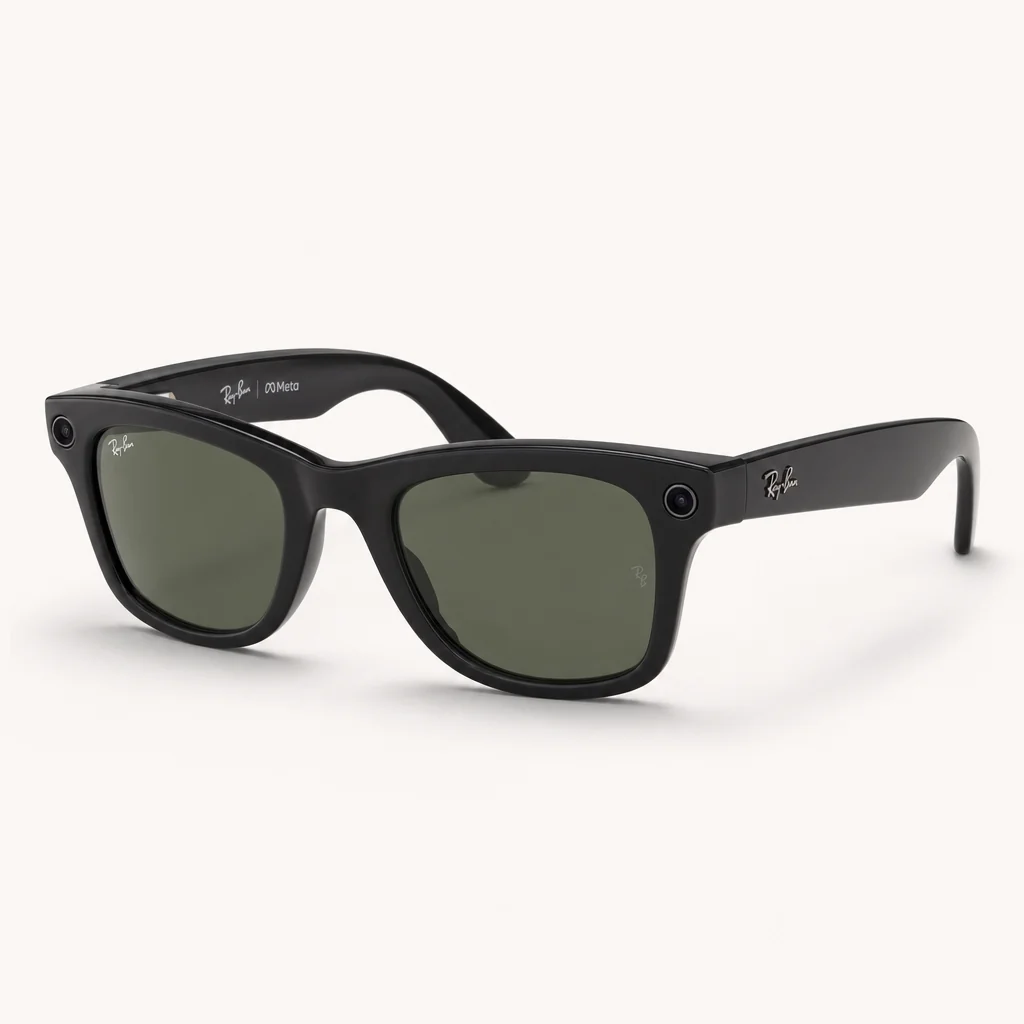
I'm including the Ray-Ban Meta Gen 2 here because if you searched "AR glasses UK" there's roughly a 40% chance this is actually what you wanted, not a tethered display. Let me be unambiguous: the Ray-Ban Meta has no display whatsoever. You will not see Netflix, you will not see a virtual monitor, you will not see overlays on the world. There is no screen.
What you do get is a normal-looking pair of Wayfarers (or Headliners, or Skylers — Meta has properly invested in real Ray-Ban frames rather than awkward tech-bro silhouettes) with a camera, dual open-ear speakers, an array of microphones, and Meta AI on call. You ask the glasses what something is, you take POV photos, you livestream, you control Spotify with your voice, you get directions whispered in your ears. The hardware essentially disappears — they look like glasses, because they are glasses.
This is "AR" in the loosest possible sense — it's AI-augmented reality rather than visually-augmented reality. If you want a private screen for films and games, do not buy these. If you want a discreet camera and a voice assistant on your face, they're the only game in town that doesn't look ridiculous.
Worth knowing: Meta AI features in the UK have historically rolled out later than in the US, and some functionality depends on the Meta View app and a current Meta account. Check the current UK feature availability before you buy — what works in California may not yet work in Cardiff.
Head-to-Head Comparison
Here's how the display-glasses contenders stack up against each other on the specs that actually matter day-to-day. (I've left Ray-Ban Meta out of this one because comparing a camera-only product against display glasses is genuinely apples and oranges.)
| Feature | Xreal Air 2 Ultra | Rokid Max 2 | Viture Beast |
|---|---|---|---|
| Panel type | Sony 0.68″ Micro-OLED | Sony Micro-OLED | Micro-OLED |
| Resolution per eye | 1920×1080 | 1920×1080 | Up to 1200p |
| Field of view | 52° | 50° | 58° |
| Refresh rate | Up to 120Hz | 120Hz | Not stated on the cited manufacturer page |
| Peak brightness | 500 nits | 600 nits | 1250 nits |
| Weight | 83g | 75g | Not stated on the cited manufacturer page |
| Tracking | Full 6DoF + depth sensors | 3DoF | 3DoF |
| Electrochromic dimming | 3-stage (0%/35%/100%) | Physical shade cover | Electrochromic film |
| Built-in myopia adjustment | No (prescription frame) | 0.00 to −6.00D | To −5.0D (Pro) / VisionPair |
| Audio | Stereo + leakage reduction | Stereo (modest) | Harman spatial audio |
| Frame material | Titanium | Titanium-alloy hinges | Premium build |
| Best for | Spatial computing / dev | Spectacle-wearers | Media in bright rooms |
There's no single "best" pair — the right answer depends entirely on whether you want spatial features, the brightest screen, or the easiest experience for spectacle-wearers.
UK Pricing and Availability — The Honest Bit
Here's where I have to be brutally honest. UK pricing in this category moves around constantly, models get bundled with Beam accessories or prescription inserts at different times, and Amazon listings frequently undercut direct prices or vice versa. The only confirmed UK price I'd stake my reputation on right now is the Xreal Air 2 at £199 direct from Xreal's UK store — that's the cheap, sensible entry into the category and it's properly priced.
For everything else — Air 2 Ultra, Rokid Max 2, Viture's full range, Ray-Ban Meta — pricing depends heavily on the bundle, retailer and current promotion. Rather than quote numbers that might be wrong by the time you read this, I'd strongly suggest checking the latest price and any bundle deals on Amazon UK before you commit.
Check the latest price and any current bundles on Amazon.
My Overall Rankings
If I had to rate the field as a whole — weighing display quality, comfort, ecosystem and how much you actually get for the asking price — here's where I'd land.
The two weak points across the board are the same ones the category has had for two years now: none of the tethered display glasses contain a battery, so you're permanently leashed to a phone or laptop, and the software / app ecosystems are still nowhere near as polished as Meta's Horizon OS on a Quest. Both will improve. Neither should stop you buying today.
Who Should Buy What?
Developers and spatial-curious enthusiasts
Xreal Air 2 Ultra. It's the only pair here with real 6DoF, depth sensors and a proper SDK.
Frequent flyers and commuters
Xreal Air 2. Cheapest entry, lightest weight, plugs straight into a USB-C phone. £199 well spent.
Anyone who wears prescription specs
Rokid Max 2 if you're between 0 and −6.00D. Viture Pro if you're up to −5.0D and want better audio.
Home cinema and bright-room users
Viture Beast. 1250 nits and Harman audio is the most cinematic experience in the category.
Steam Deck and console gamers
Rokid Max 2. Confirmed broad compatibility with Switch, Steam Deck, PS4/5 and Xbox Series.
You wanted AI, not a screen
Ray-Ban Meta Gen 2. Different product, different category — but the right one if you want a discreet camera and Meta AI.
Frequently Asked Questions
The Verdict
There's no single "best" pair of AR glasses for UK buyers in 2026 — there's a best pair for what you actually want to do. For the genuine spatial-computing future, the Xreal Air 2 Ultra is the only realistic choice with its 6DoF tracking, depth sensors and Nebula SDK. For the easiest, cheapest entry, the Xreal Air 2 at £199 remains the smartest buy in the category. For spectacle-wearers, the Rokid Max 2's built-in diopter dial is genuinely transformative. For the best living-room media experience, the Viture Beast's 1250-nit Harman-tuned setup is unmatched. And if you actually wanted AI and a camera rather than a screen, the Ray-Ban Meta Gen 2 is the only pair that doesn't look daft. Pick the one that matches what you'll actually do — not the one with the loudest marketing — and you'll be very happy.
Some images in this article are illustrative scenes generated by AI for editorial context. Photos of named products are real product photography. The brands and models discussed are unaffiliated with the imagery.
 Xreal Air 2View on Amazon
 Ray-Ban Meta Gen 2View on Amazon