
Steam Machine 2026: What Valve's Living-Room PC Means for Gamers
Valve is back in the living room with a proper little powerhouse. Here's everything we know about the specs, the rumoured tiers, and how it stacks up against handhelds and consoles.

The 2026 Steam Machine is a compact black cube built around a single large cooling fan.
So what exactly is this thing? In short, it's a compact small-form-factor PC that Valve designed and engineered itself, rather than licensing the name out to third parties as it did the first time around. It runs the same SteamOS 3 lineage as the Steam Deck — Arch Linux underneath with the KDE Plasma desktop — and it's aimed squarely at people who want a console-style "press the button, start playing" experience but with the open library and flexibility of a PC. It was announced in November 2025 with a confirmed Summer 2026 launch window, and hardware has already been shipped to US warehouses, so it's very much real and very much imminent.
In this piece I'll walk through the confirmed specifications, the model range (including the SKUs that have been spotted lurking in Steam's own metadata), the early performance picture, and — crucially — how it compares to a gaming handheld and to the current console crowd. Let's dig in.
What's in this review
- The model range explained
- Full confirmed specifications
- CPU and GPU performance
- Ports, connectivity and the HDMI question
- SteamOS and the software story
- How it compares to consoles & handhelds
- Pros and cons
- Who should actually buy one
- FAQ and final verdict
Concept visualisation for illustration — based on rumoured specs, not a confirmed design.
The Steam Machine model range
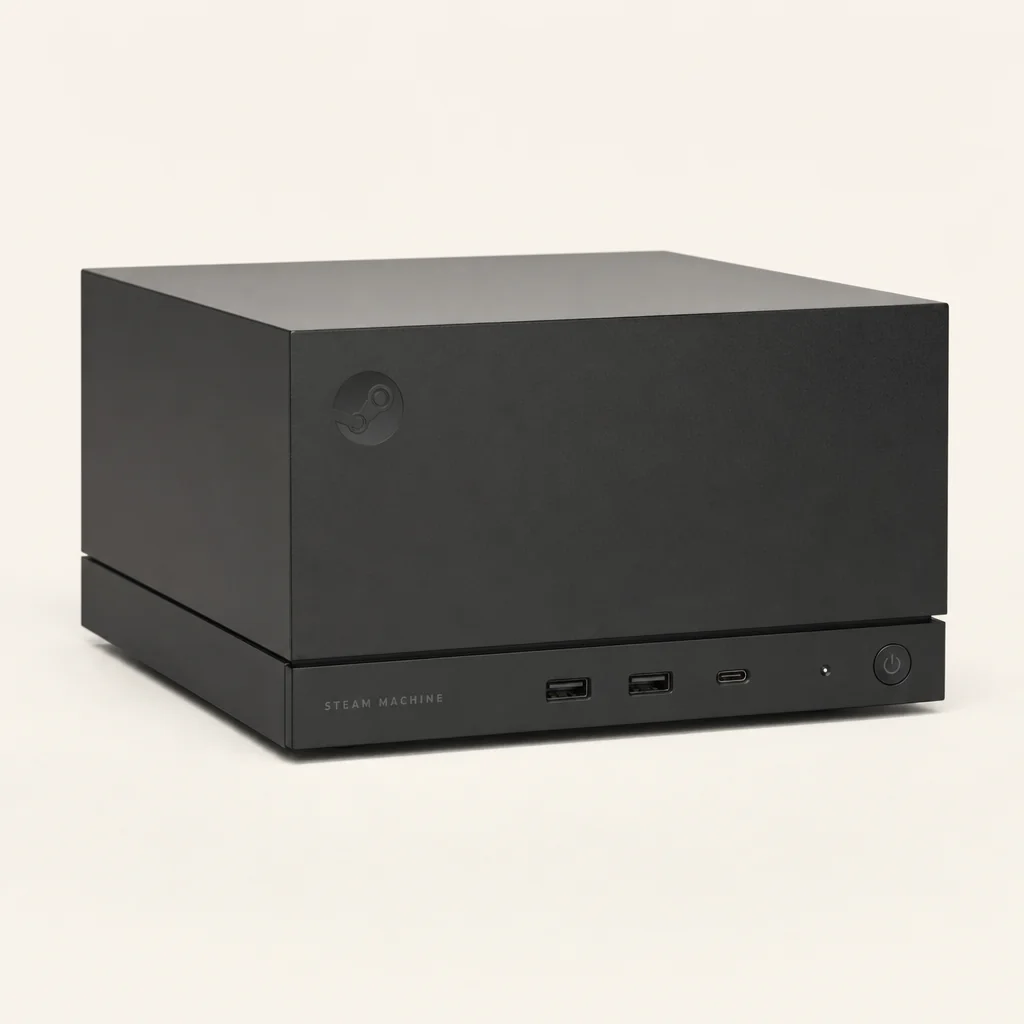
Valve is launching the Steam Machine as a multi-tier range. Officially, the company has described two configurations, distinguished purely by storage: a 512GB base model and a 2TB higher-storage model. Critically, both share exactly the same silicon — the CPU, GPU, RAM and form factor are identical. The only difference between the two officially described units is how much built-in storage you get out of the box.
Interestingly, sleuths digging through the Steam client metadata have spotted hints of four total SKUs sitting in Valve's pipeline, suggesting additional tiers beyond the two storage variants we've had formally described. The exact specs of those extra tiers haven't been confirmed publicly, so I'd treat them as a "watch this space" rather than anything you can plan a purchase around. For now, the safe assumption is: pick your storage capacity, and you're getting the same machine either way.
Steam Machine (512GB)
The base configuration — a compact cube SFF PC running SteamOS 3, with the same internal silicon as its bigger sibling. The sensible choice if you mostly stream, play a focused library, or plan to expand storage yourself.
Steam Machine (2TB)
The higher-storage variant. Every other spec is identical to the 512GB model, so you're paying purely for the extra room — handy given how chunky modern PC installs have become.
Storage isn't a one-shot decision. Both models can be expanded internally with NVMe SSDs, and externally via microSD cards — so even the 512GB unit needn't feel cramped if you're comfortable popping the lid or slotting a card in.
Full confirmed specifications
Here's the heart of it. Because both models run identical hardware, this single spec sheet applies right across the range — only the storage figure shifts depending on which box you buy.
A few things jump out at me here. First, that CPU: a semi-custom AMD chip with six Zen 4 cores and twelve threads clocking up to 4.8 GHz, but doing so within a remarkably modest 30-watt power envelope. Valve reckons it delivers performance comparable to a desktop Ryzen 5 7600X, which is a genuinely capable mid-range gaming CPU. The Vulkan certification database backs the story up too — the listing, filed as "AMD Steam Machine," exposes a custom processor designated "AMD Custom CPU 1772" running on Valve's own Neptune Linux kernel branch.
The graphics side is where the family resemblance to the Steam Deck ends and the "this is a proper living-room machine" story begins. The GPU is RDNA 3-based with 28 compute units, clocking up to 2.45 GHz and drawing around 110 watts. The Mesa driver identifies it as RADV_NAVI33 — pointing to AMD's Navi 33 architecture, the same chip family behind the RX 7600-series desktop and mobile GPUs. Valve positions this comfortably above the Steam Deck and just below a Radeon RX 7600. Their headline claim? The new Steam Machine is more than six times more powerful than the Steam Deck handheld.
A 120mm fan dominates the internal layout, with the whole chassis essentially designed around it.
Memory and upgradeability
The 16GB of DDR5 system memory is paired with 8GB of dedicated GDDR6 for the graphics — a split-pool arrangement that should keep modern game assets fed nicely. What I particularly like is the upgrade story. The M.2 NVMe SSD is user-replaceable and supports both 2230 and 2280 form factors, and the 16GB DDR5 SO-DIMM is replaceable too. Valve does flag that swapping the RAM is the more involved job because of the tightly packed thermal design, so it's not quite as casual as sliding a microSD card in — but the fact it's possible at all is exactly the sort of PC-flavoured flexibility consoles simply don't offer.
Pro tip
If you go for the 512GB model to save a bit, factor in the cost of an aftermarket NVMe SSD. The Steam Machine accepts both 2230 and 2280 drives, so you've got loads of choice — and adding your own storage is almost always cheaper than paying for the larger factory configuration. The microSD slot on the front is the no-tools fallback for installs you don't mind running a touch slower.
Form factor and design
Physically, the Steam Machine is a roughly cubical black box measuring 156 × 152 × 162 mm (about 6.1 × 6.0 × 6.4 inches) and weighing 2.6kg. The entire chassis is essentially built around a single 120mm cooling fan, which is the kind of engineering decision that tends to pay off in low noise levels — big, slow-spinning fans generally beat small, screaming ones. On the front you get a removable faceplate plus a customisable LED light strip running 17 individually addressable RGB LEDs, used for system status and a bit of personalisation. It's a tidy, unobtrusive little cube that should slot under a telly without dominating the shelf.
Ports, connectivity and the HDMI question
For such a compact box, the I/O is generous. Round the back you'll find one DisplayPort 1.4, one HDMI 2.0, two USB-A 2.0, one USB-C 3.2 Gen 2, and a gigabit Ethernet port. The front adds two USB-A 3.2 Gen 1 ports, a microSD card slot, a power indicator LED and the power button. The power supply is fully integrated into the chassis, so there's just an AC port on the rear — no chunky external brick to hide, which is a small but meaningful win for living-room tidiness.
Two display paths
DisplayPort 1.4 handles high-refresh 4K (up to 240Hz) or 8K at 60Hz with HDR and FreeSync. HDMI 2.0 covers up to 4K 120Hz with HDR, FreeSync and TV control via CEC.
Modern wireless
Wi-Fi 6E and Bluetooth 5.3 are on board, plus a dedicated 2.4GHz adapter for the new Steam Controller. There are four antennae in total — two for Wi-Fi, one for Bluetooth, and one solely for connecting up to four controllers at once.
Plenty of USB
Five USB ports across front and back, mixing modern USB-C 3.2 Gen 2 and USB-A 3.2 Gen 1 with a pair of slower USB-A 2.0 ports for peripherals like keyboards and dongles.
There's no HDMI 2.1 and no Thunderbolt here. The HDMI 2.0 limitation is a deliberate consequence of Valve relying on open-source drivers — the HDMI Forum still doesn't provide open documentation. If you want full 4K at 120Hz (or beyond), the answer is to use DisplayPort rather than HDMI.
This is one of those quirks that's worth understanding before you buy. If your TV or monitor has a DisplayPort input, brilliant — you've got headroom all the way up to 4K/240Hz or 8K/60Hz. If you're plugging into a typical living-room telly via HDMI, you're capped at 4K 120Hz, which honestly is still more than most TVs and most games will need. It only really stings for the niche crowd chasing very high frame rates at 4K over HDMI. For the vast majority, the HDMI 2.0 path is perfectly fine.
The rear panel keeps things simple: DisplayPort, HDMI, USB, gigabit Ethernet and an integrated AC power input.
Performance: what to expect
Here's where I have to be straight with you: as things stand, the Steam Machine hasn't shipped to consumers, so there are no full independent retail benchmarks yet. What we do have are Valve's own claims and some sensible comparisons against the closely related hardware the chips are based on. So treat the figures below as the early performance picture rather than a finished verdict.
The most useful headline number is raw GPU throughput. Despite having fewer compute units than a PlayStation 5 (28 versus the PS5's 36), the Steam Machine is expected to land at roughly 10.5 to 11.5 TFLOPS, edging past the PS5's 10.28 TFLOPS thanks to higher clock speeds and the architectural gains of RDNA 3. That's a striking result — it means a far smaller, far quieter box is theoretically trading blows with a full-fat console on raw graphics horsepower.
The other comparison worth anchoring on is the Steam Deck itself. Valve's claim that the new machine is more than six times more powerful than the handheld is significant, because it tells you exactly what role this device is meant to play. The Deck is the device you take to bed or on the train; the Steam Machine is the device you sit in front of the big telly. They share an OS and an ecosystem, but they're aimed at completely different sofa-versus-suitcase scenarios.
A realistic expectation
With a GPU positioned below a Radeon RX 7600 but well above the Steam Deck, the Steam Machine looks built for comfortable 1080p and capable 1440p gaming, with 4K on the table for less demanding or well-optimised titles — exactly where you'd expect a console-class living-room PC to live. Don't go in expecting an RTX flagship; do expect a box that punches well above its tiny footprint.
SteamOS: the software story
Hardware is only half the picture — the experience is defined by the software, and this is where Valve has the home advantage. The Steam Machine runs a customised version of SteamOS 3, the same Arch Linux foundation with KDE Plasma desktop that powers the Steam Deck. That matters enormously, because the Steam Deck has spent years maturing SteamOS into something that genuinely feels console-like: you boot into a tailored Big Picture-style interface, your library is right there, and Proton handles the compatibility layer that lets a huge swathe of Windows games run on Linux without you having to think about it.
Because it inherits all of that work, the Steam Machine arrives with a software platform that's already been battle-tested by millions of Deck owners, rather than starting from scratch the way the first-generation Steam Machines did a decade ago. That alone makes me far more optimistic about this attempt.
Console-style by default
SteamOS comes preinstalled and boots into a living-room-friendly interface designed for a controller and a sofa rather than a mouse at a desk.
But it's still a PC
Unlike a sealed console, you're completely free to install Windows or any other operating system on it. The openness that defines PC gaming stays intact.
Built for the new controller
The dedicated 2.4GHz adapter and antenna let it pair with up to four of the second-generation Steam Controllers simultaneously — couch co-op sorted out of the box.
That last point — the ability to install Windows — is the quiet superpower of this whole concept. A PS5 or Xbox is what Sony or Microsoft says it is, full stop. The Steam Machine can be the slick SteamOS console for most of the year and then, if you really need a particular Windows-only app or an anti-cheat title that doesn't play nicely with Linux, you've got an escape hatch. You don't get that with a console, and you don't get the console-grade plug-and-play simplicity with a self-built mini PC. The Steam Machine sits neatly in the middle.
Steam Machine vs console vs handheld
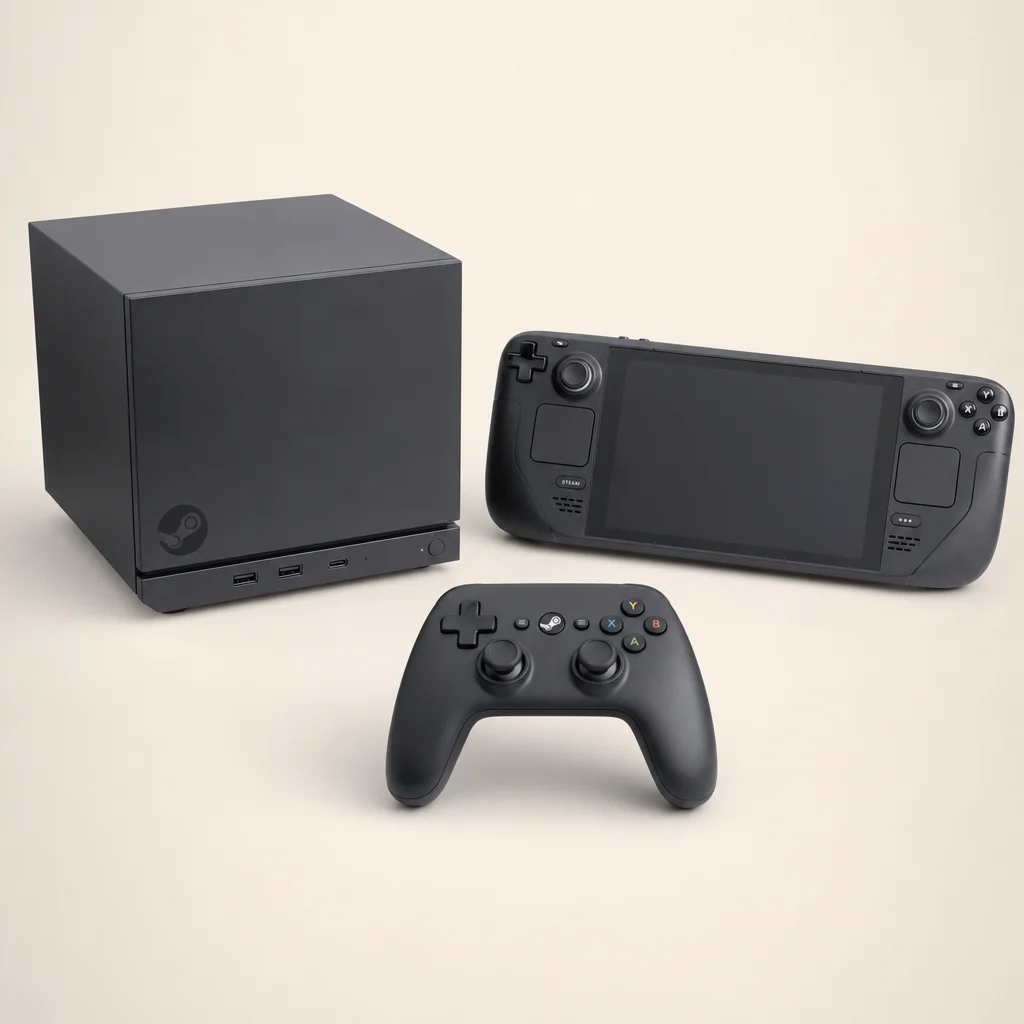
This is the comparison most people will care about. Where does a SteamOS living-room cube fit in a world that already has the PlayStation 5 and the Steam Deck? Let's lay it out plainly.
| Feature | Steam Machine 2026 | PlayStation 5 | Steam Deck (handheld) |
|---|---|---|---|
| Form factor | Compact desktop cube (156 × 152 × 162 mm, 2.6kg) | Large console | Portable handheld |
| Architecture | Semi-custom AMD, Zen 4 CPU + RDNA 3 GPU | Custom AMD | Custom AMD APU |
| Compute units | 28 | 36 | Fewer than Steam Machine |
| Raw GPU throughput | ~10.5–11.5 TFLOPS (estimated) | 10.28 TFLOPS | Far lower |
| Relative GPU power | 6×+ the Steam Deck | 10.2 teraflops (RDNA 2) | Baseline |
| Operating system | SteamOS 3 (Windows installable) | Closed console OS | SteamOS 3 |
| User-upgradeable storage | NVMe (2230/2280) + microSD | NVMe expansion | NVMe + microSD |
| Top display output | 4K/240Hz or 8K/60Hz via DisplayPort | 4K/120Hz | Built-in screen |
| Mobility | Mains-powered, fixed | Mains-powered, fixed | Battery, fully portable |
The takeaway? Against the PS5, the Steam Machine is competitive on raw graphics throughput while being far smaller, and it brings the entire openness of the PC platform — a vast Steam library, mod support, the ability to run a different OS entirely. The trade-off is that consoles still benefit from tightly optimised first-party exclusives and a completely walled-off, hassle-free environment.
Against the Steam Deck, there's barely any contest in raw power — the Steam Machine is the more-than-six-times-more-powerful sibling. But that misses the point: the Deck wins on portability and the Steam Machine wins on the big screen. The genuinely clever bit is that they speak the same language. Your Steam library, your saves, your settings — they live across both. For a lot of people, the dream setup might be a Deck for travel and a Steam Machine under the telly, sharing one ecosystem.
The "best of both worlds" play
Because both devices run SteamOS, owning a Steam Deck and a Steam Machine isn't redundant — it's complementary. Cloud saves and a shared library mean you can pick up your handheld game right where you left it on the big screen, and vice versa. That cross-device continuity is something neither Sony nor Microsoft can match today.
A SteamOS living room machine that shares its library with the Steam Deck — the handheld-to-telly continuity is a real selling point.
The good and the not-so-good
Pros
- Genuinely strong raw GPU throughput — estimated to edge past the PS5's 10.28 TFLOPS
- More than six times the power of the Steam Deck, in a tiny 2.6kg cube
- Mature, console-like SteamOS experience inherited from the Steam Deck
- User-replaceable NVMe SSD (2230/2280) and SO-DIMM RAM, plus microSD expansion
- Freedom to install Windows or another OS — true PC openness
- Built around a quiet-friendly 120mm fan with an integrated PSU (no brick)
- Generous I/O and high-end display support up to 8K/60Hz over DisplayPort
Cons
- No HDMI 2.1 — you need DisplayPort to exceed 4K/120Hz
- No Thunderbolt support
- RAM upgrades are fiddly thanks to the compact thermal design
- GPU sits below a Radeon RX 7600, so it's not a 4K-everything powerhouse
- Independent retail benchmarks aren't available yet ahead of the Summer 2026 launch
- Console exclusives still live elsewhere — this is a PC, not a PlayStation
Who should buy the Steam Machine?
The console-curious PC fan
If you love the openness of Steam but want a plonk-it-under-the-telly, controller-first experience without building a PC yourself, this is almost tailor-made for you.
The existing Steam Deck owner
Already living in SteamOS on the go? A Steam Machine extends that exact library and save-sync to your living room with six-times-plus the horsepower.
The tinkerer
Replaceable NVMe and RAM, microSD expansion and the option to install Windows mean this rewards anyone who likes to fiddle, upgrade and customise.
Who might want to look elsewhere? If your gaming life revolves around PlayStation or Xbox exclusives, a dedicated console still makes more sense. And if you're chasing absolute top-tier 4K performance with ray tracing maxed out, a full-size gaming PC with a more powerful discrete GPU will leave this little cube behind. But for the sweet spot — comfortable 1080p/1440p living-room gaming with PC flexibility — the Steam Machine is shaping up to be a compelling option.
Thinking of picking one up?
The Steam Machine is launching in a Summer 2026 window. Check the latest price and any current bundles on Amazon.
Frequently asked questions
Our rating
Pre-launch rating based on confirmed specifications and Valve's stated performance positioning; subject to revision once retail review units are tested.
The verdict
Valve's first attempt at a Steam Machine flopped because it was a half-hearted, third-party affair with immature software. This 2026 effort is the polar opposite: a purpose-built, semi-custom AMD machine engineered by Valve itself, riding on the back of years of SteamOS maturity earned through the Steam Deck. The specifications tell a confident story — a Zen 4 CPU in the league of a Ryzen 5 7600X, an RDNA 3 GPU more than six times the power of the Deck, and estimated raw graphics throughput that nudges ahead of the PlayStation 5, all inside a quiet 2.6kg cube.
It isn't flawless. The lack of HDMI 2.1 means high-refresh 4K demands a DisplayPort connection, there's no Thunderbolt, and the GPU sits just below an RX 7600 rather than challenging the high end. We also can't fully judge real-world frame rates until retail units land in the Summer 2026 window. But the proposition is genuinely exciting: console-style simplicity, PC-style openness, user-upgradeable storage and RAM, and seamless continuity with the Steam Deck.
If Valve gets the pricing right when it's revealed, the Steam Machine could be the most compelling living-room gaming device of the year — and the rare PC that feels like it actually belongs next to the telly. Colour me impressed, and keep an eye on that summer launch.