
PlayStation 6 Rumours: When It's Launching and What's Inside
Everything the leaks claim about Sony's next console — the "Orion" home machine, the "Canis" handheld, and how confident we really are about each thread.
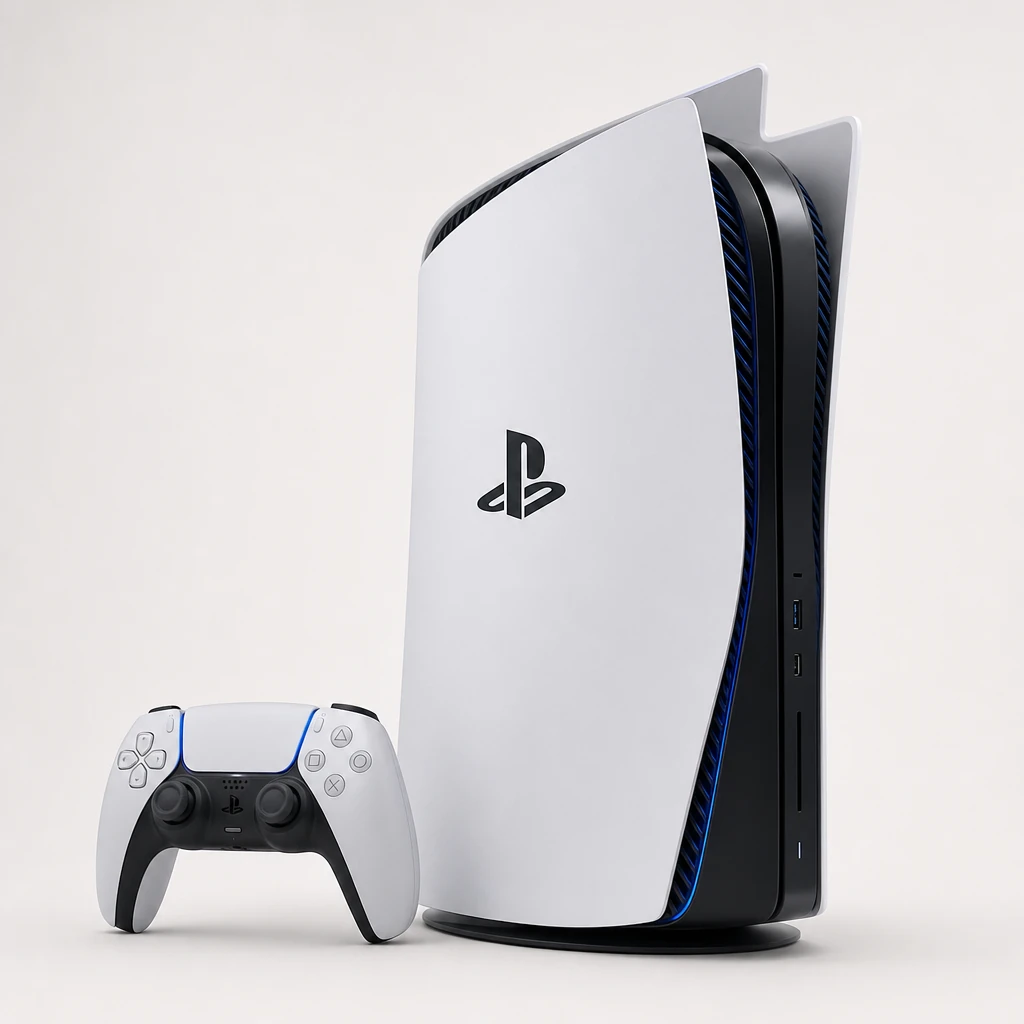 Illustrative concept image, not an official photo
Sony has yet to show any PS6 hardware publicly — every image circulating is fan-made or conceptual.
Concept image - the PlayStation 6 has not been officially announced.
If you've been following PlayStation chatter on the forums and leak channels, you'll know the PS6 conversation has gone from idle daydreaming to surprisingly detailed silicon talk over the past year. AMD documentation has reportedly leaked, supply-chain whispers have firmed up, and a couple of well-regarded names — Tom Henderson at Insider Gaming, Bloomberg's reporting team, and the leak channel Moore's Law Is Dead (MLID) — have kept the rumour mill spinning. But "detailed" is not the same as "true," and a lot of what's floating around deserves a healthy pinch of salt.
So in this piece I'll lay out what's being said about the launch window, the rumoured line-up, the leaked internals, the design, what looks unchanged, and the biggest open questions. Crucially, I've included a dedicated "How confident are we?" section that grades each rumour High, Medium or Low — because frankly, that's the only responsible way to write about a product that doesn't officially exist yet.
What this article covers
- The one official statement that anchors everything
- Expected launch window (and why it's murky)
- The rumoured three-SKU line-up
- Leaked "Orion" home console specs
- The "Canis" handheld leaks
- Backward compatibility and AI tech
- What looks unchanged vs PS5
- How confident are we? (graded)
- The biggest open questions
- When will we know for sure?
Concept visualisation for illustration — based on rumoured specs, not a confirmed design.
The one thing Sony has actually said
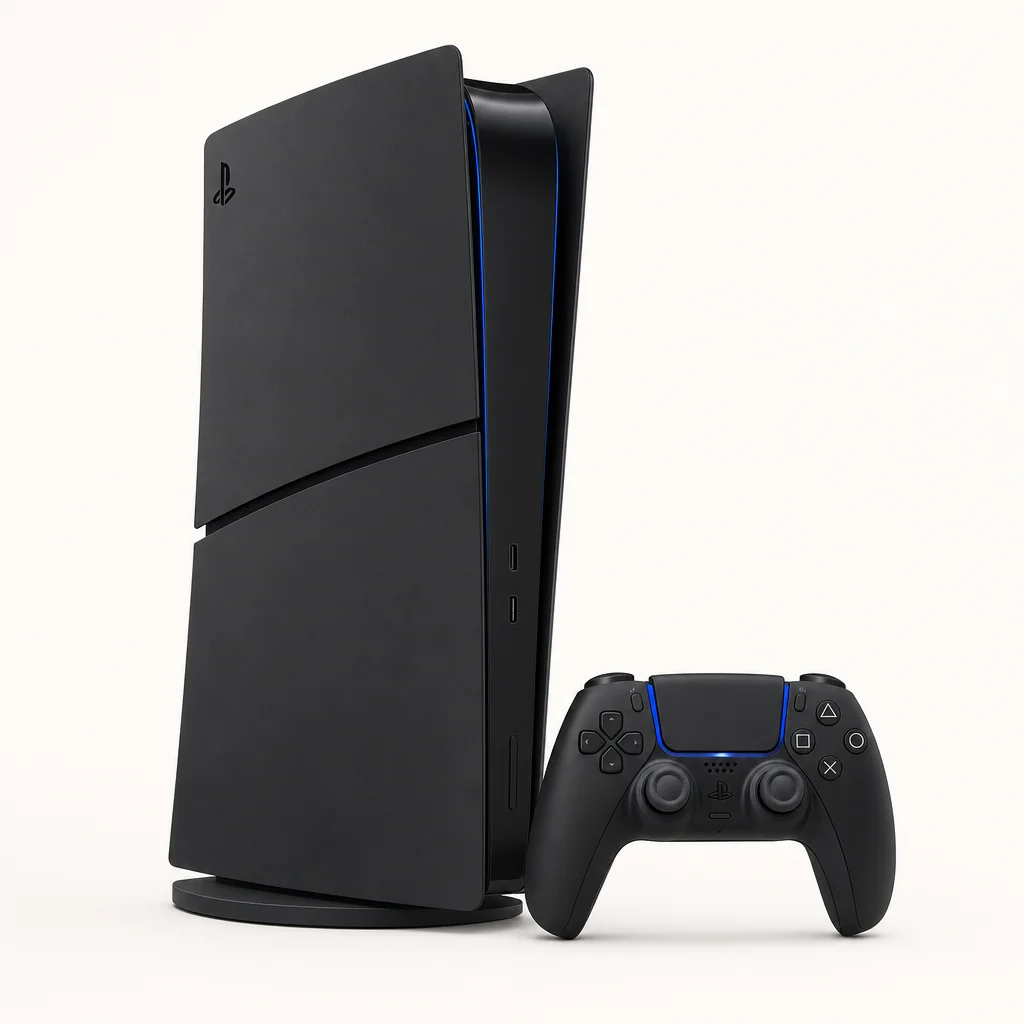
Before we wade into leaks, here's the firmest ground we've got. On 8 May 2026, during an earnings call with investors, Sony president and CEO Hiroki Totoki addressed the PS6 question directly and said the company has not yet decided when it will launch the next console or how much to charge for it. His exact words: "We have not yet decided on at what timing we will launch the new console, or at what prices."
That's it. That's the entire body of official communication on the PlayStation 6, and everything else in this article sits underneath it. If a leak contradicts that baseline — if someone tells you confidently that the PS6 launches on a specific date at a specific price — they're getting ahead of Sony's own stated position. Keep that in mind throughout.
Because no prices and no release date have been confirmed by Sony, this is a journalism/preview piece. There are deliberately no buying links, no price grids and no "value for money" verdicts here — you can't sensibly judge value on a machine nobody can buy or has officially priced.
Expected launch window
This is one of the murkier threads, so let's be careful. There's no confirmed release date, and Totoki's statement makes clear Sony itself hasn't locked one in. What the leak ecosystem broadly converges on is a launch somewhere in the late 2027 to 2028 window — a sensible-looking gap from the PS5's late-2020 debut and consistent with Sony's roughly seven-year console cadence.
I'd treat any specific date you see as speculation rather than reporting. The reason the window is presented as a range rather than a date is precisely because the sources disagree on the finer detail, and Sony hasn't given them anything firm to anchor to. The PS5 Pro's mid-generation positioning is also part of the conversation — a Pro refresh tends to buy a platform holder more runway, which some leakers read as gentle evidence that Sony isn't rushing the PS6 out of the door.
How to read launch-window leaks
When multiple leakers all say "late 2027 or 2028," that consensus is itself the signal — not because they've each independently confirmed a date, but because it reflects the realistic manufacturing and platform timelines they're all working backwards from. A precise day-and-month claim, by contrast, is almost always someone guessing.
The rumoured line-up: three SKUs?
One of the more interesting wrinkles in the PS6 rumour cycle is that it may not be a single box at all. Three distinct hardware SKUs are circulating in the leak ecosystem — and none has been officially confirmed by Sony. Here's how they break down.
PS6 Home Console — codename "Orion"
The flagship, full-fat home console. Leaked specs point to an AMD "Orion" APU built around Zen 6 CPU cores and an RDNA 5 GPU. The codename reportedly originates from leaked AMD documentation.
PS6 Handheld — codename "Canis"
A dedicated gaming handheld rumoured to launch alongside, or shortly after, the home console. Bloomberg first reported in 2024 that Sony was exploring a handheld internally dubbed "Project Canis," and multiple leakers have since corroborated the device's existence.
A possible entry-level "PS6S"
The least-corroborated thread suggests the generation could span three systems — an entry-level slim, a standard PS6 and the handheld — with prices reportedly ranging from roughly £300 to £849. Treat this one as highly speculative.
The handheld is genuinely the surprise here. PlayStation handheld fans had all but given up after the commercial disappointment of the PS Vita, so the idea of Sony returning to dedicated portable hardware in the PS6 era is a properly intriguing one. The Vita's failure casts a long shadow, mind, so I'd keep expectations measured even though the "Canis exists" claim is unusually well-supported by leak standards.
Leaks describe a potential three-tier PS6 generation: an entry-level slim, a standard console, and a dedicated handheld.
Leaked "Orion" home console specs
Right, the bit everyone scrolls to. Everything below is sourced from leaks — primarily MLID and the leaker known as KeplerL2 — and is not confirmed by Sony or AMD. I'm presenting it with that caveat front and centre. Read the numbers as "what the leaks claim," not "what the PS6 has."
The CPU: two flavours of Zen 6
The leaked Orion SoC reportedly uses two types of CPU cores. There are said to be eight Zen 6c cores with 16 threads available to games, plus two Zen 6 LP (Low Power) cores with four threads reserved for the operating system and background tasks. That's a total of ten cores, one of which could reportedly be disabled — a common move to improve manufacturing yields. If accurate, it's a neat split: keep the heavy lifting on the performance cores while offloading the OS housekeeping to efficient ones.
The GPU: RDNA 5, with yield headroom
On the graphics side, leaks point to an RDNA 5 GPU with 52–54 compute units, with two potentially disabled for yield, running at a clock somewhere between 2.6 and 3.0 GHz. That reportedly lands the rasterisation figure in the 34–40 TFLOPS range. A widely-circulated OC3D leak summarised the package as a 280 mm² TSMC 3nm die, 160W TDP, 54 RDNA 5 CUs (two disabled), eight Zen 6c cores (one disabled) and two Zen 6 LP cores, paired with a 160-bit GDDR7 memory bus.
Memory: fast, but the capacity isn't settled
The memory system reportedly runs on a 160-bit bus, with five memory slots each using 32 Gbps GDDR7 modules for around 640 GB/s of bandwidth. KeplerL2 corroborated this and noted the SoC would be paired with 3 GB GDDR7 modules in a clamshell configuration at 32 Gbps. The headline uncertainty is total capacity: depending on Sony's chosen configuration, the system could feature 30 GB or 40 GB of GDDR7 — and crucially, this reportedly hasn't been finalised, with memory pricing likely to influence the final figure.
Notice how even the leakers hedge on memory capacity. When the people doing the leaking say a number "hasn't been finalised," that's your cue to hold it loosely rather than quote it as gospel.
To give you a rough sense of the rumoured generational leap on raw rasterisation, here's how the leaked Orion figures stack up against the current PlayStation hardware. Again — these are leaked targets for the PS6 column, not measured results.
PS6 figures are leaked targets and unconfirmed; PS5 and PS5 Pro figures are Sony's published numbers, shown for context only.
Separate what Sony has actually hinted at from rumour before holding off on a PS5 Pro.
The "Canis" handheld leaks
Now for the portable. The "Canis" handheld has the unusual distinction of being seeded by a credible mainstream outlet — Bloomberg, in 2024 — and then fleshed out with hardware detail by leakers afterwards. That two-step provenance is part of why I rate its existence more highly than most PS6 rumours.
According to MLID's leaked figures, the Canis APU is a roughly 135 mm² TSMC 3nm chip pairing four Zen 6c cores with two Zen 6 LP cores reserved for the OS — essentially a scaled-down cousin of the Orion home-console silicon, which makes a lot of architectural sense. The GPU side is where the leaks get noisy: one figure pegs it at 16 RDNA 5 compute units running around 1.20 GHz in handheld mode, while an earlier leak suggested 12–20 CUs at 1.6–2.0 GHz. Those numbers haven't been reconciled, so I'd hold the handheld's exact GPU performance very loosely indeed.
Nothing credible has surfaced yet about the Canis handheld's display, battery life, weight or final form factor. Anyone describing those in detail is filling gaps with imagination, not leaks.
Backward compatibility and the AI tech stack
Two of the more strategically interesting rumours concern what the PS6 inherits and what it invents.
Backward compatibility
A leaked slide attributed to MLID suggests the PS6 would offer backward compatibility with both PS4 and PS5 libraries. If that holds, it would extend the broad backward-compatibility approach Sony took with the PS5 and would be very welcome — few things sting more than a generation jump that orphans your existing library. It's a single leaked slide, though, so I'd file it as plausible-but-unconfirmed rather than locked in.
The AI and upscaling stack
This thread is unusually well-supported. In October 2025, Sony's Mark Cerny and AMD publicly discussed collaborative R&D under the banner "Project Amethyst," covering technologies described as Neural Arrays, Radiance Cores and Universal Compression. Because that came from named figures rather than anonymous leakers, the existence of the collaboration is firmer ground than most. On top of that, leaks point to machine-learning-based upscaling along the lines of FSR 4 and a next-generation PSSR (sometimes referred to as PSSR 2.0). The upscaling specifics are leak-tier; the underlying AMD collaboration is the most concrete forward-looking detail we have.
Neural Arrays & Radiance Cores
Part of the publicly-acknowledged Project Amethyst collaboration between Mark Cerny and AMD — aimed at hardware better suited to machine-learning graphics work.
Next-gen upscaling (PSSR 2.0 / FSR 4-class)
Leaks point to a substantially upgraded machine-learning upscaler, building on the PSSR approach Sony introduced with the PS5 Pro.
Universal Compression
Another Project Amethyst pillar, reportedly aimed at squeezing more out of memory and bandwidth — relevant given the unresolved 30 GB vs 40 GB question.
The publicly-acknowledged "Project Amethyst" collaboration between Sony's Mark Cerny and AMD is among the firmest forward-looking signals.
What looks unchanged versus the PS5
It's easy to fixate on the new and shiny, but a chunk of the PS6 picture looks evolutionary rather than revolutionary — and that's not a criticism. Sticking with AMD silicon, keeping a custom APU architecture, retaining a fast SSD-based storage pipeline and (if the leaks hold) preserving backward compatibility all point to Sony refining the PS5 formula rather than tearing it up. The Gen5 SSD rumour in particular reads as a natural step up from the PS5's celebrated storage solution rather than a reinvention.
Equally, nothing credible has surfaced about a dramatic shift in the controller, the operating system philosophy or Sony's broader services strategy. In the absence of leaks suggesting otherwise, the safe assumption is continuity — the DualSense lineage, the PlayStation Network ecosystem and the general PlayStation user experience carrying forward in refined form.
What the leaks make me optimistic about
- A genuinely large rasterisation leap if 34–40 TFLOPS holds — multiples over the PS5
- Modern Zen 6 / RDNA 5 architecture on a TSMC 3nm node
- Fast GDDR7 memory at a rumoured ~640 GB/s
- PS4 and PS5 backward compatibility (single leaked slide)
- A publicly-acknowledged AI/upscaling collaboration with AMD
- The intriguing prospect of a dedicated PlayStation handheld returning
What's still genuinely uncertain
- No confirmed launch date — Sony itself says it hasn't decided
- No confirmed pricing for any model
- Memory capacity (30 GB vs 40 GB) reportedly not finalised
- Handheld GPU figures contradict each other and aren't reconciled
- The three-SKU theory is thinly corroborated
- Many specs rest on a single leaker rather than several
How confident are we?
This is the section I'd most want you to read. Below I've graded each major rumour thread High, Medium or Low confidence, with a one-line justification based on who reported it and whether it's been corroborated. Confidence here means "how likely is this broadly true," not "this is definitely the final spec."
Sony hasn't decided launch date or price
Direct on-record statement from CEO Hiroki Totoki on an 8 May 2026 earnings call.
Late 2027 / 2028 launch window
Broad leaker consensus consistent with Sony's console cadence — but a window, not a date.
AMD Zen 6 CPU + RDNA 5 GPU architecture
Reported by multiple sources and consistent with AMD's roadmap; the most agreed-upon spec claim.
Project Amethyst AI collaboration (Neural Arrays etc.)
Publicly discussed by Mark Cerny and AMD in October 2025 — named sources, not anonymous leaks.
"Canis" handheld exists
First reported by Bloomberg in 2024, since corroborated by multiple leakers.
34–40 TFLOPS, 280 mm² die, ~160W, GDDR7 specifics
From MLID and KeplerL2; partially cross-corroborated but still leak-tier and pre-finalisation.
PS4 + PS5 backward compatibility
Rests on a single leaked MLID slide; plausible given PS5 precedent but not independently confirmed.
Three-SKU line-up incl. entry-level "PS6S"
Least-corroborated thread; the £300–£849 range is highly speculative.
Exact handheld GPU specs
Conflicting leaked figures (16 CUs at ~1.2 GHz vs 12–20 CUs at 1.6–2.0 GHz) that haven't been reconciled.
Where the rumours sit against today's hardware
To put the leaked Orion targets in context, here's a like-for-like-ish comparison against Sony's current machines. The PS6 column is entirely leaked and unconfirmed; the PS5 and PS5 Pro columns reflect published specifications.
| Feature | PS6 "Orion" (leaked) | PS5 Pro | PS5 |
|---|---|---|---|
| CPU architecture | AMD Zen 6 (reported) | AMD Zen 2 (custom) | AMD Zen 2 (custom) |
| GPU architecture | AMD RDNA 5 (reported) | RDNA-based (custom) | RDNA 2 (custom) |
| Rasterisation | 34–40 TFLOPS (leaked) | ~16.7 TFLOPS | ~10.3 TFLOPS |
| Memory | 30–40 GB GDDR7 (leaked, not finalised) | 16 GB GDDR6 (+ extra system RAM) | 16 GB GDDR6 |
| Process node | TSMC 3nm (leaked) | 4nm-class | 7nm-class |
| Storage | Gen5 SSD (leaked) | Custom NVMe SSD | Custom NVMe SSD |
| Backward compatibility | PS4 + PS5 (single leaked slide) | PS4 + PS5 | PS4 |
| Upscaling | PSSR 2.0 / FSR 4-class (leaked) | PSSR | None — PSSR arrived with the PS5 Pro |
On raw leaked figures, the PS6 would represent a substantial leap — but every PS6 entry above remains unconfirmed.
The biggest open questions
If you strip away the spec sheets, a handful of genuinely consequential unknowns remain. These are the things I'll be watching most closely.
Price positioning
Totoki has explicitly said pricing isn't decided. With the PS5 Pro having pushed the premium ceiling higher, where the standard PS6 lands — and whether a cheaper "PS6S" materialises — is the single biggest open question for buyers.
Exact timing
Late 2027 or 2028 is the working assumption, but the gap between those two is enormous in planning terms, and Sony hasn't committed.
Does the handheld actually ship — and when?
"Canis exists" is reasonably well-supported, but whether it launches alongside the home console or later, and what it'll genuinely deliver, remains unsettled.
30 GB or 40 GB?
Even the leakers say this isn't finalised, with memory pricing as the swing factor. It materially affects what the machine can do at higher resolutions.
My honest take
If I had to summarise: the architecture rumours (Zen 6, RDNA 5, 3nm, GDDR7) and the AI collaboration feel solid because they line up with AMD's roadmap and named public statements. The precise numbers and the three-SKU theory are where I'd urge caution. And the launch date and price are, by Sony's own admission, undecided — so anyone quoting them with confidence is guessing.
Frequently asked questions
Who should be paying attention?
The early-adopter watcher
If you upgrade at every generation, the leaked architecture leap is worth tracking — but there's nothing to act on yet, and won't be until Sony talks.
The handheld hopeful
Anyone who missed a true PlayStation portable should keep an eye on "Canis" — it's the most genuinely novel thread in the whole rumour cycle.
The cautious upgrader
If you're weighing a PS5 or PS5 Pro now, nothing here should panic you — a PS6 is, at the earliest, a couple of years out and unconfirmed.
When will we know for sure?
Here's the realistic timeline. The firmest signal we'll get is an official Sony announcement, and there's no scheduled date for one. Given Totoki's May 2026 comments that timing and pricing remain undecided, a formal reveal is unlikely until Sony is genuinely ready — which, if the late-2027-to-2028 launch window proves accurate, would typically mean a reveal in the run-up to that period rather than imminently.
Until then, the most reliable updates will come from Sony's own earnings calls and any official PlayStation showcase, with named-source reporting (think Bloomberg-tier journalism or on-record AMD/Sony statements like the Project Amethyst disclosure) being far more trustworthy than anonymous spec dumps. The leaks will keep flowing — that's the nature of console silicon working its way through the supply chain — but I'd hold every figure in this article loosely until Sony confirms it on the record.
My advice? Enjoy the speculation for what it is, weight the credible threads above the shaky ones using the confidence grades here, and don't let any leaked number influence a purchase decision today. When Sony actually shows the PlayStation 6, we'll revisit every claim in this piece and see how the rumour mill did.