
Nvidia Launches Cosmos 3 Edge as Japan Coalition Expands
Nvidia’s new edge AI model and Jetson modules are central to a broader push to bring smarter robots into Japanese factories, farms and homes.
What you need to know
- Cosmos 3 Edge is Nvidia’s new on-device world model for robots and vision AI systems.
- Japan’s industrial leaders, including Fujitsu, Hitachi and Kawasaki Heavy Industries, intend to join the Cosmos Coalition.
- New Jetson T3000 and T2000 modules are due in the first quarter of 2027.
Nvidia has unveiled Cosmos 3 Edge, a compact AI model intended to give robots and camera-based systems the ability to understand their surroundings and react in real time without depending on cloud computing. The announcement was datestamped Tokyo on 15 July, during a two-day Japan visit by Nvidia chief executive Jensen Huang that also brought an expansion of the company’s Cosmos Coalition and a separate national AI infrastructure project.

The new 4-billion-parameter model is built on Nvidia Nemotron and is aimed at on-device vision reasoning and robot action generation. Nvidia says developers will be able to adapt the open model for particular robots, sensors, vehicles and operating environments in around a day. It is designed to run on Nvidia Jetson hardware and edge GPUs, rather than requiring every decision to be made in a distant data centre.
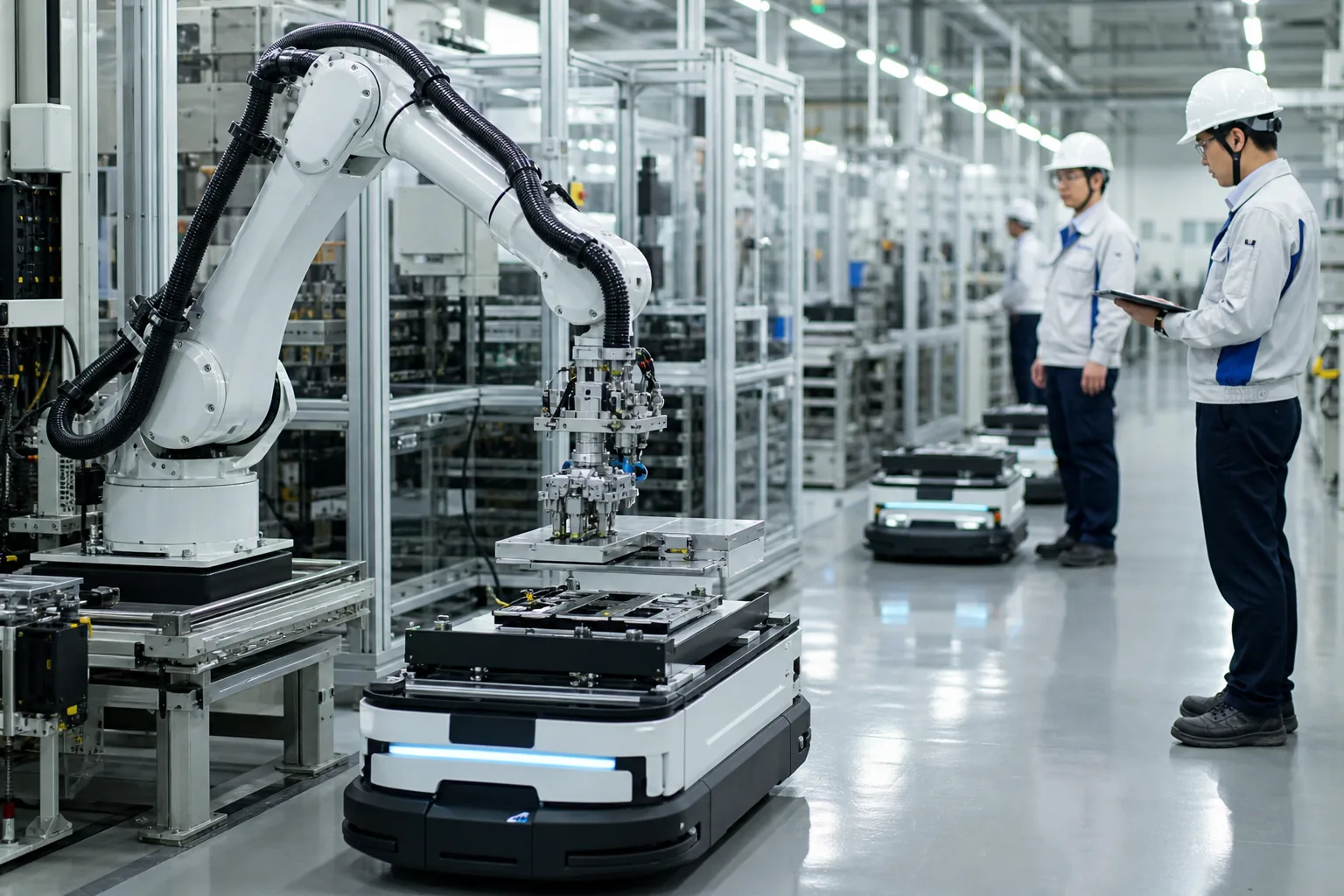
That matters because physical AI is a rather different challenge from generating text or images. A robot in a warehouse, a machine on a production line or an autonomous vehicle has to interpret a changing physical scene, reason about it and act quickly. Nvidia’s pitch is that its “world models” can give those systems a better understanding of their environment.
“With AI, robots will become intelligent, easy to adapt, and accessible.”
Huang made that assessment during the Japan visit, where Nvidia positioned the work as a combination of the country’s established expertise in industrial machines and its own AI platforms.
Japan’s industrial names line up behind Cosmos
Nvidia is expanding the Nvidia Cosmos Coalition to Japan, bringing together world-model builders, AI developers and physical AI companies working with Cosmos technologies. The group is intended to advance open world models, with members able to contribute to and build on the Nvidia Cosmos platform’s models, data curation libraries, datasets and frameworks.
A long list of Japanese companies intends to join, including FANUC, Fujitsu, Hitachi, Honda R&D, Kawasaki Heavy Industries, Kubota, NEC, Sony Group Corporation, SoftBank Corp., TIER IV and Yaskawa Electric. Other participants named by Nvidia include AIRoA, classmethod, Enactic, GROOVE X, Mitsubishi Corp., Mujin, Preferred Networks, Telexistence, Turing and TRON K.K.
The stated aim is to let Japanese companies test and optimise physical AI systems before putting them into service, potentially shortening development cycles in factories, logistics sites, farms, construction projects, hospitals, roads and homes. Fujitsu is already building a collaborative control platform with FANUC, Yaskawa Electric and Kawasaki Heavy Industries.
“The next frontier of AI is in the physical world, and this is a once-in-a-generation opportunity for Japan. Japan invented modern manufacturing. Now, it has the opportunity to reinvent it for the age of intelligent industries.”
That is Huang’s view of the opportunity, but the coalition’s scale also shows Nvidia’s interest in making its hardware and software a central layer of future industrial automation.
New Jetson modules aim at smaller machines
Alongside Cosmos 3 Edge, Nvidia announced the Jetson T3000 and T2000 modules, based on its Thor architecture. Both are intended for compact, power-efficient AI systems used in mass-market robotics and edge AI applications.
The Jetson T3000 offers 865 FP4 teraflops of AI compute, a Blackwell GPU, an eight-core Neoverse Arm CPU, 32GB of LPDDR5X memory, 273GB/s of memory bandwidth and 25GbE connectivity. Nvidia rates the platform at 70W and says it is roughly half the size and power of the Jetson T5000 while delivering similar inference performance across workloads including large language models and vision-language models.
The lower-end T2000 has 400 FP4 teraflops of compute, 16GB of memory and a 40W rating. Nvidia is targeting developers building visual AI agents, autonomous mobile robots, industrial manipulators and other intelligent machines. The company says its resulting Jetson edge platform spans performance from 70 TOPS to 2,000 teraflops.
Neither module is ready for purchase. Nvidia says the T3000 and T2000 are scheduled to become available in the first quarter of 2027, while T3000 emulation mode will arrive later this month through JetPack 7.2.1. T2000 emulation support will follow in a future release. UK pricing, precise dimensions and power-consumption ranges have not been confirmed.
Nvidia also announced new Metropolis libraries and skills for building video intelligence systems with coding agents. According to Nvidia, these tools can help developers build, train and operate such systems with Cosmos at least six times faster.
A national AI factory for physical AI
On 16 July, Nvidia and Noetra Corp. announced plans for a Nvidia Vera Rubin AI factory supporting Japan’s FRONTia Project. The facility is planned to use 13,750 Nvidia Vera CPUs and 27,500 Rubin GPUs, delivering 140MW of data-centre capacity on Nvidia’s DSX platform. Those chip totals equate to 382 Vera Rubin NVL72 racks, each containing 72 Rubin GPUs and 36 Vera CPUs.
Noetra is a consortium founded by SoftBank Corp., Sony, NEC and Honda, with investment from 44 companies and organisations. Japan’s Ministry of Economy, Trade and Industry is supporting the initiative.
Noetra and national research institute AIST won a NEDO public tender on 30 June to operate FRONTia from fiscal 2026 to fiscal 2030. The project has ¥387.3 billion in first-year funding and could receive up to ¥1 trillion over five years, although funding beyond its first two years is subject to annual stage-gate reviews.
Noetra’s roadmap targets a reasoning foundation model in fiscal 2026, an omni-modal model handling text, images, video and audio by fiscal 2028, and spatially aware “real-world native AI” by fiscal 2030. Its pretrained multimodal model weights are planned to be broadly available to domestic developers and enterprises, alongside Nvidia software and open models.
Why it matters
This is not consumer hardware yet, but it could shape the robots people encounter in warehouses, hospitals, shops and eventually homes. Running AI directly on a machine rather than constantly sending data to the cloud could make robots faster to respond and more useful in environments where connectivity is limited. For UK industry, Nvidia’s Japan push underlines how quickly the competition to build practical AI-powered automation is moving beyond chatbots.